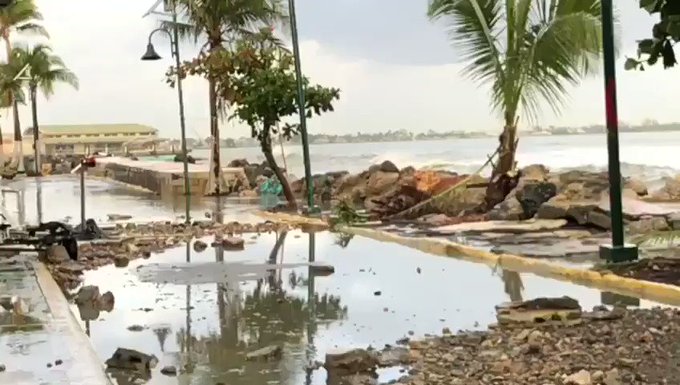
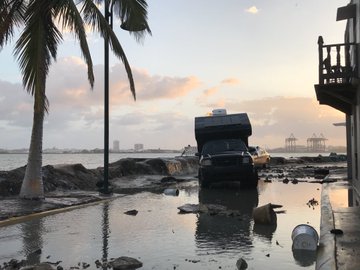
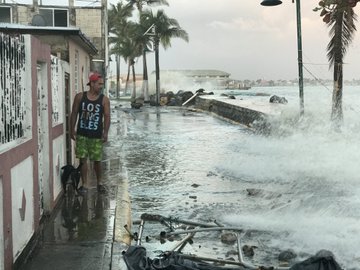
The nor’easter is nowhere near the Caribbean, yet its influence is rippling — literally — far and wide across the Atlantic. Huge waves are spreading out from the center of the storm, and they just arrived in Puerto Rico and the surrounding islands.
John Morales, a TV meteorologist in Florida who was raised in Puerto Rico, is calling it “one of the worst ocean swell events in recent decades,” and not just for Puerto Rico. Hispaniola and the Virgin Islands are getting smacked by these waves, too.
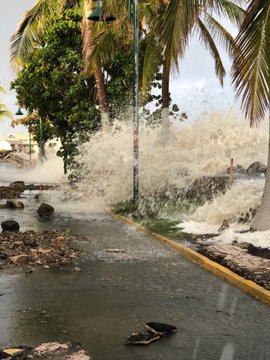
Andy Rivera, who runs the Puerto Rico Historic Building Drawings Society and captured the waves lashing Old San Juan in the photo above, agreed that these are the worst waves in decades. Rivera said Hurricane Maria didn’t affect Old San Juan as much as it did the other parts of Puerto Rico. But the hurricane made the historical town “softer” — in other words, Maria made Old San Juan more susceptible to damage from waves like these, or even everyday storms.
A huge wave breaks on the Paseo de la Princesa, damaging part of the promenade. (Andy Rivera/Puerto Rico Historic Building Drawings Society)
“The ocean swell event has been so impactful in the Caribbean,” Morales wrote on Twitter, “that even within San Juan Bay the rising water and wave action caused damage along the outside of ancient wall surrounds Old San Juan.”
Old San Juan is the oldest settlement in Puerto Rico. San Juan is the oldest city in the United States, founded in 1521. Puerto Rico has a lot of history — and it has been through plenty of storms.
On Monday, the same nor’easter that battered the New England coast managed to do more damage to San Juan than many of the hurricanes it has faced over the centuries.
Across the northern shore of Puerto Rico, waves were crashing onto beaches and flooding coastal roads. Huge waves pounded Old San Juan on Monday morning, damaging some historical landmarks, including Paseo de la Princesa, a roadway turned promenade around Old San Juan that is popular for its food vendors and artist stalls.
The waves are expected to last into at least Tuesday, according to the Ocean Prediction Center.
Angela Fritz is an atmospheric scientist and The Washington Post's deputy weather editor. She has a BS in meteorology and an MS in earth and atmospheric science.
Life is better for Michelle Rebollo since Hurricane Maria upended her world last year. The electricity vanishes at times, often for hours, but is largely back on, water flows steadily from faucets and work crews finally hauled away piles of debris left by the storm.
Yet life is still far from normal. She’s a month behind in her bills. Her income is unsteady. Worst of all, the jovial unity forged among her neighbors in the storm’s immediate aftermath has faded to sullen despair.
“Recovery here has been so slow that it’s affected people,” said Rebollo, 45. “Everyone’s tense. No one’s talking to one another. You see it in their faces: They’ve changed.”
The powerful Category 4 Hurricane Maria raked across the island Sept. 20, killing at least 60 people and causing widespread damage. It was the strongest storm to hit the U.S. territory in 89 years.
As the six-month anniversary of the storm approaches, Puerto Ricans are trudging slowly away from survival and into the difficult realities of long-term recovery.
Thousands of Puerto Ricans who came to the mainland to flee Hurricane Maria damage have settled in New York City. This mimics the influx of Puerto Ricans 70 years ago.
STEVE INSKEEP, HOST:
Tens of thousands of Puerto Ricans have moved to the mainland since Hurricane Maria devastated the island last fall. Many have moved New York City, which has seen this story before. Around 70 years ago, some half a million Puerto Ricans moved to New York. Alexandra Starr reports.
ALEXANDRA STARR, BYLINE: The Extended Stay America Hotel in Queens, N.Y., has become Rosa Basora's temporary home. FEMA's paying for it through a program that provides housing to people displaced by Hurricane Maria. From behind the sink in the hotel room's kitchenette, Basora watches as her baby grandson Skype's with relatives in Puerto Rico.
UNIDENTIFIED PERSON: (Speaking Spanish).
(LAUGHTER)
STARR: This is a kind of homecoming for Basora. Born and raised in Brooklyn, she didn't move to the island until she was 28.
ROSA BASORA: Everybody's telling me, ah, you're not going to get used to it, you're not going to get used to it. Guess what? I just came back to New York this past October.
STARR: In 23 years, she hadn't visited once. She came back because Hurricane Maria left her home with no water and no electricity. In returning, Basora retraced the steps of her parents. They came to New York in the 1950s, in search of work.
BASORA: My dad was a steel metal polisher.
STARR: And her mother, grandmother, grandfather, all worked in garment factories. Kat Lloyd is an educator at the Tenement Museum in New York City. She explains that Puerto Ricans, like the Basora family, helped drive a transformation in the city's workforce.
KAT LLOYD: Puerto Rican migrants, African-American migrants coming from the South, start to fill the jobs that had previously been held by Jewish immigrants.
STARR: The Tenement Museum recently opened an exhibit, called "Under One Roof," documenting that transition. It starts with the Epsteins, a Jewish family from Poland. They worked in the needle trades in the 1940s. The museum has recreated their dining room.
LLOYD: On the side table, we see candlesticks and prayer books.
STARR: Now, by the 1950s, Eastern Europeans, like the Epsteins, were leaving their jobs in the garment industry, and their kids weren't replacing them. Factory owners couldn't bring in new workers from Eastern and southern European countries because of the tighter immigration laws. So they recruited citizens from poorer parts of the U.S., like the South and Puerto Rico.
LLOYD: So we'll be moving now into Ramonita Rivera Saez's kitchen.
STARR: Saez was a Puerto Rican who moved to New York in 1955 and became a seamstress. The Tenement Museum has recreated the apartment she lived in right next to the Epstein's. While Saez spent most of her life in New York, she frequently flew back to Puerto Rico. Lloyd says that was common. There were a lot of flights, and they were cheap.
LLOYD: The flight between JFK and San Juan was packed every week.
STARR: That ensured a lot of Puerto Ricans maintained close ties to the island. Hector Codero is a professor at Baruch College. He says this is a reason why we see thousands of Puerto Ricans coming to New York today.
HECTOR CORDERO: New York City has 700,000 to 800,000 Puerto Ricans. Those connections at a time of a crisis are activated and become really important.
STARR: Rosa Basora, who currently lives in that hotel in Queens, she wants to return to Puerto Rico. Her son and daughter, however, say that the migratory cycle will end with them. The damage caused by Maria means they don't see a future on the island. New York will be their permanent home. For NPR News, I'm Alexandra Starr in New York.
NPR transcripts are created on a rush deadline by Verb8tm, Inc., an NPR contractor, and produced using a proprietary transcription process developed with NPR. This text may not be in its final form and may be updated or revised in the future. Accuracy and availability may vary. The authoritative record of NPR’s programming is the audio record.
The Federal Housing Administration on Thursday extended through May 18 a foreclosure moratorium for certain homeowners in Puerto Rico and the U.S. Virgin Islands, which were devastated last September by Hurricane Maria.
Homeowners whose mortgages are insured by the FHA will get an additional 60 days of foreclosure relief on top of the previously-imposed 180-day moratorium, according to a statement from the U.S. Department of Housing and Urban Development, the FHA’s parent agency.
FHA insures more than 117,000 mortgages in the U.S. territory of Puerto Rico, or about one-third of all mortgages on the island. Though Puerto Rico is home to 3.4 million U.S. citizens, the number of mortgages is limited by the prevalence of illegal housing, thought to comprise around half the homes on the island.
FHA also insures around 600 mortgages in the Virgin Islands. Both territories’ economies are struggling to bounce back from the Sept. 20 hurricane.
In Puerto Rico, the local power grid was virtually destroyed, and thousands remain without power, more than five months after the storm.
Puerto Rico Governor Ricardo Rossello welcomed the extension, saying it would help the island’s low-income and elderly populations.
“My thanks to [HUD Secretary Ben] Carson for extending the moratorium so that American citizens living on the island receive a relief and are not exposed to losing their homes,” Rossello said in a statement.
About 90,000 borrowers in Puerto Rico were delinquent in their payments as of December, according to the statement from Rossello’s office. Nearly half the island’s population lives under the poverty line.
Maria exacerbated a decade-long financial crisis in Puerto Rico, which culminated in May with the island filing the largest bankruptcy in U.S. government history.
Puerto Rico has some $71.5 billion in bond debt, and another $50 billion or so in unfunded public pension liabilities.
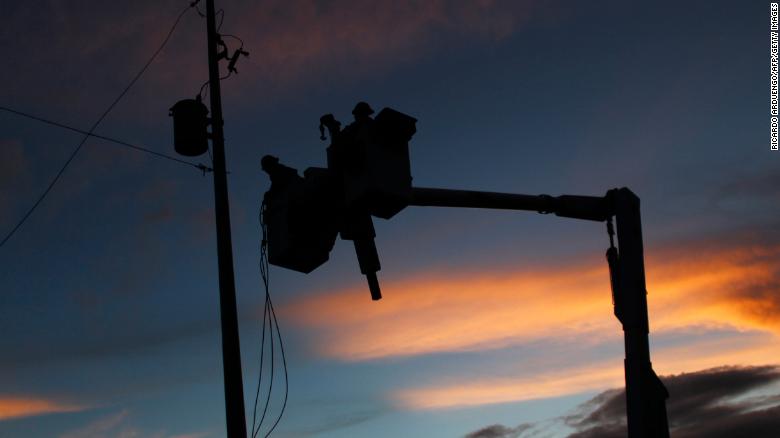
More than $200 million dollars' worth of materials are expected to arrive in Puerto Rico this month to help the U.S. Army Corps of Engineers hit its 95% power restoration goal at the end of the month.
More than 7,000 poles and nearly 400 miles of conductor wire are slated to arrive in the next two weeks, said Col. Jason Kirk, commander of the Corps' district that includes the island.
The additional supplies, according to Kirk, are part of the reason he believes the people of Puerto Rico can count on 90 to 95% power restoration by March 31.
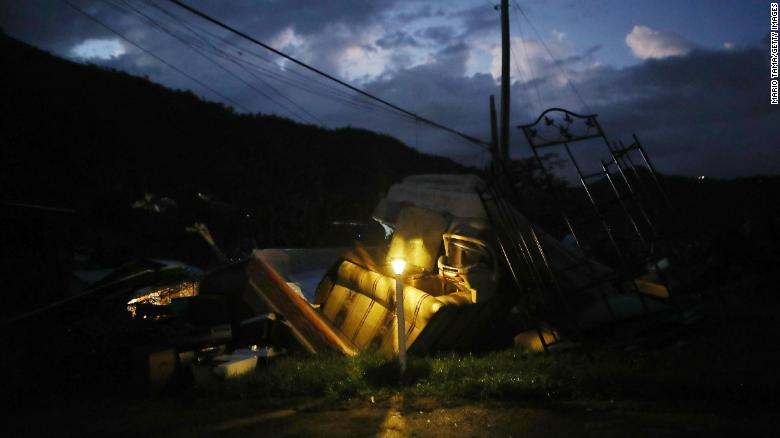
A donated solar lamp in a driveway illuminates storm debris still waiting to be collected last December.
Contractors restoring power in Puerto Rico under the USACE are expected to leave the island by mid-April, according to the Corps' current plan as obtained by CNN.
According to Puerto Rico's power authority, on average 87% of the island has power. But Kirk admits that number falls to about 50% in the interior part of the island, and 150,000 US citizens on the island still don't have power.
"We know that there are a couple of regions that will take into April, potentially May," Kirk told CNN.
USACE is downsizing, as the Puerto Rico Electric Power Authority is increasing its workforce across the island. The Army Corps of Engineers projects its contractors will have completed work by April 7.
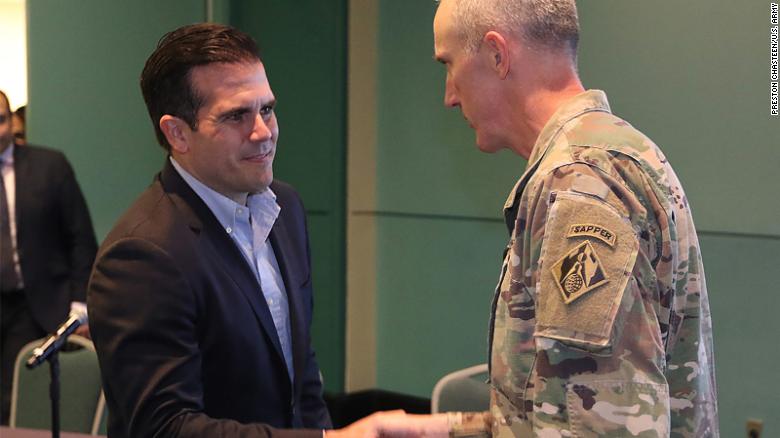
Task Force Power Restoration Commander, Col Jason Kirk (right), and Puerto Rico Governor Ricardo Rosselló on Wednesday.
Puerto Rico Governor Ricardo Rosselló has repeatedly expressed frustration at the slow pace of recovery and help. He has questioned the USACE's response on the island compared to other states dealing with disasters. At a press conference Wednesday, he claimed people on the US territory are being treated like second class citizens, saying, "I don't see the urgency."
Getting the work done has also become a frustration for mayors on the island like Jorge Gonzalez Otero of Jayuya, in the interior part of the island.
He tells people in his municipality, "Prepare yourselves. We're in it for the long haul."
Only 45% of Jayuya, according to the mayor's office, has power. Hurricane Maria wiped out the power grid when it hit Puerto Rico on September 20 last year. And even where the electricity has been restored, like in the capital San Juan, mass outages are still happening.
USACE admits materials have been a challenge in restoration efforts.
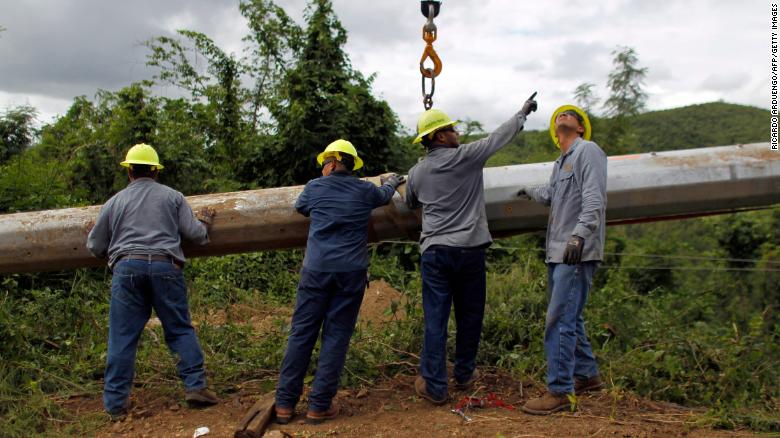
Puerto Rico Electric and Power Authority workers guide an utility pole raised with a crane to repair a downed power transmission line in Ponce, last November.
"The initial assessment told us that we would need about 60,000 power poles and over 3 million individual items to work the repair of 30,000 miles of line across the island," Kirk said.
To date, USACE has received 38,831 poles and 3,068 miles of conductor wire for power restoration efforts. Some of the materials expected to arrive this month were manufactured in January in South Carolina.
According to Kirk, a big part of the challenge is the amount of material needed, the distance it has to travel, and the response to other disasters.
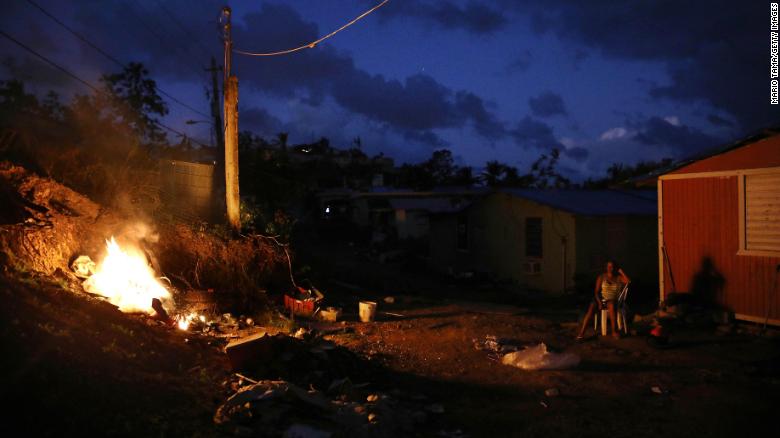
A resident sits outside her home, which lacks electricity, as a trash fire burns in San Isidro, last December.
Puerto Rico's governor claims USACE agreed to have power restored in 45 days, but did not provide proof.
Kirk, however, counters, "The Army Corps has never committed to a 45-day restoration time line."
At its peak, USACE had more than 4,000 contractors and personnel at work on the island. Currently, about 2,300 workers are engaged in the power restoration efforts, as many people across the island wait for the lights to come back on.
Julia Keleher, Puerto Rico's education secretary, stood in front of a school library full of high school students and asked them to do something students in Puerto Rico's public schools aren't often asked.
"Take out your phones," she said. "Look up the definition of charter school."
A girl's hand shot up.
"A charter school," the girl read, "is a school that receives government funding but operates independently of the established state school system in which it is located."
Keleher repeated after the girl, putting emphasis on "government funding" and "independently."
The point she really wanted to drive home was that charter schools, while run by private entities, are still public schools.
"But everyone is going to take to the streets and say, 'you want to privatize our schools!'" Keleher told the students. "I don't. It's still public money. Your money."
Most of the students in the room had never heard of a charter school. But Keleher knew that before long, her critics – notably the island's teachers' unions – would be mobilizing to derail her plan to transform the island's troubled public school system. Introducing charter schools is a central part of her plan. So Keleher was playing offense.
"What charter schools offer," she told students, "are more opportunities. More options."
That is not how Puerto Rico's teachers unions and their allies see it.
Charter schools continue to be controversial because they are not helpful for students and often hubs for "fraud, waste and mismanagement" because of lagging accountability, according to a 2015 joint report from three groups. Supporters of charter schools say they are good for students because they tend to be high-performingand have the freedom to be innovative.
Teachers' unions in Puerto Rico have responded to the government's proposed overhaul with protest, anger and derision. Since Gov. Ricardo Rossello presented it to the legislature last month, critics have said he and Keleher are using the damage that Hurricane Maria inflicted on the island and its schools as justification to push privatization, much like the governor recently announced his intention to sell off Puerto Rico's publicly owned electric grid.
Teachers protest outside Puerto Rico's Department of Education. An education reform bill in the legislature would allow charter schools in the island's public school system, something the teachers' unions oppose.
Adrian Florido/NPR
Speaking at a recent protest outside the Department of Education, Mercedes Martinez, president of the Puerto Rico Teachers' Federation, likened the reform proposal to a corporate overhaul.
"They think that because our island is vulnerable, because it doesn't have electricity, that we're going to let them privatize our schools, get rid of our teachers," she said.
The teachers' unions tick off a litany of concerns. They say that charter schools, freed from many of the rules that govern traditional public schools, will divert funding from those schools while being free to pay teachers less, eliminate benefits, and kick out under-performing students.
They also oppose the reform plan's proposal to begin issuing school vouchers that families could use to attend a public or private school of their choosing.
"Everyone knows what the vouchers do to public schools," Aida Diaz, who leads the Puerto Rico Teachers' Association, said at an event in Washington this week. "They take money from public schools to private schools. So we have a budget that is tight, and now we are having money taken from our budget."
Her organization marched to the governor's mansion last month but Gov. Rosselló was visiting charter schools in Pennsylvania, according to his social media posts.
That Puerto Rico's public school system needs restructuring is not in question. Student enrollment has declined by 45 percent since 2004, as a decade-long recession has driven hundreds of thousands of people from the island. Administrative costs eat up a large share of the department's $2.5 billion budget, limiting the availability of technology and text books. Hurricane Maria has made the situation worse.
The Escuela Rafael Hernandez is a rural elementary and middle school in the mountains outside San Juan. Parents fear the dwindling enrollment, made worse by Hurricane Maria, will lead the government to close the school.
Adrian Florido/NPR
Still no power, dwindling enrollment
The fallout is being felt at schools across the island, like the Escuela Rafael Hernandez. It's an elementary and middle school in Guaraguao, a rural mountain community within the municipality of Guaynabo. Student enrollment has been declining for years, and Hurricane Maria decimated it further.
Mariliana Sanchez, the leader of a parents' group at the school, said that when the school finally re-opened two months after Hurricane Maria, only about 60 of 150 students came back.
"Many families left for the United States because we didn't have water or power. We still don't have power," Sanchez said. Other families, tired of waiting for the school to re-open, enrolled their children elsewhere. The dwindling enrollment, Sanchez said, led to the transfer of two of the school's teachers.
And while Sanchez said students are slowly returning, it may be too late. This month the education secretary plans to release a list of 300 schools she'll close in a move to consolidate the 1,100-campus system. Sanchez and other parents fear their school will be on the list.
"This school is so necessary," Sanchez said. "We don't have schools in the mountains, in the countryside. Not everyone can take their kids to schools in the city."
Under the proposed reform, an entity like a non-profit organization, a university, or a municipality would, with the government's approval, be allowed to open its own school or try to take over an existing one like Escuela Rafael Hernandez. It would then get funding based on the number of students it enrolled. It could make its own hiring and salary decisions, adopt a specialized curriculum, and require students to meet minimum standards in order to stay at the school.
Secretary Keleher says this kind of flexibility will allow charter schools to innovate and provide students better options in a school system that has fewer and fewer. That's the sole reason she is pursuing charter schools, she said, and not for financial savings despite her need to find those too amid the Puerto Rican government's ongoing fiscal crisis.
She has noted, however, that charters could also help money flow to the island's education system, thanks to the Trump administration's desire to see the expansion of charter school programs. The White House's proposed 2019 budget, Keleher recently tweeted, grants "priority and FUNDS to initiatives that give students more OPTIONS."
"That's the context within which they're presenting their proposal," said Roamé Torres Gonzalez, dean of the School of Education at the University of Puerto Rico. "Their interest in securing federal funds amid the island's fiscal crisis is evident.
Torres said Puerto Rico regularly gets far more of its education budget from the federal government than any U.S. state. Last year, it was 37 percent.
But union leaders say private entities would stand to benefit from the move to charters while traditional schools would be disadvantaged academically and financially. They would not have the same flexibility as charter schools but would be held to the same evaluation standards. As they lose more students to charter schools, they say, their own funding allocations would be reduced, possibly triggering another provision in the reform bill requiring schools that can't cover their costs to close.
Rather than treat public education as something to invest in, said Aida Diaz of the Puerto Rico Teachers' Association, the proposed bill treats schools "as a collection of goods and services to be consumed."
Critics are drawing comparisons Gov. Rosselló's attempt to revamp the education system to New Orleans. After Hurricane Katrina wrecked Louisiana's most populous city in 2005, officials saw an opportunity to revamp the school system, which was rife with corruption. The result: all but five schools are charter.
The proposal has support from Puerto Rico's legislature, which is controlled by the governor's party. But union leaders say they will continue their campaign to defeat it.
Erin B. Logan contributed to this report.
Puerto Rico Education Secretary Julia Keleher visits a high school in Arecibo, Puerto Rico, to talk to students about her proposed education reform. It would introduce charter schools to the public school system.