Wednesday, February 07, 2018

Company with FEMA meal delivery contract shortchanged Puerto Rico

FEMA gave a $156 million contract to a single-employee Georgia company (which had five previously-terminated government contracts) to provide 30 million meals for Puerto Rico after Hurricane Maria, according to a report from The New York Times. The company only delivered 50,000 meals and the contract was canceled last October.
Why it matters: Risky contracts awarded in the earliest days after Maria, like Whitefish Energy, indicate that both the federal government and local entities in Puerto Rico simply weren't equipped for the scale of the disaster.

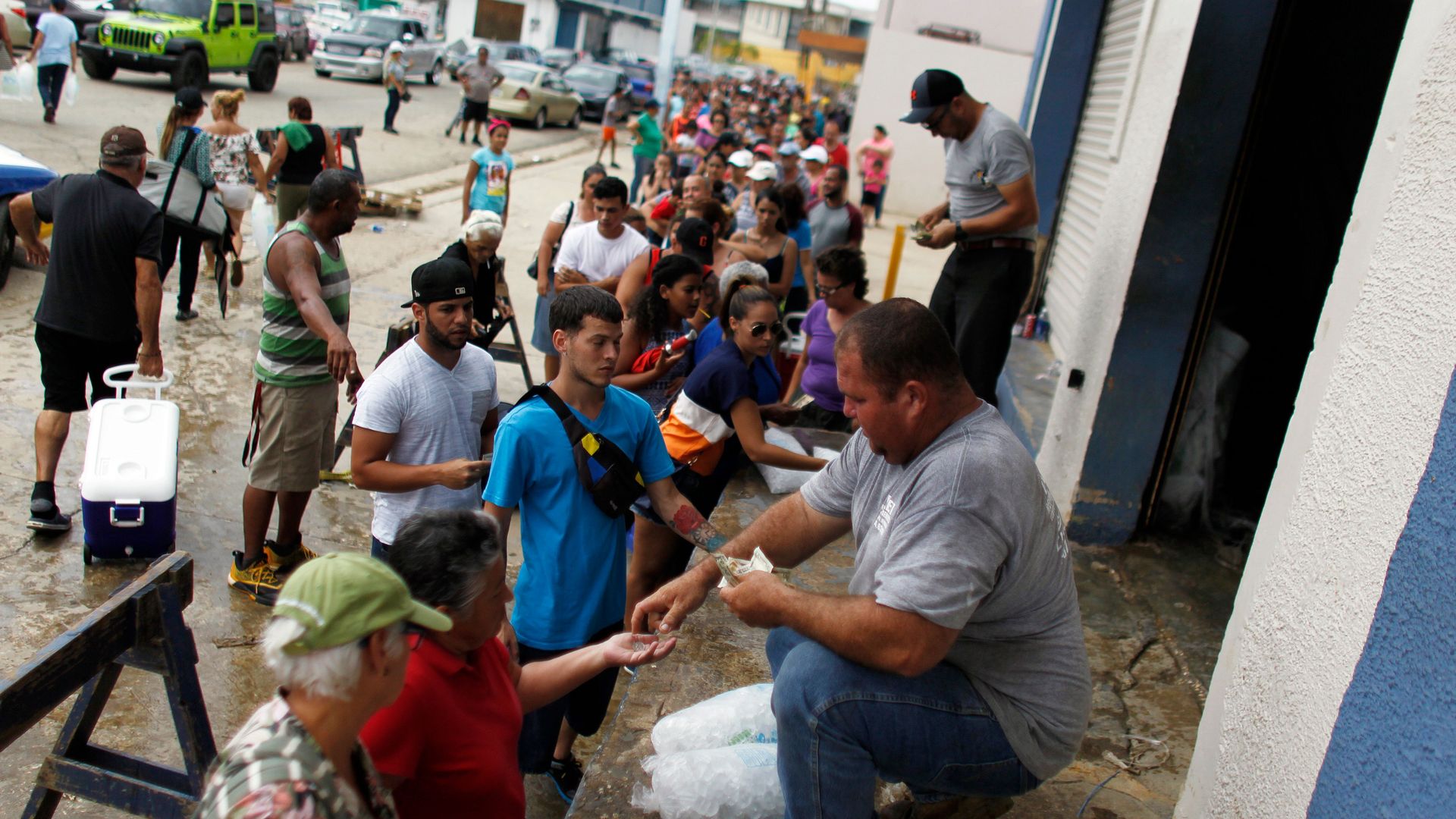
Puerto Ricans line up to purchase ice
Puerto Ricans line up to purchase ice in September after Hurricane Maria. Photo: Ricardo Arduengo / AFP / Getty Images
Shane Savitsky
Company with FEMA meal delivery contract shortchanged Puerto Rico

Puerto Rico vows to protect public employees in fiscal plan

Puerto Rico government officials on Tuesday pushed back against a federal control board's suggestion that they cut benefits for the U.S. territory's employees to cope with an 11-year financial crisis.
Secretary of Public Affairs Ramon Rosario said the government won't implement any measures that financially affect government workers.
The control board that oversees Puerto Rico's finances is demanding changes in the territory's fiscal plan, and more details about it. The board suggested late Monday that the government could cut costs by making severance pay and Christmas bonuses optional or by reducing requirements for vacation and sick leave to U.S. mainland levels. The board said no state requires that employers provide vacation pay, and that only nine of 50 U.S. states require any paid sick leave.
"It is imperative that Puerto Rico seize this moment to fundamentally reform an economy that has been in a long-term recession, even before Hurricanes Irma and Maria," wrote board chairman Jose Carrion.
One month before Hurricane Maria hit on Sept. 20, the board sued Puerto Rico's government for refusing to impose furloughs and other cost-saving measures.
In one of several letters filed Monday, the board said the government must revise its fiscal plan to clearly show the link between the proposed tax reforms and any anticipated economic growth. It also said the administration of Gov. Ricardo Rossello has to be more specific in its capital investment plan and note the sources of funding for all investments.
The board questioned the government's estimate that it needs only $400 million a year for capital expenditures, saying there is no analysis to support a reduction to that amount. It noted that federal funds would not cover many of the capital expenditures required.
The board also called for sharp cuts in government pensions, with a 25 percent reduction imposed on people whose combined pension and social security income is above a $1,000 a month poverty line. Puerto Rico's pension system faces nearly $50 billion in liabilities, and hundreds of Puerto Ricans last year protested a plan to cut the system by 10 percent.
Board members called on Puerto Rico to create an emergency fund and build a reserve of $1.3 billion in the next decade. They also said the fiscal plan should contain realistic measures to reduce costs so the power company can deliver electricity at more affordable rates, and that legislators should submit a measure by this summer to create an independent energy regulator as the company moves to privatize.
Puerto Rico has until Feb. 12 to submit a revised fiscal plan.
By DANICA COTO
Puerto Rico vows to protect public employees in fiscal plan

Critics blast move to dismember Puerto Rico’s statistical agency

Puerto Rico’s legislature is set to consider a bill that critics say would hobble the collection and analysis of statistical data on the island. Scientists, business groups, and even some U.S. congressional representatives contend that a proposed overhaul of the Puerto Rican Institute of Statistics (PRIS) in San Juan, an independent agency, would undermine the independence and trustworthiness of data on Puerto Rico. But Governor Ricardo Rosselló told Science that privatizing parts of PRIS and encouraging the federal government to take over the rest would do precisely the opposite: He argues that it would restore credibility to statistics collected in the territory.
Last month, following up on a promise he made during the 2016 election campaign, Rosselló proposed a sweeping overhaul of Puerto Rico’s government agencies. Under the reorganization, PRIS would come under the control of Puerto Rico’s Department of Economic Development and Commerce, with a mandate to consolidate all data collection responsibilities on the island within that department and then outsource those functions to the private sector. Now, Puerto Rico’s government agencies each collect their own statistics, with PRIS analyzing the data and ensuring that methodologies meet international standards. Rosselló says his plan would streamline the process. The Puerto Rican House of Representatives is scheduled to vote on the measure on Wednesday; the island’s Senate also plans to take it up this week.
Although PRIS, which employs 12 data scientists, doesn’t collect much data itself, CEO Mario Marazzi-Santiago says it provides the government with vital services. For example, PRIS recently identified and corrected methodological mistakes made by other agencies that led Puerto Rico to underestimate its mortality statistics and overestimate inflation. Now, PRIS is part of the executive branch but is overseen by an independent board of directors that appoints CEOs to 10-year terms. That setup is unusual in Puerto Rico, where most government appointments are made by the political party in power. “PRIS is an exception since the law that created it guarantees its autonomy,” says Rafael Irizarry, an applied statistician at the Dana-Farber Cancer Institute in Boston and Harvard University. “Once PRIS falls under a government agency, it is no longer autonomous.”
“We need something that uniformly works in an independent way, regardless of political parties,” agrees Roberto Rivera, a statistician at the University of Puerto Rico in Mayagüez.
Rosselló, who has a Ph.D. in bioengineering, says that consolidation and privatization would do just that. He’s frustrated that even a decade after PRIS’s establishment, unreliable statistics remain a problem for the island. Most recently, the government dramatically undercounted the death toll from Hurricane Maria. (PRIS was not invited to calculate or vet the death toll from the hurricane.)
“It’s been one of the main areas of criticism [of Puerto Rico], that we don’t have verifiable and good statistics,” Rosselló says. “Let’s just fix it by consolidating all of these data-driven entities into one, and then let’s take it completely out of local government for it to be managed.” He points out that the U.S. federal government excludes Puerto Rico from many of the statistical programs it manages for states, including surveys about housing, education, and criminal justice. He hopes the reorganization and outsourcing plan will encourage the federal government to extend more of its data collection programs to Puerto Rico.
Marazzi-Santiago says his agency has established itself as a trusted liaison between Puerto Rico and the federal government. Fifteen U.S. congressional representatives agreed in a 2 February letter to the United States’s chief statistician, calling PRIS “a key ally of the federal statistical agencies” and expressing concern over the reorganization. PRIS is currently working with the U.S. Census Bureau on preparations for the 2020 census. If the reorganization passes, “all of those collaborations and initiatives would stop,” Marazzi-Santiago says. “Instead of seeing [PRIS’s] assets, the [local] government just wants to tear it down.”
Critics of Rosselló’s plan say PRIS’s unique organizational structure ensures its independence, and that privatization brings up a host of questions regarding conflicts of interest, transparency, and public availability of data. “The ability to withstand improper political or outside influence is imperative, because people need to trust the data,” says Steve Pierson, director of science policy for the American Statistical Association in Alexandria, Virginia. “From so many angles, this does not seem like a good proposal.”
By Lizzie Wade


Unreliable statistics are a problem in Puerto Rico. Most recently, the government grossly undercounted Hurricane Maria’s death toll.
Critics blast move to dismember Puerto Rico’s statistical agency

Is Puerto Rico ready for tourists?

Julia Cruz normally steers clear of Old San Juan during the third weekend in January. That’s when the blue cobblestone streets swell with convivial throngs of party people celebrating the San Sebastian Street Festival in a manner that would make most saints blush.
Thousands line the sidewalks, parks, and city squares for the evening concerts on five stages. There are dozens of food stalls, the parada de cabezudos (parade of big heads), preternaturally enthusiastic people walking on stilts, small groups roaming about playing merengue, and copious amounts of booze. Sometimes things can get a bit sloppy in the name of good, saintly fun.
Cruz, 36, said she hadn’t been to the festival since she was a teenager, but said she came this year because she needed an excuse to celebrate. Any excuse. Since Hurricane Maria ravaged Puerto Rico on Sept. 20, Cruz has been helping family members who live in the countryside and volunteering to check on the elderly almost every day.

A lone sunbather relaxes on a beach in the Condado neighborhood of San Juan.
CHRISTOPHER MUTHER
Is Puerto Rico ready for tourists?

Tuesday, February 06, 2018

Puerto Rico oversight board wants changes to island's fiscal plan

Puerto Rico’s financial oversight board told the bankrupt island’s governor on Monday to revise his proposed fiscal turnaround plan to add more detail on labor and other reforms, and to create room in the budget for a $1.3 billion emergency fund.

In a letter to Governor Ricardo Rossello, the federally appointed, seven-member panel set a Feb. 12 deadline for the new draft, which will chart Puerto Rico’s plan to regain economic stability.
The U.S. territory is struggling to recover from September’s Hurricane Maria - its worst storm in 90 years - while also navigating the biggest government bankruptcy in U.S. history, with $120 billion in combined bond and pension debt.
Rossello’s draft turnaround plan, submitted on Jan. 24, projected a $3.4 billion budget gap that would bar the island from repaying a penny of its debt until 2022.
While the plan included subsidy cuts to cities and towns and the streamlining of public agencies, the board, which must approve the plan, demanded more details in Monday’s eight-page letter.
The board wants an emergency reserve of $650 million in the next five years and $1.3 billion within 10 years, “based on best practices for states and territories regularly impacted by storms,” it said.
Puerto Rico Governor Ricardo Rossello addresses the nation in a televised speech, in Toa Baja, Puerto Rico February 5, 2018. REUTERS/Alvin Baez
It also wants more details on key structural reforms, notably labor. The board suggested that Rossello make Puerto Rico an at-will employer and make severance and Christmas bonuses optional, both of which are norms among U.S. states.
The board criticized Rossello’s proposed reduction of capital expenditures to $400 million a year, saying there had “been no project or agency-specific analysis” to support that figure and that the plan should provide for expenditures “necessary to maintain assets of the commonwealth.”
The board also sought more detail on Rossello’s vision for Puerto Rico’s energy grid, which was decimated by Maria.
Rossello has announced plans to privatize Puerto Rico’s bankrupt, quasi-public power utility, PREPA.
But the governor’s plan must “support a transaction by providing a set of targets for a potential bidder to meet or exceed during the bidding process,” the board said.
It said the plan should provide a five-year outlook for financial stability at the utility, and for the creation of an independent energy regulator with commissioners appointed by the governor, from a candidate list developed by an independent expert panel.

People watch television powered with the help of a generator, as Puerto Rico Governor Ricardo Rossello addresses the nation in a televised speech, in Toa Baja, Puerto Rico February 5, 2018. REUTERS/Alvin Baez

Nick Brown
Puerto Rico oversight board wants changes to island's fiscal plan

Friday, January 26, 2018

Bishop Statement on Puerto Rico Fiscal Plans, PREPA Privatization

WASHINGTON, D.C., January 25, 2018 -
Today, Puerto Rico Governor Ricardo Rosselló submitted updated fiscal plans to the Financial Management and Oversight Board, as required under the Puerto Rico Oversight, Management and Economic Stability Act (PROMESA). The proposals include initial plans for the privatization of the Puerto Rico Electric Power Authority (PREPA). Chairman Rob Bishop (R-UT) issued the following statement:  
“These plans are a first step in Puerto Rico’s future recovery, of which the privatization of PREPA will be a key component. However, the transformation of PREPA and the recovery of the island will not occur overnight, and cannot be done behind closed doors. It is imperative the Oversight Board and Governor fully integrate those who hold the debt into the development of these plans, thereby guaranteeing accuracy and transparency in the underlying assumptions. After all, the Board’s stated goal under PROMESA is to return Puerto Rico to fiscal accountability and the capital markets, and this can only occur if the fiscal plans respect the lawful priorities and liens of debt holders. My committee will be following the development of these plans intently to ensure financial stability and success return to the island.”
Background:
PROMESA, which became Public Law 114-187 on June 30, 2016, vested the Oversight Board with exclusive control to facilitate the development, enactment and implementation of fiscal plans as a means to restore fiscal solvency and access to capital markets for Puerto Rico.
The initial plans were approved by the Oversight Board in March 2017.  The devastating impacts of Hurricanes Irma and Maria necessitated the development of new fiscal plans.  

Bishop Statement on Puerto Rico Fiscal Plans, PREPA Privatization

Here’s why restoring power in Puerto Rico is taking so long [Video]

  • Judy Woodruff:
    It’s hard to fully comprehend, but more than four months since hurricanes swept through the Caribbean, about half of Puerto Ricans remain without electricity.
    This week, Governor Ricardo Rossello announced the island’s public energy monopoly would be sold off to private companies following a series of scandals.
    In the first of two reports from Puerto Rico, special correspondent Monica Villamizar looks at what’s behind the delay in restoring power and how people are coping.
  • Monica Villamizar:
    When Hurricane Maria struck in September, fires broke out and victims had to run to the station to inform firefighter Ronald Vega and his colleagues. There was no way to dial 911. This fire station in the eastern town of Naguabo is now functioning normally.
    But at Ronald Vega’s home nearby, there is no electricity. He uses a generator at night and relies on emergency food aid. The signs of water damage still loom above his head.
  • Ronald Vega (through interpreter):
    It’s not easy. It’s such a tough situation. I’m paying at least $15 a day for the fuel of my generator during the week. That’s every day.
  • Monica Villamizar:
     As a firefighter, Vega makes less than $20,000 a year. Before the storm he was already supplementing his income with part-time work at Walgreens. Four months after the storm, about 450,000 of the 1.5 million electricity customers are without service.
    Blackouts occur regularly our hours at a time, even in San Juan. Outside the capital, destruction remains. In Salinas, home to the island’s largest power plant, Barber Julio Ortiz set up shop at a ruined gas station. It took him three months to find an inverter to connect his razors to the car battery.
  • Julio Ortiz (through interpreter):
    People have to survive one way or another. I have to make it happen somehow because, you know, money doesn’t grow on trees.
  • Monica Villamizar:
    The response here remains an emergency. The U.S. Army Corps of Engineers coordinates repairs by private contractors using dollars from FEMA, the Federal Emergency Management Agency.
  • Woman:
    We’re standing at the lay-down yard where all of our large items come into.
  • Monica Villamizar:
    The Army Corps oversees materials distributed across the island, but under the federal Stafford Act, FEMA is only allowed to restore infrastructure exactly as it was before a disaster.
    In some cases, materials in Puerto Rico were so outdated that the Corps had to get them made especially for the island, furthering delays.
  • Col. John Lloyd:
    It really doesn’t allow to do more resilient or hardening work that made that Puerto Rico’s grid definitely needs.
  • Monica Villamizar:
    Colonel John Lloyd directs the Army Corps’ operation from the headquarters of the electricity utility.
    So what’s the point of restoring it to something old and essentially in bad shape?
  • Col. John Lloyd:
    The work that we are doing does — it brings it up to code, and in many cases the grid wasn’t to current code.
  • Monica Villamizar:
    And when do you think everybody will have power again?
  • Col. John Lloyd:
    We will slowly get more customers online. I think by the middle of March, end of March, we’re going to see the majority of customers with power.
  • Monica Villamizar:
    Many people have accused Puerto Rico’s only electric utility company, PREPA, of being corrupt and wasteful.
    Before the storm, PREPA was bankrupt, and it saved money by cutting down on important maintenance. After the storm, PREPA contracted Whitefish, a small, Montana-based firm, for repairs it could not complete. The contract was canceled, but PREPA still has to pay Whitefish more than $100 million for work done.
    And then this week, the Puerto Rican governor announced that PREPA will be privatized over the next 18 months.
  • Gov. Ricardo Rossello (through interpreter):
    The process will begin for PREPA assets to be sold to companies who will transform the generation system into a modern, efficient, and less expensive one for the people.
  • Monica Villamizar:
    The privatization is not expected to affect the repair schedule. About 80 percent of electrical infrastructure was destroyed.
    PREPA told us that restoring power everyone on the island, not just the majority, is expected to take at least until May, eight months after Hurricane Maria. Houses across the countryside are lined with blue tarp on their roofs.
    But not everyone is waiting for outside help to move forward with repairs.
  • Arturo Massol Deya:
    We don’t depend upon the grid to supply the energy needs of Casa Pueblo.
  • Monica Villamizar:
    Arturo Massol Deya is the head of Casa Pueblo, an environmental organization in Adjuntas. This local community center has been running on solar energy since 1999. The sun powers everything, from industrial coffee grinders to medicine refrigerators, as well as a radio station.
  • Arturo Massol Deya:
    Lighting was a critical thing. And it was a way to teach people how inexpensive, easy it is to embrace renewable energy sources like the sun, in which you are less vulnerable, because the capture of the energy and the utilization of the energy is at the point of consumption.
  • Monica Villamizar:
    Casa Pueblo is technically still connected to the grid. But it creates so much power that it can send it back into the system.
    The Puerto Rican government still hasn’t approved regulations for people to provide power to the grid with solar. In addition to the costs of infrastructure, that’s one more barrier to making alternative energy widespread.
    The government does plan to increase renewable power from only a small amount to 30 percent of the island’s energy, so it can be more prepared for the next hurricane.
    This place became a very important power source for the entire community after the hurricane. People were coming here to charge their phones and get solar lamps and refrigerators. And the radio station never stopped broadcasting, because it runs on solar energy.
    It’s a community station where people call in to request their favorite salsa songs and make dedications to friends and family. In the hills around his town, Arturo has installed solar power systems to connect vulnerable people isolated from the power network.
    Jonathan is disabled, living with his grandmother, Luz Leida Plaza. With solar, they have lights and power for their phones and a tiny fridge for medicine. The same system powers a neighbor’s dialysis machine.
  • Luz Leida Plaza (through interpreter):
    Before they had a solar system, my neighbor told me he had to connect his mother’s machine to a car battery all night.
  • Monica Villamizar:
    It’s a familiar story to Ronald Vega.
  • Ronald Vega (through interpreter):
    In some places, they are fighting, fighting to get electricity. People in many villages say they feel that they have simply been forgotten. And that’s because, in many places, they are still without power and lights, and it’s been more than 116 days.
  • Monica Villamizar:
    And like Casa Pueblo, his fire station is now prepared. Thanks to a solar power system brought to the island by Las Vegas firefighters, they are strong enough to weather the next hurricane. For the PBS NewsHour, I’m Monica Villamizar in Puerto Rico.
  • Judy Woodruff:
    And in the coming days, we will continue our series After the Storms with additional reports from Puerto Rico and from Texas.

Four months after Hurricane Maria, about 450,000 of 1.5 million electricity customers in Puerto Rico still have no service. Blackouts regularly occur for hours at a time, even in San Juan. Special correspondent Monica Villamizar reports on the emergency efforts to restore power, and how some have taken matters into their own hands as outdated technology and suspected corruption stand in the way.

Here’s why restoring power in Puerto Rico is taking so long

Thursday, January 25, 2018

Whitefish spent $150K lobbying Congress after Puerto Rico disaster

The small Montana energy company that botched the critical rebuilding of Puerto Rico in the aftermath of Hurricane Maria spent $150,000 lobbying Congress last quarter amid investigations, a disclosure report filed Friday shows.
The fourth quarter lobbying report shows that Whitefish paid the law firm Foley & Lardner to have five representatives lobby the Senate and House on the company’s behalf.
What the firm was specifically hired to accomplish is unclear.
In the report, under “Specific lobbying issues,” Foley & Lardner wrote “Puerto Rico Electric Power Authority to rebuild transmission lines damaged from recent hurricane damage.”
The five lobbyists working for Whitefish included two former members of Congress (David Cardoza and Scott Klug); two former congressional staffers (Jennifer Walsh and Ted Bornstein); and Michael Crossen, an attorney whose experience includes representing “businesses before boards and administrative agencies in all forms dispute resolutions,” according to a company profile.
Whitefish Energy and Foley & Lardner did not immediately respond to questions from the Center for Responsive Politics on Wednesday.
Last year, Whitefish was thrust into controversy after it was awarded a $300 million contract by Puerto Rico Electric Power Authority (PREPA), an electric power corporation owned by the Puerto Rican government, to rebuild the island’s power grids after Hurricane Maria devastated the U.S. territory. The September disaster knocked out the power of 3.4 million residents on the island and resulted in a death toll that may be upwards of 1,000.
The Puerto Rican government gave the two-person Montana utility company the contract almost out of the blue, without a competitive bidding process and with significant price markups certain services.
The deal also drew skepticism because the company is based in the small hometown of Ryan Zinke, interior secretary for the Trump administration. Zinke denied claims that he was tied to the contract.
“I had absolutely nothing to do with Whitefish Energy receiving a contract in Puerto Rico,” Zinke said in a statement. “Any attempts by the dishonest media or political operatives to tie me to awarding or influencing any contract involving Whitefish are completely baseless. Only in elitist Washington D.C. would being from a small town be considered a crime.”
In October, PREPA canceled the contract with Whitefish as it drew investigations by the Department of Homeland Security, multiple House committees and the Puerto Rican government.
When news broke the company had signed with Foley & Lardner, a Whitefish spokesman said in a statement to The Hill that the firm was hired to give the company “representation in D.C.”
“Whitefish Energy has a reputation to uphold and we felt that Foley would help us in being able to have those conversations in a productive manner,” said Ken Luce, a former spokesman for the company.
by 
Whitefish spent $150K lobbying Congress after Puerto Rico disaster

Wednesday, January 24, 2018

Hope, fear as Puerto Rico moves to privatize power company


The announcement that Puerto Rico's governor is moving to privatize the U.S. territory's public power company has many on the island of 3.3 million people asking whether this will finally bring them more affordable electric bills and more reliable service.
More than 30 percent of customers are still without electricity more than four months after Hurricane Maria, and many blame that and previous blackouts on the Puerto Rico Electric Power Authority, whose infrastructure averages roughly 45 years old, compared with 18 years on the U.S. mainland.
Many also wonder who, if anyone, would be willing to buy a power company that has a $9 billion debt load, filed for bankruptcy last year and faces longstanding accusations of mismanagement and corruption. But Puerto Ricans in a flurry of exchanges across social media after Monday's announcement seemed to agree that any change would be a good one, though they remained wary that the utility could fall into the wrong hands.
"Some people have faith that privatization will improve everything, but it's not a guarantee," said Puerto Rico economist Jose Caraballo. "If a good deal isn't hammered out, Puerto Rico can end up worse than it is."
Gov. Ricardo Rossello said he will be working with legislators in the coming days to draft a measure that would allow the government to sell the utility's assets in a process expected to take 18 months. The majority leader in Puerto Rico's House of Representatives said he would back the measure, while the president of the island's Senate said he first needed to see the legislation to ensure it would serve the interests of all Puerto Ricans.
Power bills on the island have long been double the average of those on the U.S. mainland, in part because of imported fuel supplies three-fourths of the energy consumed in Puerto Rico, according to the U.S. Energy Information Administration.
Rossello said privatizing the power company would both improve service and lower power bills, and he predicted it would lead to more investment in renewable energy projects.
"With this transformation of PREPA, you will cease being its hostage," he told Puerto Ricans. "The deficient and obsolete system of generation and distribution of energy is one of the great impediments to our economic development."
Sen. Juan Dalmau, whose party supports independence for Puerto Rico, said privatization would not necessarily translate into efficiency or savings.
"The message is a manipulation of the justified hopelessness of an island facing a lack of power after the hurricane," he said.
A spokesman for the utility did not return a message for comment, while union leaders said they would not comment until Tuesday.
Rossello said the electrical grid is not designed for Puerto Rico's current needs, noting that the greatest demand exists in the northern part of the island while the main generation plants are in the south. In addition to its aging infrastructure, PREPA has lost 30 percent of its employees in the last five years, 86 percent of whom worked in maintenance, he added.
The company also has faced internal turmoil. Its director was forced out in November after the utility failed to immediately call for help from its mainland counterparts after Hurricane Maria. Instead, PREPA granted a power-restoration contract to a little-known company that the utility was later forced to rescind. Most recently, PREPA was blamed for the failure to distribute badly needed parts found in one of its warehouses even as repairs to the storm-damaged power system went undone for lack of supplies.
Founded in 1979 as a public utility run by appointees of the island's governor, PREPA has long been criticized for political patronage and inefficiency. It has been beset by frequent blackouts, including an island-wide outage in September 2016.
The island's water and sewer company was once privatized, but the government had to take it back over in the early 2000s after problems with service, billing and quality requirements set the U.S. Environmental Protection Agency. But Puerto Rico has been privatizing the operations of some government agencies in recent years amid a recession that has lasted more than a decade, including management of the main international airport and one of its main highways.
Economist Gustavo Velez said privatizing PREPA will be a positive move if whoever buys it is a good operator. He added that he supports the privatization of not only the power company, but other state agencies as well, including the Ports Authority, the water and sewer company and the highway authority.
"We have to open up all these utilities that are bankrupt, failed," Velez said.

  • The announcement that Puerto Rico's governor is moving to privatize the U.S. territory's public power company has many on the island of 3.3 million people asking whether this will finally bring them more affordable electric bills and more reliable service.
  • Gov. Ricardo Rossello said privatizing the power company would both improve service and lower power bills, and he predicted it would lead to more investment in renewable energy projects.
  • Sen. Juan Dalmau, whose party supports independence for Puerto Rico, believes privatization would not necessarily translate into efficiency or savings.
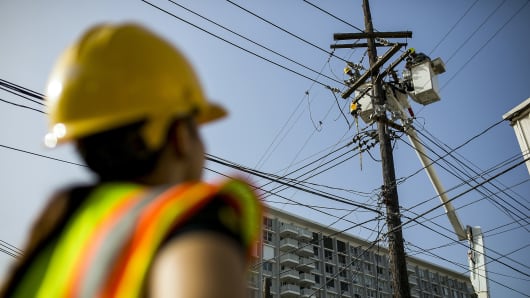
Puerto Rico Electric Power Authority (PREPA) employees fix power lines in Santurce, San Juan, Puerto Rico, on Thursday, Oct. 19, 2017.

Hope, fear as Puerto Rico moves to privatize power company