The NAACP on Tuesday passed a resolution supporting a bill to make Puerto Rico the 51st state by 2021.
Under that bill, Puerto Rico would be integrated as an incorporated territory of the United States until its full acceptance as a state in 2021.
“The Puerto Rican Admission Act [is] a major step towards realizing the democratic will of the U.S. citizens of Puerto Rico,” the NAACP resolution states.
The resolution was approved after Puerto Rico Gov. Ricardo Rosselló (D) addressed the group, calling statehood a “civil rights issue” and Puerto Rico's current territorial status “colonialism.”
In a 2017 referendum in Puerto Rico, 97 percent of voters chose statehood over independence or the status quo. But that referendum was boycotted by opposition parties, so only 23 percent of the electorate showed up to vote.
Opposition parties have panned the governor’s characterization of statehood as a civil rights issue.
Héctor Ferrer, president of the opposition Popular Democratic Party, said the referendum process was “rigged” because it did not include the word “commonwealth” as an option.
“[The government] is depriving at least half of the people of Puerto Rico of the right to choose,” he said of the turnout.
Ferrer is a Democrat at a national level, as is Rosselló, while Del. Jenniffer González-Colón is a Republican. But in Puerto Rico, González-Colón and Rosselló both belong to the New Progressive Party, a coalition of centrist Democrats and Puerto Rico's Republicans.
The debate over Puerto Rico’s status heated up in 2016, after the Supreme Court decided that the United States and Puerto Rico cannot successively try the same person for the same crime.
That decision fudged the distinction between Puerto Rico’s commonwealth status, adopted in 1952, and territories fully under control of the federal government, as established in the U.S. Constitution.
Still, specific distinctions remain: Puerto Ricans do not vote in federal elections or pay federal income tax, and the island sends a non-voting resident commissioner to Congress for four-year terms.
Rosselló and González-Colón blame the island's status for its poor economic development and say full representation in Washington will help the island achieve equal footing with the states.
Rosselló told the NAACP convention that the lack of statehood is an “injustice that damages” the more than four million U.S. citizens in the territories of Puerto Rico, U.S. Virgin Islands, Guam and American Samoa.
Puerto Rico's governor named a new CEO on Wednesday to lead the U.S. territory's power company, which has now seen three top executives in two weeks as it struggles with a lack of leadership, bankruptcy and the restoration of electricity to hundreds who remain in the dark since Hurricane Maria.
Electrical engineer Jose Ortiz, who once served as executive director of the island's water and sewer company, takes over the Puerto Rico Electric Power Authority on July 23. He replaces a CEO who lasted only one day in the position and took over from another CEO who announced his resignation last week after nearly four months on the job.
Ortiz once served as president of the power company's board, which saw five members resign last week following an outcry over the $750,000 annual salary that a previous CEO would have earned amid an 11-year recession. Ortiz will be making $250,000 annually and will receive no bonuses.
Ortiz said his priority is to rebuild Puerto Rico's credibility to help attract foreign investment and reach a deal with creditors to resolve the agency's $9 billion public debt.
"One of the first things we have to do is pull the company out of bankruptcy," he said.
He also said he will review multimillion-dollar federal contracts awarded to U.S. companies who are helping restore and rebuild the island's electrical grid after the Category 4 storm destroyed up to 75 percent of transmission lines.
Ortiz promised that Puerto Ricans will see "substantial change" early next year at the power company and in their bills as the government prepares to privatize the generation of energy and award concessions for transmission and distribution.
"We cannot keep planning much further," he said. "We all know what needs to be done."
Gov. Ricardo Rossello is among those who have been blamed for the ongoing turmoil at the power company. A day after the previous CEO was appointed last week, he issued a statement saying that the $750,000 salary was not appropriate given the island's economic crisis and said that any board member who disagreed should step down. Five of them did, including the CEO who was previously part of the board.
Rossello defended his actions, saying energy "is the linchpin of our society."
"The transformation of the electrical system is critical to Puerto Rico's development," he said.
Ortiz takes over as crews try to restore power to about 650 customers who remain without electricity some 10 months after hurricanes Irma and Maria devastated the island in September.
FILE - In this Oct. 19, 2017 file photo, a brigade from the Electric Power Authority repairs distribution lines damaged by Hurricane Maria in the Cantera community of San Juan, Puerto Rico. Jose Ortiz will take over Puerto Rico's Electric Power Authority on July 23, 2018, the company's second CEO in two weeks as it struggles with leadership issues, bankruptcy and the restoration of electricity to hundreds who have remained in the dark since Hurricane Maria. (AP Photo/Carlos Giusti, File)
The NAACP has a long history of supporting the democratic value of self-determination.
Our position as it stands seeks to advance the prosperity of the people of Puerto Rico. We, as the NAACP want to ensure that Puerto Ricans receive the resources, and support required to aid their recovery efforts.
We feel our position is especially important following the devastating hurricane and abysmal response from our federal government.
The NAACP stands with the people of Puerto Rico now more than ever, and we affirm our ability to work together in our joint struggle for equal protection, equal opportunity, and free will. Puerto Rico should be free to decide its preferred option in a fair and inclusive manner.
Media Relations Contact: Aba Blankson Vice President, Communications & Digital Media ablankson@naacpnet.org
Leadership of Puerto Rico's troubled electric utility collapsed after a mass resignation from its board of directors. At the same time, thousands of residents are still waiting for power 10 months after Hurricane Maria.
NOEL KING, HOST:
In Puerto Rico, the search is on for a new CEO for the island's electric utility. This will be the fifth CEO since Hurricane Maria destroyed the electric grid. The most recent CEO quit last week before he even started the job. Meanwhile, about a thousand households are still waiting for power 10 months after the storm. NPR's Adrian Florido reports.
ADRIAN FLORIDO, BYLINE: High in Puerto Rico's central mountain range, 85-year-old Ana Delia Medina Delgado opens the front door to her tidy but darkened home. "Come in," she says, "look at what I use for light."
ANA DELIA MEDINA DELGADO: (Speaking Spanish).
FLORIDO: She has a little lantern and a flashlight - nothing more. Her refrigerator is empty, unplugged.
MEDINA: (Speaking Spanish).
FLORIDO: "I think my dear lord," she begins. But then, her wide smile fades, and she falls into the arms of her adult grandson, Abdiel.
MEDINA: (Speaking Spanish).
FLORIDO: "I have a wonderful daughter," she sobs, "and my grandkids. They are the ones who've looked after me." Medina is among the last thousand or so customers that Puerto Rico's electric utility says are still waiting for power 10 months after Hurricane Maria. The utility, known as PREPA, says it won't stop till they all have power.
But last week, PREPA fell into chaos. The island's governor, Ricardo Rossello, demanded that PREPA's board cut the $750,000 salary of its newly hired CEO. In response, five out of the seven board members, including the new CEO, resigned, saying in a letter that, quote, "petty political interests" were trying to control the utility.
The governor denied interfering politically and quickly began filling the vacancies on PREPA's board. It's a critical time at the utility, which is owned by the government. Last month, the governor signed a bill that will privatize power generation on the island but keep power distribution under government control.
SERGIO MARXUACH: Even though the governor talks about privatizing PREPA, he still has the hope to be able to control the company.
FLORIDO: Sergio Marxuach is with the Center for a New Economy, a think tank in Puerto Rico. It's well-known, he says, that because PREPA is so huge, generates so much cash, issues so many contracts, that the island's governors have long seen control of the utility as one of the spoils of office.
MARXUACH: On the other hand, you had the old board. And I think they had a different vision to make PREPA less political, more professional and also perhaps had a different vision as to how it should operate going into the future.
FLORIDO: Angel Figueroa Jaramillo, president of the union representing electric workers, agrees that political meddling is a rampant problem at PREPA. But he also feared that the resignation of its independent board members would only allow the government to exert more control over the utility.
ANGEL FIGUEROA JARAMILLO: (Speaking Spanish).
FLORIDO: "They resigned from Puerto Rico's most important corporation," Jaramillo says, "without any sense of their obligation to the people." Jaramillo and his union have fiercely opposed the government's plan to privatize the utility. Aside from its ongoing struggle to turn the lights on after the hurricane, the utility is bankrupt and owes creditors billions of dollars. Cate Long does research for some of those creditors.
Is this common? Does this happen often?
CATE LONG: No, it never happens - never. Utilities tend to be exceptionally stable businesses. Investors love putting - you know, buying bonds of utilities because they're really basically the most stable entities in the United States economy. So this is so far off the charts, it just doesn't even register.
FLORIDO: Long wants the federal government to take PREPA over, at least for a while. That idea is being hotly debated in local news. This is all news to Carlos Lopez.
CARLOS LOPEZ: (Speaking Spanish).
FLORIDO: "No power means we can't turn on the news," he said. Right now, one of his big concerns is keeping his little generator running. It's the third one he's bought since the hurricane. He said they burn out every three months or so.
NPR transcripts are created on a rush deadline by Verb8tm, Inc., an NPR contractor, and produced using a proprietary transcription process developed with NPR. This text may not be in its final form and may be updated or revised in the future. Accuracy and availability may vary. The authoritative record of NPR’s programming is the audio record.
On Independence Day, 3.7 million Puerto Ricans will be celebrating America’s birthday, but they would also like to be reveling in their own liberation. Twice in the past five years, a majority of Puerto Ricans have voted in favor of becoming a state, rather than remaining a territory or being a sovereign nation. On the campaign, President Trump said that Puerto Ricans should be able to determine their own political status, and Congress should follow through on whatever the people decided.
There are 36 cosponsors for the bipartisan Puerto Rico Admission Act of 2018, including the chairmen of the House Natural Resources Committee and its Indian and Insular Affairs Subcommittee. The legislation would create a task force to determine which laws needed to be amended or repealed before the territory can become a state, and recommend economic measure that would aid the transition.
Granting statehood to Puerto Rico would provide many benefits. The Government Accountability Office found that “statehood could eliminate any risk associated with Puerto Rico’s uncertain political status and any related deterrent to business investment.” It also reported that statehood would increase both federal revenue and spending, but the complete fiscal impact would be determined by the “terms of admission, strategies to promote economic development, and decisions regarding Puerto Rico’s government revenue structure.”
Alaska and Hawaii both generated significant economic growth during their first decade after admission to the union. If the process is done with similar objectives in mind, there could be equal benefits for the people. Puerto Rico has been a territory since 1898, its residents have been U.S. citizens since 1917, and it has governed itself since 1952. The longest wait for any territory to become a state was 50 years for Hawaii.
The record length of time that Puerto Rico has been a territory likely accounts for the astonishing lack of knowledge that its residents are citizens, which in turn has an impact on support outside of the island. A Morning Consult poll, taken just days after Hurricane Maria devastated Puerto Rico, found that only 54 percent knew that its residents are U.S. citizens. An abysmal 37 percent of those 18 to 29 were aware of this fact, while 64 percent of those 65 and older had the correct information.
When asked whether Puerto Rico should receive federal aid to help rebuild after Hurricane Maria, 80 percent of those surveyed who knew about citizenship said yes, while only 40 percent of those who did not know about citizenship said yes. In other words, the latter group viewed them as foreigners, not fellow citizens.
Many Americans outside of Puerto Rico also are unlikely to be aware that Puerto Ricans do not pay federal income taxes on income earned in Puerto Rico, but they do pay all other federal taxes including Medicare and Social Security taxes. Yet, these U.S. citizens do not receive the same benefits as those of us living in states.
The commonwealth has the lowest participation rate in the labor market in the United States and all territories. A significant reason for this problem is that Puerto Rico has not been able to attract a sufficient quantity or quality of jobs due to its territorial status. Putting Puerto Rico on a path to statehood would not be a bailout. Instead, it would enable the territory to determine its own future, enhance economic growth and opportunity, and reduce the financial burden on all taxpayers.
Recognizing some of the innovative economic opportunities that are arising out of the devastation caused by the hurricanes, the governor of Puerto Rico, Ricardo Rosselló, signed legislation that would privatize the electric grid, while telecommunications companies are moving to establish 5G technology as that system is being rebuilt.
Focusing on the path forward, Puerto Rico can and will manage through this crisis and restore growth and opportunity on the island. If Congress does not allow Puerto Rico to start the process toward statehood, the federal government and taxpayers will face an even longer, more difficult, more costly and uncertain process to recovery.
Ah, Puerto Rico! Land of rum and iguanas, palm trees and paddleboard yoga. I arrived in San Juan two days ago with every intention of reporting briskly and soberly on the state of food and farming here since Hurricane Maria hit last September.
But even the most sober reporter would be entrapped by this island’s enchantments. Since touching down I have: drunk a cocktail called the Tesla out of a lightbulb at the pert little La Coctelera (where the cocktails are quite performative: The Paper Plane is garnished with a folded airplane); eaten deep-fried fish fritters with mayo-ketchup—the island’s preferred sauce; sat with my feet in the sand reading about Lolita Lebrón, the stylish Puerto Rican nationalist who, in 1954, led an attack in which five U.S. representatives were shot, shouting, “¡Viva Puerto Rico libre!” without once rumpling her French-knotted scarf.
This might all come across as frivolous given recent events, but in San Juan, at least, so much has been rebuilt in seven months that it’s hard to find evidence of Maria’s devastation—but for the occasional inoperative traffic light and the blue pointillist dots of FEMA tarp roofs against the composed pastel city. Of course there is damage one can’t see from bar stools or beaches, and I am en route to meet a 34-year-old named Tara Rodríguez Besosa, cofounder of the Puerto Rico Resilience Fund—an effort to help rebuild the island’s beleaguered farms. Rodríguez Besosa is the force behind an emergent Puerto Rican food revolution, and my plan is to join one of her volunteer brigades tilling topsoil at Huerto Semilla (“seed garden”), an agroecological student-run farm smack in the middle of San Juan, at the University of Puerto Rico’s Río Piedras campus.
When I arrive, the scene is a veritable hive of activity: young farmers, almost all women, bent over hoes, ferrying large bunches of holy basil or laying irrigation tape. Rodríguez Besosa, whose pixie cut and thin limbs give her the appearance of a rangy Peter Pan, stands with a shovel by beds of cilantro, mustard greens, and kale. She is physically striking, making a schools not prisons T-shirt, short black leggings, work boots, and dirt smudges look chic. The effect is partly due to her height—she is five feet ten—and her deep outdoor tan, sparkling eyes, and constant smile. She shovels soil through a sieve, while directing admiring young volunteers and answering her constantly ringing phone: Here’s where to deliver lunch; this is what time the car should meet her in New Orleans in two days; here’s where to send the next brigade.
Restoring Puerto Rican agriculture is a complex and novel project, since the island mostly stopped producing its own food long ago. By a conservative estimate, Puerto Rico imported at least 80 percent of what it consumed before the hurricane. The story of why in the briefest possible terms: Farming declined during Puerto Rico’s days as a Spanish colony, when native agriculture ceded to large colonial plantations. Under U.S. administration, beginning after the 1898 Spanish-American War, Puerto Rico was subjected to a combination of economic restructuring, industrialization, and the growing stigma of being perceived as a rural, peasant island. Surviving farms grew profitable sugarcane, coffee, or, in rarer cases, plantains and other fruits. By the turn of the twenty-first century it was all but impossible to procure anything locally but a very limited set of crops.
This does not perhaps sound so bad—until you consider the high environmental costs of transporting the island’s food. And the poignant lesson of Maria, which destroyed 80 percent of Puerto Rico’s crops in addition to roads, homes, vehicles: that dependence on imports left Puerto Ricans uniquely susceptible, in the face of a natural disaster, to starvation.
“They say that during Maria, Puerto Rico only had enough food for one week,” says Carmen Yulín Cruz, the mayor of San Juan, who rose to international prominence feuding with President Trump over aid. “I hate to say anything positive about Maria. But what the hurricane did was force us to look at the realities of life here and how our dependency on the outside weakens our ability to ensure our people are taken care of. Maria made it evident that we need agricultural sovereignty.”
Sylvia De Marco, a collaborator of Rodríguez Besosa’s and co-owner of a San Juan boutique hotel called the Dreamcatcher—in whose Goddess Suite I’m spending the week—agrees. “After the hurricane, even people who didn’t care about food started to care. It really opened people’s eyes: that we have to depend on our soil, not shipping containers.”
Puerto Rican farming was highly limited before the hurricane. Recovery efforts envision a more diverse crop. Detail of Papaya, by Ana Mercedes Hoyos.
Photo: Courtesy of Ana Mercedes Hoyos. Papaya, 1994. Oil on canvas, 23.6ˮ x 23.6ˮ.
Enter Rodríguez Besosa, an artist turned farmer who studied architecture at New York’s Pratt Institute and helped run a gallery in Red Hook, Brooklyn. A decade ago, missing home, she moved back to Puerto Rico. She helped out on her mother’s tiny organic farm to make money while she opened a cultishly popular, illegal, and not at all lucrative bar in San Juan. She quickly detected a problem. “There was one farmers’ market every two weeks, and you had to be up at 9:00 a.m. to get anything. I was running a bar. I wasn’t waking up at nine.” Some small vegetable and meat farms, like her mother’s, existed around the island, but farmers and consumers had few ways of getting together.
Rodríguez Besosa, a natural entrepreneur, decided to fix the problem. She accepted $10,000 in seed money from a friend, rented a warehouse, named it El Departamento de la Comida (“the department of food”) and started driving around selling boxes of local vegetables. “The vegetables I bought had to be not just local but sustainable—agroecological, biodynamic,” she says. Her quick conversion to the dogma of sustainability may be genetic. Her mother was a model and fashion retailer turned farmer; her sister studied biology before taking over the family farm in 2011. “My point was we could not afford to go on farming unsustainably in Puerto Rico,” she says.
The response was enthusiastic. María Grubb, a Puerto Rican who spent about seven years cooking at New York’s Pastis, the Modern, and Maialino before returning to open Gallo Negro in San Juan’s bohemian Santurce neighborhood, says that when her restaurant opened, El Departamento de la Comida was the only place she could find fresh local vegetables. Juan José Cuevas, former chef at Blue Hill in New York City, who moved here in 2012 to take over the kitchen at the Condado Vanderbilt Hotel, agrees: “Tara was doing this when no one was.”
“We detonated something really interesting,” Rodríguez Besosa tells me over a delightful lunch at Huerto Semilla of rice and beans, roasted eggplant, and local lettuces with orange vinaigrette. “We were all over the newspapers. The whole thing erupted. I was like, I have no idea what this is, but, holy shit, it is amazing.”
Her next step was to transform El Departamento de la Comida into a restaurant. She bought an $80 stove, installed it in the warehouse, and let friends and visitors make simple dishes like pumpkin soup and pesto. “We had two to three people in the kitchen. Maybe it was an artist who cooked outside, or maybe it was someone who liked to cook, like Paxx Caraballo Moll”—a Puerto Rican chef getting accolades for the new restaurant–in–a–tiki bar Jungle Bao Bao. Furnished with folding tables and chairs, serving a changing vegetarian menu of whatever local farms harvested, the restaurant quickly became beloved, akin to Brooklyn’s Roberta’s—shabby, a little uncomfortable, delicious.
“Then the hurricane hits us, and bang, we’re gone,” Rodríguez Besosa says. The restaurant flooded, then was repeatedly looted. Stranded in New York for an event while the storm raged, Rodríguez Besosa gathered friends to create her Resilience Fund and pitched in with the ad-hoc Queer Kitchen Brigade, which canned food to send to the island. Rodríguez Besosa brought some of the cans and jars back herself, along with seeds and farming tools—by joining a delegation aboard a Greenpeace ship.
Since November, Rodríguez Besosa has sent farming brigades, in her brightly painted Guagua Solidaria (“solidarity van”), to more than 30 gardens and farms all over the island, distributing seeds, building rainwater collection systems, donating tools, cooking meals, giving acupuncture treatments, and providing general spiritual uplift. She plans to help 200 farms before the campaign ends. “And if you’re growing food in your backyard, you’re included,” she tells me. “If you sell at farmers’ markets, you’re included. If we want to create autonomy in Puerto Rico, it will have to be in different ways. We have to do urban agriculture; we have to do school farms, community farms, backyard gardens.”
Mayor Yulín tells me that Rodríguez Besosa’s role in the island’s future is unique. “Tara is giving agriculture a new face,” she says. “She’s found a way to convey the importance of a new local agriculture at a primal level, with the technology and vision to ensure it’s done in a socially responsible and fair and ethical way. She’s taking something old and making it exciting.”
Rodríguez Besosa isn’t alone; others on the island have rallied to support local agriculture too. The Dreamcatcher’s De Marco offered guests the opportunity to volunteer at a farm called Estancia Verde Luz in nearby Ciales last spring. She tells me, “Our menu is all local, and Estancia Verde Luz was the main farm who sold to us. It was completely trashed in the hurricane. So we had guests help with cleanup. People felt really good to be supporting the economy, and at the same time helping a farm rebuild.” In May, De Marco launched a monthly dinner series called Nuestra Mesa (“our table”) in collaboration with Rodríguez Besosa: four courses of local vegetables, served in the Dreamcatcher’s airy kitchen and patio, attended by hotel guests, locals, and farmers.
An hour and a half east of San Juan, I pay a visit to an Ayurvedic biodynamic farm named Finca Pajuil that Rodríguez Besosa has told me is a model of resilience, replete with rotation planting, rainwater collection, aquaponics—the kinds of things Mayor Yulín says must be part of Puerto Rico’s agriculture.
An unfortunate misunderstanding with my phone’s GPS system leads me to a distinctly un-Ayurvedic pizzeria (I recommend the calzones), but eventually I arrive at my destination, and the bright-eyed head farmer, Jey Ma Tulasi, greets me at the gate—an inexplicable but not entirely unattractive green botanical V painted down the middle of her face. Tulasi shows me where neem and breadfruit trees once divided her land from the road, their disappearance depriving her crops of shade. Still, it’s impossible not to see how many more birds flock to Tulasi’s moringa and banana groves than to neighbors’ backyards, how many more bees buzz in flowers, and how healthy her curving spirals of holy basil and tarragon, aloe and mint make the land. Her little shop sells a homegrown, Ayurvedic version of adobo made with her own turmeric and local sea salt. There is moringa for sale by the bunch, and curry leaves. I’m struck by the hopefulness of the hugelkultur beds—deep garden plots made from fallen trees—which are already thick with pumpkins and sweet potatoes.
Over a final dinner with Rodríguez Besosa at Cuevas’s 1919, inside the Vanderbilt, I note that women seem to be leading this movement. “In terms of activists inside the farming movement, at least half of them are women,” Rodríguez Besosa says. “And more than half the farmers I work with are.”
What follows is one of the more exciting meals of my recent memory: white gazpacho; lobster with eggplant and mozzarella; tuna tartare with caviar; barely cooked tuna with tomatoes; salmon with fresh shelling beans; local goat-cheese ravioli; and a local fish from the snapper family called cartucho—much of which comes from farms and fishermen on the island, whom Cuevas buys from directly.
Cuevas joins us as we share coconut sorbet and a salted caramel–and–chocolate tart. He sees another silver lining in Maria. “Obviously, six months ago things were very bad,” he says. “But six months have given people time to stop, think, and grow things. The Puerto Rican diet of rice, beans, plantains, and root vegetables is very earthy, but it also takes a really long time to grow.” The destruction of plantain groves has encouraged the planting of fast-growing beets, greens, tomatoes instead—ingredients healthy diets demand.
We end the night tasting three homemade jams from a woman who delivers them biweekly: one pineapple-and-mango, one papaya, one guava-coconut. They are faultless. I wonder whether I could find them in New York.
Rodríguez Besosa’s sparkling eyes light up further. Her next project is starting her own farm on land she bought last week. “It’s in a small community in Caguas, 45 minutes south of San Juan,” she tells me, so excited she’s nearly vibrating. “I’ll finally produce my own food on a larger scale.” It’s also the next iteration of El Departamento de la Comida. “This will be a model farm that hosts only workshops using permaculture and agroecology frameworks, and a collective for queer and trans people who want to work the land.” She plans to build a commercial kitchen on-site and use primarily the harvest from the farm itself. Next up, she says, as we chase our jam with petits fours: “our own product line.”
In this story: Sittings Editor: Yohana Lebasi. Hair: Adam Szabó; Makeup: Caoilfhionn Gifford.
Tara Rodríguez Besosa is among those leading farm-recovery efforts. Céline top. Marni skirt. Soko earrings.
In its version of a bill to privatize the Puerto Rico Electric Power Authority, the Puerto Rico legislature has improved some on Gov. Ricardo Rosselló’s original proposal, but lawmakers are ultimately failing the Puerto Rican people every bit as badly as Rosselló has.
We’ve criticized the governor’s original privatization proposal for essentially aiming to set up a process that would enable the implementation of politically driven contracts devoid of regulatory oversight.
The amended legislation contains some improvements, but — crucially — it does not say how privatization would solve the two fundamental problems of Puerto Rico’s electrical system: its over-reliance on imported fossil fuels and its crippling debt.
Key improvements in the revised privatization bill:
A somewhat greater role for independent regulatory oversight. The independent Puerto Rico Energy Commission would have the authority to accept or reject proposed privatization contracts, although it would still have no authority to amend contracts, and its enforcement role would be subordinate to the Public-Private Partnership Authority, an existing government agency charged with managing the privatization transactions.
A requirement that the Puerto Rico legislature approve any sale of PREPA power plants to third parties.
A requirement that privatization transactions be consistent with a forthcoming energy public policy and regulatory framework unless a transaction is specifically exempted by the legislature, which has given itself a deadline of 180 days after the passage of the privatization bill to develop this framework.
Prohibition on a single company owning the entire generation system.
Requirement of an RFP process for generation asset sales.
Unfortunately, the bill retains many flaws from the governor’s original proposal:
It lacks any provision for the maintenance of collective bargaining agreements under private contractors, and labor organizations are excluded from oversight and partnership committees. In combination with the recent legislative decision to remove employee protections against dismissal without just cause, the bill has no protection against termination of workers transferred to private entities. These deficiencies undermine some improvements made to the bill, including a requirement that PREPA employees transferred to other government positions retain collective bargaining rights, pensions and benefits; and that private contractors establish occupational classifications, seniority, salaries and benefits equivalent to what employees had under PREPA.
It leaves negotiation and enforcement of contracts under the direction of the Public-Private Partnership Authority, an entity effectively controlled by the governor, and it includes no indication that these contracts will prioritize renewable energy, transitioning off of imported oil, enhancing grid resiliency or integrating distributed generation and microgrids.
It restructures the Puerto Rico Energy Commission, making it a five-member board whose members must meet certain professional qualifications and are to be selected from a list submitted to the governor. This follows the directives of the federal Financial Oversight and Management Board, and while this structure is reasonable in theory, in practice it gives Rosselló the power to appoint the majority of the commission during the period of the privatization transactions, even though the governor has made clear his hostility to the current commission and to renewable energy.
It allows privatization contracts to be exempt from compliance with the integrated resource plan (IRP) at the recommendation of the partnership committee (controlled by PREPA and the Public-Private Partnership Authority) and with the advice of the Puerto Rico Energy Commission. Given that Rosselló would be able to appoint the majority of the commission, it seems likely that the IRP — and any true commitment to sound energy planning — will fall by the wayside.
It omits any competitive bidding requirement for the leasing of transmission and distribution-related functions and lacks any requirement that the contract process include a determination by the contracting agency that the vendors chosen meet certain standards: that they do not owe taxes to Puerto Rico, that they have a clean track record with regard to past performance in Puerto Rico, and that they disclose fines and penalties from other jurisdictions and conflicts of interest.
Authors of the legislature’s privatization bill, to their credit, appear to recognize that privatization is a means to an end, not an end in itself. But while their bill requires that privatization transactions comply with a new public energy policy, which is mandated but not yet written, it is nevertheless backwards — and risky — to authorize privatization without good policy in place.
In their intent to hasten private investment in Puerto Rico, the governor and the legislature now are creating policy that fails to spell out what role the public sector will play in the financing of the these transactions. It also fails to explain where future ownership of electricity assets will lie; how development and management of those assets will proceed; whether labor-force decisions will be in the best interest of Puerto Ricans.
We fail to see how the proposed privatization of PREPA would result in a more affordable, resilient, or financially sustainable electrical system. The privatization plan that the legislature has produced has no clear policy vision, lacks a commitment to energy planning, and creates yet more opportunity for politics to interfere in the negotiation and enforcement of contracts.
Cathy Kunkel is an energy analyst at the Institute for Energy Economics and Financial Analysis. Tom Sanzillo is director of finance.
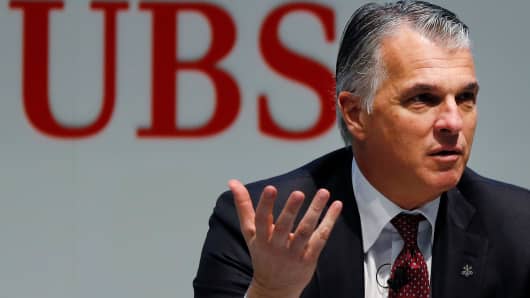
Sergio Ermotti, chief executive officer of UBS Group
UBS could have done things differently in Puerto Rico, where thousands of the island's residents blame the Swiss financial services giant for the depletion of their life savings, the bank's CEO said in an interview.
"When you go back and you look at the situation, you could always argue that we could have done things better, or some people could have behaved better," Sergio Ermotti told CNBC's Michelle Caruso-Cabrera in an exclusive interview on Monday.
"When there is scope for admitting something went wrong, we do that," Ermotti said. However, if "we believe that there are situations where people are just trying to take advantage of something, then we will fight and we will just try to present facts."
He was referring to the tsunami of arbitration claims that have been filed against UBS by Puerto Rico-based investors for — among other counts — breach of fiduciary duty, negligence and fraud.
The claims came after 2013, when 23 closed-end bonds funds managed or co-managed by UBS Puerto Rico and sold to island residents lost $3 billion in value, or nearly 70 percent, according to data from Securities Litigation and Consulting Group.
Ermotti said there were not obvious warning signs in the years prior to the UBS Puerto Rico bond funds imploding.
"Until 2013, it was very difficult to predict that things could…evolve in such a way," Ermotti said. No ratings agencies, "nobody was waving their flag about the danger of Puerto Rico."
However, a CNBC investigation in December showed that a mere few months after Ermotti took over as CEO in November 2011, it was clear not only to the ratings agencies, but also to UBS, that Puerto Rico's credit was deteriorating.
In a research report that UBS issued in January 2012, the firm identified major risks for investors holding the Commonwealth's debt, including the "slower than anticipated recovery" and "rising debt burden." The 45-page report recommended: "Conservative investors with concentrated exposure to any single borrower in the municipal market should pursue portfolio diversification.
Ermotti says that despite the extremely tumultuous past few years, the financial firm has stayed on the island and is working together with regulators and through arbitration to try and find the best solutions for their clients.
"We are trying to clearly [and] constructively find resolutions," Ermotti said. "The truth of the matter is we are very committed to Puerto Rico."
UBS Puerto Rico is a subsidiary of UBS Americas Financial Services headquartered in Weehawken, New Jersey. At its peak, UBS had the largest wealth management business in Puerto Rico, representing an estimated 20,000 households. By 2012, UBS investors on the island had about $10 billion invested in the bond funds, or roughly 10 percent of the island's gross domestic product.
UBS Puerto Rico has been the primary underwriter of a series of closed-end funds since the mid-1990s. And it managed or co-managed the 23 proprietary closed-end funds that could only be sold to Puerto Rico residents and corporations whose primary place of business is on the island.
Through the years 2004 to 2008, the direct and indirect revenue generated by the bond funds accounted for 42 percent to 53 percent of UBS Puerto Rico's total revenue. Those profits flowed up the chain to the parent company, UBS AG.
The funds had many unique qualities since they were offered in a U.S. territory, rather than a U.S. state. In particular, the bond funds weren't registered with the Securities and Exchange Commission or listed on a U.S. exchange like a typical mainland closed-end fund.
This was because of a recently closed legal loophole that previously exempted U.S. territories from the Investment Company Act of 1940. That legislation, among other things, limited the use of leverage and barred certain types of transactions.
The exemption allowed the UBS funds in Puerto Rico to be levered in many instances 2 to 1, which was the maximum amount legally allowed by Puerto Rico's securities regulations.
The funds also had an immense overconcentration of Puerto Rico-issued securities. Two particular securities, bonds issued by the island's government development bank and bonds issued by a government-run corporation, accounted for more than 90 percent of the net assets in 10 of the UBS funds by the end of June 2013.
The heavy concentration and high leverage of the funds ultimately led to staggering losses for investors in 2013, after Puerto Rican bonds suffered a massive sell-off.
Ermotti pointed out in Monday's interview that prior to their implosion, the closed-end funds were highly profitable for investors.
"The only thing we know, which is not an excuse but is an explanation, is that in the previous 20 years or so, clients and investors made $3 billion of profits [from the funds]," Ermotti said.
The massive decline in value of the funds "led to multiple regulatory inquiries, as well as customer complaints and arbitrations with aggregate claimed damages of USD 2.5 billion, of which claims with aggregate claimed damages of USD 1.5 billion have been resolved through settlements, arbitration or withdrawal of the claim," according to UBS's first quarter 2018 report.
The firm settled with the SEC in 2012 for $26.6 million and in 2015 for $15 million. Also in 2015, UBS settled with Finra, Wall Street's self-policing regulatory agency, for $18.5 million. A year earlier, in 2014, UBS settled with Puerto Rico's local regulator, the Office of the Commissioner of Financial Institutions, for $5.2 million.
The regulators' charges included that the firm misrepresented and omitted material facts about the closed-end bond funds to investors and failed to monitor the combination of leverage and concentration levels in customer accounts, according to the settlement documents.
UBS Puerto Rico did not admit or deny wrongdoing in any of the settlements.
UBS has disclosed in regulatory filings that the Department of Justice is conducting a criminal inquiry into the impermissible reinvestment of the non-purpose loan proceeds, in regard to the Puerto Rico funds. "We are cooperating with the authorities in this inquiry," the filing states.
At its peak, UBS had the largest wealth management business in Puerto Rico, representing an estimated 20,000 households. By 2012, island investors had about $10 billion invested in UBS bond funds.
The bond funds were highly leveraged and concentrated in securities issued by two Puerto Rico government entities.
In 2013, the funds lost $3 billion in value, or nearly 70 percent. CEO Sergio Ermotti told CNBC there were not obvious warning signs in the years prior to that.