Wednesday, May 21, 2014

Fitch: Puerto Rican Banks Weighed Down by Weak Island Economy

(The following statement was released by the rating agency) NEW YORK, May 20 (Fitch) Weak economic fundamentals in Puerto Rico and ongoing budgetary challenges for the island's government are likely to weigh on the operating performance and credit profiles of local banks, according to Fitch Ratings. 

Economic conditions in Puerto Rico have kept the non-performing assets (NPAs) of banks on the island very high relative to U.S. midtier and community bank peer groups. Combined, the NPA rate of Fitch-rated Puerto Rican banks was 11.9% at the end of 4Q13, compared with 2.5% for mainland peers.

 Unemployment in Puerto Rico remains high, running at over 14%. Labor market conditions are restraining recovery potential in the local housing market and worsening the recoveries on defaulted loans. The government's high debt levels, pension funding requirements and still-sluggish growth have exacerbated the banks' challenges. The core deposit base of the Puerto Rican banks is not sufficient to support local banks' funding requirements. Heavy reliance on non-core funding, particularly brokered CDs and other wholesale sources, could constrain liquidity if economic conditions worsen. Doral Financial (DRL), which had $1.4 billion in brokered deposits at year end 2013, or 28% of total deposits and 18% of total funding, saw its use of brokered deposits frozen by the FDIC on May 1.

 The bank must resubmit a revised capital plan to resume access to the brokered deposit market. DRL's IDR was downgraded to 'C' from 'CCC' on May 5. Maintaining a good measure of stability in the Puerto Rican banks' capital positions is critical to supporting current ratings in light of the poor economic environment. Favorably, most banks' capital positions have improved somewhat over the past two years as a result of equity issuances that have helped to shore up credit quality. 

 While all of Puerto Rico's banks have suffered from market weakness, DRL entered 2014 as already the weakest of the island's rated banks. The FDIC advised the bank and the Office of Financial Commissions, Puerto Rico's local bank regulator, that it could no longer include some or all of certain tax receivables due from the government of Puerto Rico as part of its Tier 1 capital calculation. The tax receivables, totaling $289 million, account for roughly 43% of DRL's current Tier 1 capital. With the exclusion of these assets, DRL is no longer compliant with its minimum regulatory capital requirement. 

For most of Puerto Rico's banks, better profitability will be key in determining whether capital ratios and other financial measures can continue improving in the face of macro headwinds. For a full analysis of Puerto Rican bank credit profiles, as well as a discussion of the impact that weak economic fundamentals are having on banks' operating environment, see the Fitch special report "Puerto Rican Banks: Difficult Operating Environment Constrains Ratings," dated May 20, 2014, at www.fitchratings.com. 

Contact: Doriana Gamboa Director Financial Institutions +1 212 908-0865 33 Whitehall Street New York, NY Matthew Noll, CFA Senior Director Fitch Wire +1 212 908-1652 begin_of_the_skype_highlighting +1 212 908-1652 FREE  end_of_the_skype_highlighting Media Relations: Brian Bertsch, New York, Tel: +1 212-908-0549 begin_of_the_skype_highlighting +1 212-908-0549 FREE  end_of_the_skype_highlighting , Email: brian.bertsch@fitchratings.com. 

Additional information is available on www.fitchratings.com. The above article originally appeared as a post on the Fitch Wire credit market commentary page. The original article, which may include hyperlinks to companies and current ratings, can be accessed at www.fitchratings.com. All opinions expressed are those of Fitch Ratings. 

Applicable Criteria and Related Research: Puerto Rican Banks: Difficult Operating Environment Constrains Ratings here ALL FITCH CREDIT RATINGS ARE SUBJECT TO CERTAIN LIMITATIONS AND DISCLAIMERS. PLEASE READ THESE LIMITATIONS AND DISCLAIMERS BY FOLLOWING THIS LINK: here. IN ADDITION, RATING DEFINITIONS AND THE TERMS OF USE OF SUCH RATINGS ARE AVAILABLE ON THE AGENCY'S PUBLIC WEBSITE 'WWW.FITCHRATINGS.COM'. 

PUBLISHED RATINGS, CRITERIA AND METHODOLOGIES ARE AVAILABLE FROM THIS SITE AT ALL TIMES. FITCH'S CODE OF CONDUCT, CONFIDENTIALITY, CONFLICTS OF INTEREST, AFFILIATE FIREWALL, COMPLIANCE AND OTHER RELEVANT POLICIES AND PROCEDURES ARE ALSO AVAILABLE FROM THE 'CODE OF CONDUCT' SECTION OF THIS SITE. 

FITCH MAY HAVE PROVIDED ANOTHER PERMISSIBLE SERVICE TO THE RATED ENTITY OR ITS RELATED THIRD PARTIES. DETAILS OF THIS SERVICE FOR RATINGS FOR WHICH THE LEAD ANALYST IS BASED IN AN EU-REGISTERED ENTITY CAN BE FOUND ON THE ENTITY SUMMARY PAGE FOR THIS ISSUER ON THE FITCH WEBSITE.

Fitch: Puerto Rican Banks Weighed Down by Weak Island Economy

Tuesday, May 20, 2014

Moody s Is Positive About Proposed Puerto Rico Budget

Moody's said Puerto Rico Gov. García Padilla's proposed budget is a credit positive but that the commonwealth government still has potential challenges.

by

Moody s Is Positive About Proposed Puerto Rico Budget

Monday, May 19, 2014

Caribbean Business in 2014

The article “Growth to Accelerate in Latin America and the Caribbean …”, in the Annual World Economic Situation and Prospects 2014 report of the UN Department of Economic and Social Affairs (UNDESA), indicates that Haiti and the Dominican Republic will lead the Caribbean in growth by 2015.

The global competitiveness of both from 2012 to 2013 are recorded in Doing Business 2014 – Regional Profile: Caribbean States, a co-publication of the World Bank and International Financial Corporation, which also records the global competitiveness of eleven other Caribbean islands.

Except for Puerto Rico, all these islands are members of the Caribbean Forum (CARIFORUM); and beside Haiti and the Dominican Republic, all are Small Island Developing States (SIDS). In comparing SIDS to non-SIDS, part 1 of this article indicated that non-SIDS performed worse in Doing Business 2014.

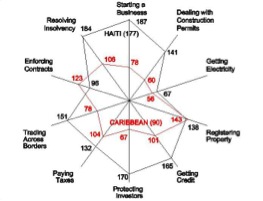
The region was ranked 90, of the 189 nations examined. Ten indicators, across the four stages of the business cycle (i.e. start-up, operation, expansion and insolvency), were evaluated to determine ranks. Figure 1 maps the performance of the Caribbean, and Haiti in particular, across these indicators.


Figure 1: Global Competitiveness Map of the Caribbean

Points closer to the centre indicate better performance. Hence, Haiti which has an overall rank of 177 performed worse in eight of these indicators when compared to the Caribbean region, which has the higher rank. But, it should be noted that performance in each indicator varies about the overall rank.

To improve on overall rank, it stands to reason that the worse indicators need to be addressed as a priority. For the Caribbean, priority indicators starting from the worst seem to be: registering property [143], enforcing contracts [123], resolving insolvency [106], paying taxes [104], and getting credit [102].

As a point of interest, “Getting Credit” is not a priority indicator for Puerto Rico, and Trinidad and Tobago, which have the two highest overall ranks in the Caribbean. Puerto Rico, with the highest overall rank, also has the highest rank in this indicator at 13: followed by Trinidad and Tobago at 28.

When considering only CARIFORUM member states rather than islands of the regional profile, there are marked differences. The priority indicators for the SIDS group do not change, but their order of priority does. For the non-SIDS group, both their priority indicators and order of priority change significantly.

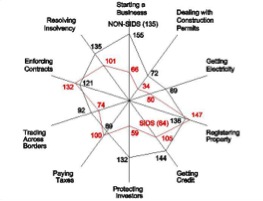
Figure 2 maps the global competitiveness of CARIFORUM SIDS versus non-SIDS. The SIDS group does not include Puerto Rico, and the non-SIDS group includes Guyana, Suriname and Belize – CARIFORUM member states – which were not included in the regional profile.


The overall rank for SIDS is 84. The priority indicators starting from the worst are: registering property [147], enforcing contracts [132], getting credit [105], resolving insolvency [101], and paying taxes [100]. Of note, the ranks of the first three priority indicators are worse than they were for the regional profile.

The overall rank for non-SIDS is 135. In this case, the priority indicators are: starting business [155], getting credit [144], registering property [136], resolving insolvency [135], and protecting investors [132]. “Enforcing Contracts” and “Paying Taxes” are not priority indicators for non-SIDS.

Nevertheless, international assistance is needed to address “Registering Property”, “Enforcing Contracts”, and “Getting Credit”. In the former, Guyana ranked highest at 111. Only Antigua and Barbuda was higher than 81 in the next; and, only Trinidad and Tobago was higher than 86 in the latter.

The importance of “Enforcing Contracts” is self evident: especially when considering foreign direct investment. Which foreign enterprise is going to invest in an unfamiliar location where enforcing contracts is known to be a problem?

However, the significance of “Registering Property” should not be underestimated. According to Peruvian social scientist Hernando DeSoto, eighty per cent of the World is under-capitalized because property owners cannot generate capital from their assets.

Using Haiti as an example, DeSoto stated that the total assets held by its poor amount to over 150 times all foreign investment made in that nation since its independence in 1804. This is particularly alarming when considering that Haiti’s rank in this indicator is better than the average Caribbean state.

But, it is incomprehensible that “Getting Credit” is a priority indicator for SIDS, when so many of these states have developed reputations as international financial centres. Is this due to underdeveloped capital markets, an absence of credit bureaus, or do we not consider local businesses acceptable risks?

The remaining priority indicators can be addressed using the model of the Asia-Pacific Economic Cooperation (APEC). As mentioned in part 1, APEC is a forum committed to the liberalization of trade and investment, business facilitation, and economic and technical cooperation.

According to “APEC: Sharing Goals and Experience” in Doing Business 2013: Smarter Regulations for Small and Medium-Sized Enterprises, APEC’s 2009 action plan has shown “encouraging early results” evident in the marked improvement of their members over non-APEC states.

“APEC sets measurable targets with specific time-lines” to facilitate monitoring and evaluation of performance. One set of targets is based on the “Doing Business” indicators. APEC’s 2009 Doing Business Action Plan sets the target of making business 25 per cent cheaper, faster and easier by 2015.

In addition, “… sustained engagement by top government officials from every APEC member is needed to accelerate progress towards the goals it has set for itself”. APEC also encourages capacity building activities amongst its members to support the attainment of these goals.

Five Doing Business indicators are selected, and the respective “champion economies” are chosen to provide capacity building assistance to the other members. These “champion economies” not only share information and experience, but also undertake personalized diagnostic studies.

“Other regional bodies can learn from this model of capacity building”, and CARIFORUM should follow suit. It has at least three states ranked within the top third in global competitiveness for each of the four remaining priority indicators. So, choosing champion economies should not be a problem.

Belize is the only non-SIDS which could be considered a champion economy in two indicators: “Resolving Insolvency”, for which it ranked 30, and “Paying Taxes”, with a rank of 48. Suriname is the only other non-SIDS champion economy and this is also in “Paying Taxes”, for which it ranked 50.

Coincidentally, “Paying Taxes” is the only indicator which has only two possible SIDS champion economies: Bahamas and St. Lucia. Both ranked 45. Otherwise, champion economies are practically all SIDS, which could affect the efficacy of capacity building assistance to non-SIDS.

There are two priority targets unique to non-SIDS: “Starting Business” and “Protecting Investors”. Addressing “Starting Business” is not likely to be a problem for SIDS champion economies. But, it is suspected that addressing “Protecting Investors” could be.

This indicator has six possible champion economies: all SIDS, and all Anglophone. So, the legal systems of the predominantly non-Anglophone non-SIDS will be totally unfamiliar. Consequently, international assistance may also be required for non-SIDS to address this indicator.

This highlights the problem of dealing with non-SIDS as a unit. Their present amorphous nature especially with regard to language and institutions makes this difficult. Probably when other states with like backgrounds join CARIFORUM, this may be resolved.

In “Doing Business in the Caribbean: Lessons from Singapore”, I benchmarked “Doing Business 2013” ratings of Barbados, Jamaica, and Trinidad and Tobago, in one indicator, against the top ranked Singapore, which is again ranked first in “Doing Business 2014.”

The chosen indicator was “Dealing with Construction Permits”. But, the above indicates that this is not one of CARIFORUM’s priority indicators. In fact, ten possible champion economies could be identified in this indicator: the highest number in any of the priority indicators.

Of the original states benchmarked, only Trinidad and Tobago could not be considered a champion in this indictor. In the 2013 report, they were ranked 101; and in the 2014 report, they were ranked 77: both ranks being below the corresponding non-SIDS rank for the respective years.

Nevertheless, this is a significant improvement in rank. In the 2013 report, this indicator was one of Trinidad and Tobago’s priority indicators. It still is. But, this improvement contributed to Trinidad and Tobago becoming the only CARIFORUM state that has improved its overall rank in the current report.

If CARIFORUM follows their lead, the deterioration of its performance may be halted, or even improved. But, a concerted effort needs to be made to improve the region’s global competitiveness. Otherwise, the growth expected into 2015 will only be short-lived. CARIFORUM needs reform now.

By Paul Hay

Caribbean Business in 2014

Saturday, May 17, 2014

Puerto Rico Rebuffs Doral s Demands for $230M Refund

Doral Financial (DRL) is evaluating its legal options after Puerto Rico rejected the company's request for a $230 million refund of overpaid taxes.

by

Puerto Rico Rebuffs Doral s Demands for $230M Refund - American Banker Article

Puerto Rico: Balanced-Budget Double Talk Can't Blind People to Dismal Reality

In March of this year, Puerto Rico Governor Alejandro García Padilla delivered his State of the Commonwealth speech, promising a balanced budget and no more borrowing. At first glance this sounded like a bold step. With some US$70 billion in debt, Puerto Rico has been financing budget deficits for decades under the leadership of both major political parties.

Something about the announcement, however, didn’t quite add up. That’s not to say balancing the budget and putting an end to borrowing is a bad thing; it is exactly the right thing to do. So what is wrong with this picture?

Earlier this year the commonwealth issued about $3.5 billion in bonds as a form of gap financing to help the government meet its obligations for the next few years as the economy recovered. Controlling spending and boosting the local economy are part of that overall plan to get the island back to some semblance of economic sanity.

While the objective is good, there is one question unanswered: is the island really going to balance the budget with no new borrowing, or did they just balance it with $3.5 billion in bonds so they could say they won’t borrow money next year?

Now comes a report that the commonwealth will issue another $500 million in bonds next year.

Wait … what?

If Puerto Rico issued $3.5 billion for gap funding to get over the borrowing hump, why do they need an extra $500 million next year? In fairness, the new bond issue is being sold as a way to refinance some municipal debt; however, it is also expected to help finance new public projects. In other words it is, at least in part, financing deficit spending.

I’m not the only one doubting the promise of no more borrowing, and there is already backlash over earlier bonds and losses. Reuters “Muniland,” for example, remains bearish on Puerto Rico. Referencing Jim Grant of Grant’s Interest Rate Observer, they write that “given the commonwealth’s population decline and low labor participation rate of around 40 percent, he is unable to discern any long-term plan to right size the government’s debt load.”  Meanwhile, some investors are suing UBS over risky PR bond funds.

The governor’s insistence that Puerto Rico is not Detroit or Greece are of little comfort when one considers the double talk on balanced budgets and debt sales. Pessimism continues to reign supreme in the non-political circles, as exemplified by this article in GuruFocus.

Meanwhile, Doral Financial announced that they will be revising their capital plan. Under orders from the FDIC, the troubled PR bank may no longer include some of or all the tax receivables from the government of Puerto Rico in its calculation of its Tier 1 capital. That money represented nearly half of the bank’s Tier 1 capital. The report says of the decision: “[leaves] Doral out of compliance with its Consent Order with FDIC because it will no longer be able to accept or roll over brokered deposits, which means they could lose about 18 percent of their deposit base.”

Doral Financial’s woes are the tip of the Puerto Rico economic-disaster iceberg. Gurufocus.com notes that Doral’s financial difficulties could spread to other banks on the island, and some of those other banks are already in trouble.

Doral maintains that the tax receivables could be included properly in the revised plan and is working with the FDIC to do so, while also seeking to raise capital and consider the sale of some assets. Beyond what is appropriate or not within the interminable maze of government banking regulation, is it possible that the FDIC knows something about potential future tax receivables revenue that the Puerto Rico government isn’t saying? If long term tax revenue is in doubt, how will Puerto Rico maintain its promise of a balanced budget? It can’t.

The islands economy continues to shrink although the pace has slowed. The island’s economy shrank at an annual rate of 0.8 percent in March, compared to 2.5 percent in the previous month. However, the economy had an accumulated drop of 3.4 percent from July 2013 to March 2014.

Still, there are those who see a brighter future for the island. Billionaire John Paulson plans to invest a billion dollars betting on the island’s recovery. Paulson’s optimism, however, appears wrongly placed given the financial situation in the United States. Puerto Rico is not (as they say) an island unto itself, when it comes to its economic future. As a US territory it goes where United States goes, which is nowhere fast. Newly appointed Chair of the Federal Reserve Janet Yellen says “under current politics the federal government’s deficits will rise to unsustainable levels.” The United States will add another $7.5 trillion in new debt in the next six years.

In addition, in what may at first glance be a good story, the US unemployment rate fell to 6.3 percent as the economy gained about 288,000 new jobs. Once again, however, the devil is in the details.  The number actually fell because people who have stopped or given up looking for a job are no longer counted. The number of people who gave up rose sharply, 800,000 last month alone. A staggering 92 million US Americans are not working.

So what happens to the United States and by default Puerto Rico when those debts and all of that unemployment come home to roost in the form of an economic downturn of biblical proportions?

If there is any bright spot in the future of Puerto Rico’s economy, it is that things are so bad that the legislature is finally putting all options on the table. Included in those options are the legalization of marijuana and prostitution, two Ideas I have long advocated.

Author’s note: a summary of the Governor’s budget proposal may be found here.


Puerto Rico: Balanced-Budget Double Talk Can't Blind People to Dismal Reality

Thursday, May 15, 2014

Puerto Rico Branch 57th Annual Meeting June 2014

Puerto Rico Society of Microbiologists (PRSM)
(Puerto Rico Branch of American Society for Microbiology)
 
57th Annual Meeting -
 
Microbiology on the 21st Century: Microbiomes and Omics
 
Date:  June 19-20, 2014
Place:  Hotel Verdanza – Isla Verde, PR
Meeting Program and Registration Information: Click Here for Meeting Program
 
Branch and Meeting Website:  www.micropr.org
 
For more information, contact
Robur Otero, PRSM President
787-380-2679
787-610-3775
Puerto Rico Branch 57th Annual Meeting June 2014

Krispy Kreme to open 600th international store in Carolina, Puerto Rico

Given its North Carolina roots, it seems pretty fitting that Krispy Kreme Doughnuts Inc. is opening its 600th international store in Carolina.

That's Carolina, Puerto Rico.

The Winston-Salem-based company (NYSE: KKD) announced Wednesday that the store will open Saturday.

It will be operated by its Puerto Rico-based franchise partner, Caribbean Glaze Corp. Caribbean Glaze opened its first Krispy Kreme location in 2008 in Caguas, Puerto Rico, and has five additional stores on the island.

“We are excited to see our international franchise business growing through deeper relationships with our franchise partners," said Dan Beem, Krispy Kreme's President of International. "All are signs of a bright future for our brand and our global partners.”

Krispy Kreme, which is in the midst of an ambitious domestic and international growth plan, now has more than 800 retail shops in more than 20 countries in North America, Latin America, the Asia/Pacific region, the Middle East and Europe.

The company aims to have 900 international franchises by fiscal 2017.


Krispy Kreme to open 600th international store in Carolina, Puerto Rico

Puerto Rico’s Capital to Invest in Ultrafast Internet Service

SAN JUAN – Puerto Rico plans to invest $17 million starting in July to create an ultrafast fiber-optic network to deliver Internet service in San Juan.

The project, which is similar to the Google Fiber initiative, is aimed at attracting creative enterprises and tech firms from the island and outside to revitalize the capital.

“Who has not heard about what Google did in Kansas City when they put in fiber-optic networks and even helped boost property prices?” Puerto Rican government information technology chief Giancarlo Gonzalez said.

Google rolled out an experimental broadband network in the Midwestern U.S. city that offered speeds of one gigabit per second, allowing information to travel between 50 and 200 times faster than the standard on the island and more reliably.

The project in Puerto Rico, dubbed the “Gigabyte Community,” will provide high-speed Internet service across a wide swath of San Juan, including the Santurce district, which has been selected to be the new entrepreneurial and artistic center of the capital of an island that is making a concerted effort to reinvent itself and put more than seven years of recession behind it.

“Thanks to the creative industries, Santurce is developing rapidly,” Secretary of Economic Development and Commerce Alberto Baco said in a press conference.

The government plans to officially unveil the project at the Tech Summit Puerto Rico on June 4, officials said.

Puerto Rico’s Capital to Invest in Ultrafast Internet Service

Wednesday, May 14, 2014

Governor: Probe eyeing if businesses ‘plotted’ to withhold tax payments

Puerto Rico Gov. Alejandro García Padilla had sharp words for thousands of companies he said “broke the law” by filing for extensions without including payments with their income tax returns due last month.

More than half of all corporations (53 percent) sought extensions but did not submit payment on estimated taxes with their returns, an unprecedented situation that the administration says was the main reason the April tax haul of $1.18 billion missed estimates by $442 million, mainly due to a $380 million shortfall in the corporate taxes target.

The April collections brought the total net through the first 10 months of fiscal 2014 (June-April) to $7.26 billion, $356 million less than projected for the period. The tax haul was up $465.4 million from the same period in fiscal 2013 after the García Padilla administration implemented some $1.5 billion in new tax measures during its first year in office.

García Padilla called for the Treasury Department to investigate, saying he would await the findings of the probe before stating whether he thinks the roughly 20,300 businesses “plotted” to withhold their payments.

“I’m not going to assume that some groups plotted this but I have asked that that angle be investigated,” the governor said.

Business groups and businesspeople have rejected the notion that the filings were a concerted effort.

“If there are losses and no profits then file a return. The problem is that they didn’t file returns,” García Padilla said in a press conference at La Fortaleza. “That is a violation of the law and I’ve asked for an investigation.”

The governor signaled that workers, not corporations, represent Puerto Rico’s productive sector.

“The island’s productive sector paid, those who wake up and go to work every day,” García Padilla said. “There were 20,000 corporations from the so-called productive sector that, in violation of the law, filed for extensions without payments.”

The tax shortfall has sparked debate over García Padilla’s $9.64 billion spending plan for fiscal 2015, which represents Puerto Rico’s first balanced budget in years. Lawmakers are scrambling to approve the package before the start of fiscal 2015 on July 1.

The governor stood behind his pledge for a balanced budget on Tuesday and dismissed speculation that the tax revenues could be trailing estimates by as much as $900 million by the end of the current fiscal year.

Answering staunch criticism from the private sector targeting his so-called national patente tax on gross sales, García Padilla said businesses can seek relief provided they show evidence that the burden is too high.

“They have to open their books to the Treasury Department,” he said. “If the books show that 0.7 percent is too high, Treasury can lower it. But they haven’t opened their books.”

Senate President Eduardo Bhatia and House Speaker Jaime Perelló also stopped short of saying that corporations acted in “bad faith” by not including estimated payments with their income tax extension filings.

“This shortfall on estimated revenues is serious,” Bhatia said. “More than 50 percent of businesses sought extensions without paying. This number is uncommon and very large. We jave to know who they were and if they are tied to particular sector in order to seek ways for them to pay before June 30.”

The Treasury Department fielded 38,518 corporate income tax filings by the April 15 deadline: 16,167 were tax returns; 2,009 were extension requests with payments; and 20,342 were extension requests without payment.

“That number is unprecedented,” Perelló said. “But we know where the money is and we’ll see why they didn’t pay.”

“If they acted in bad faith the documents will show it,” he added.

Puerto Rico’s wide miss of revenue targets is spurring debate on potentially “dramatic moves” including deeper budget cuts and more taxes for the upcoming fiscal 2015.

The shortfall, first reported by CARIBBEAN BUSINESS Online on Friday, is dominating news radio airwaves this week as economists, Cabinet officials and lawmakers weighed in on ways to shore up revenues to García Padilla’s balanced budget pledge.

Economist Elías Gutiérrez said Monday that with less than two months until the start of fiscal 2015 (July 1), there is no time for most budget adjustments or additional tax hikes. He said that leaves just two avenues to make up for the lagging revenues: issue more debt or lay off government workers.

“The economy is being strangled by the government,” Gutiérrez said in a radio interview. “It isn’t a question of a few companies not paying. It is that half of all businesses can’t pay.”

The only way to cut costs further now is to reduce the public payroll, he said.

“Time has run out. That is the problem,” Gutiérrez said. “Another loan will have to be taken to cover this.”

To cover his $9.64 billion spending plan for next year, García Padilla is calling for more than $1.4 billion in cuts and adjustments by consolidating 25 government agencies and imposing an average 8 percent spending cut for most agencies, among other things in what is being billed as Puerto Rico’s first balanced budget in years. He also pledged $775 million to pay off debt — $525 million more than in last year’s budget. At least 100 underutilized public schools could be closed.

García Padilla vowed again Tuesday that public sector layoffs won’t be considered, a position echoed by Bhatia and Perelló.The two legislative leaders have also ruled out additional tax hikes and new levies.

However, the governor’s proposed spending plan also relies on a range of revenue moves, including tax hikes and relief cuts, aimed at boosting annual income by more than $650 million.

The proposed consolidated budget, which includes federal funds and other government revenues, is $28.13 billion for fiscal 2015, a 3 percent decrease from $29 billion this year.

House Treasury Committee Chairman Rafael “Tatito” Hernández, who is overseeing budget hearings on La Fortaleza’s spending plan, acknowledged Monday that the gulf in business tax payments has changed the whole landscape in terms of analyzing the balanced budget proposal.

Citing a “change in the budget climate,” Hernández opened the door to tax increases or “deeper cuts that are currently being considered as part of education and energy reforms.”

“It’s a question of how far you can cut before reaching the bone,” the lawmaker said in a radio interview.

“If we don’t have enough to cover the budget we’ll have to make dramatic adjustments,” Hernández said.

“Renegotiating the debt is the last alternative,” he added. “Our aim has always been to safeguard the island’s credit.”

Treasury Secretary Melba Acosta told lawmakers during budget public hearings last week that the Treasury Department continues to observe the behavior of revenues in the present fiscal year — while the proposed $9.64 billion budget fiscal 2015 budget plan is being considered — and its effect on estimates so as to keep the Legislature informed of any changes. While preparing the revenue estimates for the fiscal 2015 budget, the fiscal 2014 revenue base was already reduced by $537 million. The Treasury Department is analyzing April revenues to determine whether they could impact fiscal 2015 estimates.

“Certainly, these are not exactly the results we expected. However, at the Treasury Department we will continue working on a fair tax reform that simplifies tax processes and promotes economic development; at the same time, we will continue strengthening oversight efforts to increase capture rate and fight against tax evasion, thus, attaining the financial goals we have set,” Acosta said in a statement on Friday. “Puerto Rico faces difficult and extraordinary times that demand that we all fulfill our responsibilities and contribute towards the reconstruction of our island.”

The $1.18 billion in revenues last month exceeded April 2013 revenues by $196 million, or 20 percent. In April, the month when tax returns are filed, all the principal tax revenue sources reflected increases when compared to last year.

The 6.8 percent increase over last year is due to the revenue measures enacted as part of last year’s budget to reduce the fiscal deficit, specifically the gross receipts tax (patente nacional), and the excise tax rate increase on foreign corporations, according to Acosta.

Nevertheless, April revenues were $442 million below estimates, with $380 million corresponding to the corporate income taxes line revenue. Year-to-date (July-April) revenues are below budget estimates by $356 million.

In the specific case of corporations, the Treasury secretary noted that this fluctuation, which is still being analyzed, is preliminarily attributed to a combination of different factors that were identified after the tax return filing due date, April 15.

“One of the factors that we are closely looking into are the thousands of applications for extensions of time sent with no payments (53 percent), from corporations that did not make estimate payments and the payments they included with the tax returns were below expectations. The time extension for corporations is for three months and ends July 15, 2014. We are closely monitoring this behavior until the time extensions are due to see the results for this line item,” Acosta said.

Acosta said that the Treasury Department is conducting an in-depth analysis of all this in order to take the pertinent actions. Treasury Department personnel are examining the information of the taxpayers in question and contacting those who, according to the agency’s records, should have filed their applications for extension of time with a payment, and did not, or paid less than what they were supposed to.

Corporate taxpayers that filed applications for extensions of time without a payment or with an insufficient payment could be subject to a surcharge of up to 10 percent, plus interest at a 10 percent annual rate.

“There were many extension requests. What draws our attention is the requests were not accompanied by payments,” Acosta said in a radio interview Monday. “That is a little bit strange.”

Other factors that may have influenced the behavior of corporate taxes are: credits and other items that are trailing from previous years that were higher than those taken into consideration in the projections and reduced the tax payments, purchase of tax credits above projections, a timing difference in filing of tax returns by corporations as some close their books on dates other than December 31 (e.g., corporations that close their books on January 31, file their tax returns on May 15).

Sales & use tax collections (IVU by its Spanish initials) reached $105.6 million in April. The year-over-year increase in April, at 13.2 percent, was the highest for any month since the IVU was implemented in 2006. The $376.8 million in IVU collections during the July-April period was $11 million less than estimated.
By CB Online Staff

Governor: Probe eyeing if businesses ‘plotted’ to withhold tax payments

Monday, May 12, 2014

BLS: Employment, wages drop in PR

Employment and average wages both fell in Puerto Rico last year, the federal government reported Monday.

Puerto Rico saw employment drop 2.5 percent to 910,900 while the average weekly wage declined 0.6 percent to $501, according to the report from the U.S. Bureau of Labor Statistics that covered the period from September 2012 to September 2013.

The overall U.S. economy posted a 1.7 percent employment increase and 1.9 percent gain in the average weekly wage to $922.

Puerto Rico is struggling to pull out of an economic recession dating back to 2006 and is grappling with high unemployment 14.7 percent and public debt of $73 billion. The Government Development Bank’s Economic Activity Index dropped for 16th straight month in March. However, there are some signs, including private employment gains, pointing to a potential rebound as the administration of Gov. Alejandro García Padilla aims for 2 percent growth by 2018.

Puerto Rico’s capital city San Juan posted an employment loss of 2.9 percent and a 0.3 percent wage decline on a year-over-year basis.

BLS Chief Regional Economist Martin Kohli noted that in September 2013, the capital city’s employment level of 255,000 accounted for 28 percent of total employment on the island. San Juan is Puerto Rico’s lone large county (municipality), which are defined as those with employment of 75,000 or more.)

The average weekly wage in San Juan was $598 in the third quarter of 2013, 0.3 percent lower than one year prior.

All 77 of Puerto Rico’s other municipalities had wages below the United States’ average of $922. Juncos, at $871, had the highest average weekly wage, followed by Barceloneta ($615) and Guaynabo ($613). Both Juncos and Barceloneta are pharmaceutical manufacturing hubs.

None of the other municipalities had a weekly wage above $600.

Another 35 municipalities had average weekly wages below $400, with roughly half of these low-wage municipalities located in the western half of the island. Las Marías ($310) had the lowest average pay of an town in Puerto Rico.

In the neighboring U.S. Virgin Islands, average weekly wages declined 0.6 percent to $701, putting them below the U.S. average but well above Puerto Rico. The highest average weekly wage among USVI counties was St. Thomas at $718. St. Croix, which has been hard hit by the closure of the sprawling Hovensa oil refinery, saw the average weekly wage there drop to $698. Average weekly wages on St. John were $645.

Though employment on each island was below 25,000, more than half of the territory’s 37,900 jobs in September 2013 (-1.9 percent) were on St. Thomas, and an additional 14,600 were on St. Croix.

In the U.S., employment grew 1.7 percent over the year, as 286 of the 334 largest U.S. counties gained jobs. The 334 largest counties made up 71.4 percent of total U.S. employment.
By : KEVIN MEAD

BLS: Employment, wages drop in PR

Office of Management & Budget

xecutive director explains austerity measures that will lead to economic development


In a move to meet the promise of delivering Puerto Rico's first structurally balanced budget in a generation, the Alejandro García Padilla administration submitted a package to the Legislature this week that includes 40 measures that essentially restructure 25 government agencies. It also promises to be the most contentious budget debate in decades, say some observers, because the measures contain $1.357 billion in cuts, which if passed will have far-reaching consequences for some of the government workers hired under professional services, who will see their contracts terminated. The cuts in contracts are a sacrifice that the government is pushing across the board at all public corporations to guarantee self-sufficiency in the public sector without resorting to debt to square the bottom line.

To be certain, there are many questions that remain to be answered. Analysts at the credit-rating agencies on Wall Street are still concerned about pending revisions to the teacher-pension reform, which was overturned by the Puerto Rico Supreme Court last month. The reform was intended to address the issue of a severely underfunded pension system and would have helped the teachers' pension plan to self-correct by 2025. Another concern looming large on the horizon is that these austerity measures are taking place in an economy that is hemorrhaging net jobs.

During a wide-ranging interview with CARIBBEAN BUSINESS, Office of Management & Budget (OMB) Executive Director Carlos Rivas explained that the government must cautiously approach austerity, looking at a balanced bottom line as the foundation for sustainable economic growth.

"Clearly, the government is a big part of the economy in Puerto Rico. Perhaps more than it should be and there is no denying that," Rivas told CARIBBEAN BUSINESS during the editorial board meeting held days ago. "So, what the government does has an impact on the economy. The right way to look at this is in the longer term and ask ourselves what is the impact of having a fiscally unsustainable government and what that implies in terms of financing costs and the amount of money that the debt service takes out of the economy to pay those creditors."

Rivas' remarks are consistent with the García Padilla administration's assertion that a reduction in current government expenditure is a measure that will help to ease a drop in gross domestic product (GDP) in the short term and lead to economic development in the long term by boosting labor participation and private investment.

FOUR GUIDING PRINCIPLES

Rivas said the budget was the result of a long analytical process that took into account four "design principles."

"The first and most important is to take the opportunity to make government better, and not just do what you are doing with less money, but also do it better," Rivas said, adding that the idea was to make government "more effective, more agile."

That principle is behind the reorganization of 25 government agencies and the closing of 100 underutilized schools, the OMB executive director said.

The second design principle is that Puerto Rico has one government, despite the division of powers between the three branches of government and the autonomy of public corporations.

"Fiscally, the government is interdependent, so we have to structure the finances of the government in a way that everyone is rowing in the same direction, and everyone is pulling together and working together," Rivas said. "In this budget, we have all branches of government—the legislative, the judicial, autonomous entities such as the Comptroller's Office and the State Elections Commission, with budget adjustments proportional to the change in the size of the budget.

"Generally, the concept of fiscal interdependence in the government is essential if we are going to pull out of this hole," he added.

Rivas said this philosophy will allow for public corporations that are "very solvent" to pick up expenses for activities traditionally covered by the general fund that are related to their missions. One example, he cited, is the ability of the Puerto Rico Tourism Co. to pay for incentives for the cruiseship industry.

A third guiding principle is to maximize and respect the human capital in the government as an asset, and not lay off or furlough employees, he said.

The last guiding principle is that of austerity and fiscal responsibility. "We have an 8% decrease in terms of headcount over the past year. We have a dramatic decrease in terms of professional-service purchases," Rivas said.

If the 40 measures of this budget package become law, the García Padilla administration is hopeful that Puerto Rico will see structural balance for the next three years, 2% GDP growth by 2018 and yields in the bond market that will come down to 4.8% by 2016.

Those projections, however, are based on job numbers that don't fully reflect the reality of a Puerto Rico market that is losing net jobs at an alarming rate. The budget report titled Agenda Para la Recuperación Económica points out that the Jobs Now Act, a stimulus measure to promote job creation, had helped generate 44,704 new jobs during the past 15 months.

The Jobs Now Act statistic refers only to new hires and makes no reference to the most recent employment numbers from the Puerto Rico Department of Labor, which show that the island is down 46,000 net jobs. "We are reconfiguring a labor force focused on the private sector and that is a good thing. And we have had this conversation with the [credit] rating agencies," Rivas said. "If you look at the number of public sector jobs through diminished government, it might change those net numbers or at least force us to see it in a different light. It isn't the same to have an employee retire, although it is one fewer job, but that person then has a pension and a livelihood and they keep paying their mortgage. They keep making a living and participating in economic activity. It is different to have a layoff in the public sector, which has a ripple effect on consumer expenditure."

He admitted it would have been easier to furlough some of the employees to obtain savings. "It would have been easy to do that, but it goes against the governor's value set," Rivas said. "The governor has made very clear that we must appreciate the public employee as an asset to Puerto Rico. That is one element and to the extent that we are affecting economic benefits, we aren't affecting core wages, hours and compensation such as the Christmas bonus. We view the Christmas bonus as part of the core compensation."

In the private sector, companies that are showing a loss for the year can apply for a waiver freeing them of the obligation to pay the Christmas bonus. The same rule won't apply to public corporations. "The Christmas bonus is actually granted by law as part of base compensation. If the government has a commitment to the employee's wage package and benefits, which includes the Christmas bonus, we will meet the labor commitments as they stand at this point in time," the OMB director said.

Failing to fully apply the same rule for the public and private sector is one example of challenges that remain in having the government behave as a truly self-sufficient business.

WALL STREET REACTS POSITIVELY, BUT CONCERNS REMAIN

Wall Street investors and analysts hailed Gov. García Padilla's budget proposal, but remained concerned by the stagnant local economy and the government's ability to handle its $73 billion debt load.

"The 2015 budget proposal appears to be a positive development for the commonwealth, based on its effort to move toward structural balance, its call for spending restraint and the avoidance of new deficit financings," Moody's Investors Service said.

"While the budget may constitute a significant, positive step if enacted, this financial plan still leaves the commonwealth with many economic and financial challenges," Moody's concluded.

Moody's reaction was echoed by a number of analysts. "Significant fiscal and economic challenges remain, but it is important to emphasize the immense progress made in the past 18 months," Janney Capital Markets Managing Director Alan Schankel wrote in a report following the budget's release.

The vote of confidence was also evident in a rally in the prices of Puerto Rico government bonds following the announcement, with bond value jumping by as much as 3% the next day.

"Anytime you get closer to having a balanced budget, it's a positive for the bonds and the long-term financial health of the island," Joseph Rosenblum, director of municipal credit research at AllianceBernstein, told the Wall Street Journal. "What's also important is the significant attention to economic development and public corporations."

For Robert Donahue, managing director at Municipal Market Advisers, the filing of legislation declaring the fiscal emergency shows the governor is serious about the island's fiscal challenges. By not discussing restructuring of debt, the governor's most important message is that Puerto Rico won't engage in a "pre-emptive restructuring," Donahue said.

While the administration has been adamant that it isn't considering restructuring its outstanding debt, it has hired some of the top restructuring experts in the U.S., including Millco Advisors LP, a Washington, D.C.-based affiliate of Millstein & Co.; Cleary Gottlieb Steen & Hamilton LLP; Proskauer Rose LLP; and FTI Consulting Inc.

Also, the government warned investors in last month's bond deal that it "may be unable to honor its obligation to pay the principal and interest on the bonds in full, or in a timely manner," and that it could "seek relief under existing law, or under laws enacted in the future, regarding restructuring, moratorium and similar laws affecting creditors' rights."

So the focus on making public corporations self-sufficient and paying back the debt in the budget helped quell growing concerns that Puerto Rico was planning on restructuring debt.

"Restructuring remains a very possible and, many would argue, probable outcome, but the governor is doing all that he can to avoid it," Donahue said.

"They might have restructuring plans on the shelf ready to go if the cash-fl ow crisis endangers public safety and welfare. The governor made clear he isn't going to do a pre-emptive restructuring. He will need a catalyst," he added.

Wall Street isn't necessarily buying the claims of a "balanced budget," but seems pleased with the progress made. One big reason is that the government won't pay interest and principal payments for the next few years on the $3.5 billion general-obligation bond deal that took place in March and is keeping the Puerto Rico government afloat financially. Those payments would have added up to $270 million this year.

Puerto Rico's serious commitment to paying off its debt is evident in the budget's numbers. Overall, around $906 million will go to pay off bond debt and $305 million will go toward paying Government Development Bank (GDB) loans to entities.

Additionally, the central government is putting up nearly $600 million in extra payments to shore up the retirement systems for public employees. This figure is slated to increase by at least $50 million a year during the next several years.

Debt service currently accounts for 12.56% of the general-fund budget, when loans to the GDB are included, and this will go up when the government starts paying for its $3.5 billion bond issue and other bills come due.

"Puerto Rico will be facing a larger ball of maturities in the future. The debt service levels will continue to grow," Donahue said.

The overriding concern on Wall Street, as in San Juan, is the stagnant local economy, and government officials and analysts acknowledge that the spending controls will be a drag on the budget.

Noting that the new budget comes with nearly $1.4 billion in fiscal drag, and new tax enforcement measures that could hamper growth, Daniel Hansen, of Height Securities, said the budget will "undoubtedly have a deleterious effect on growth in the coming year… Puerto Rico will remain in mild recession through fiscal 2015."

Hansen, however, found positive news in a number of economic development proposals unveiled by the governor, citing the special tax incentives for young entrepreneurs and professionals, plans to cut electricity costs, and pledges to bolster the tourism sector.

"This year's budget appears to be a credible path toward growth and fiscal responsibility that may succeed in placating investor and politician fears about the viability of the commonwealth over the medium term," he said.

IT'S THE ECONOMY…

Rivas is well aware that the budget's fiscal austerity will have an impact on the economy. "We are clearly rowing against the current and the current is economic development," he said, noting that only through an improved economy can Puerto Rico's fiscal problems be finally resolved.

That is why economic development is the main focus of Gov. García Padilla and his cabinet.

"The fiscal part of it takes up a lot of bandwidth in terms of public discussion, but the priority of this administration is economic development. That's the focus, that's what everyone spends their time on," Rivas said. "Maybe 20% of the time is spent on the fiscal part. The rest is economic development."

The governor dedicated much of his address to recent promising events on the economic development front. These include the investors' summit last month in which John Paulson, one of the biggest names in world finance, championed Puerto Rico as the "Singapore of the Caribbean" and a land of opportunity,predicting a swift return to better days. Also last month,Honeywell Aerospace announced plans to establish a new $30 million laboratory in Puerto Rico that will create 310 new jobs. And Lufthansa Technik announced it would launch a new aviation maintenance, repair and overhaul facility in Aguadilla, a project that is also expected to create hundreds of jobs.


The budget address was not only about austerity either; there were also a number of initiatives aimed at boosting economic development.

García Padilla reiterated his support to promote bioscience, aerospace and high-tech manufacturing. The spending plan also aims to make educational improvements, from preschool to university level, which should help better meet the needs of a modern economy. He pledged to increase resources to the Science & Technology Trust, bolster tourism promotion and increase funding for small businesses.

García Padilla said his government would continue to work to increase agricultural production on the island after decades of decline. He pointed to recent projects to grow rice and sugar on the island as advances.

The governor also proposed zero income tax for recent college graduates ages 27 and younger who stay on the island, and a zero corporate tax rate for companies that hire a large percentage of workers between the ages of 22 to 27.

The governor also announced several infrastructure initiatives, including a $257 million project to build a natural-gas terminal in Guayama, the commuter train to Caguas, and improvements at local ports and regional airports.

THE TRUTH ABOUT THE UPCOMING BUDGET

The fiscal year 2015 budget proposed last week by Gov. García Padilla basically holds overall spending to current year levels, but officials said they will have to make "cuts and other adjustments" of nearly $1.4 billion to halt the growth of government and pay for all its expenses during the year with recurrent revenue.

Political supporters hailed the governor for presenting a balanced budget for the first time in two decades, while keeping his pledge not to fire public employees. Political opponents, meanwhile, argued that the cuts didn't go deep enough, while union groups expressed concerns over proposals to cut back public employee benefits, such as sick days, Christmas bonuses and holidays.

"The practice of spending more than we have is over," García Padilla said in announcing the spending plan. "We are going to make clear to the world that this island pays what it owes.

"We are beginning to pay for today's expenses with today's earnings. This balanced budget complies with my commitment to prepare a budget without deficit financing or refinancing of debt," the governor added. "We have accomplished this without firing anyone, respecting the daily bread of public workers."

The governor proposed a $9.64 billion general fund fiscal year 2015 budget that consists of $8.865 billion to run the government and $906 million to pay for debt service, ending a years-long practice of putting off these annual payments by refinancing existing debt.

The administration proposes balancing the general-fund budget, which consists of commonwealth government funds, by making cuts and other adjustments of more than $1.357 billion, which consists of actual spending cuts and eliminating planned funding increases set to take effect with the July 1 start of fiscal 2015.

The proposed consolidated budget, which includes federal funds, is $28.13 billion for fiscal 2015, a 3% decrease from $29 billion this year. The 2015 budget proposal represents a $130 million cut from the current year general-fund budget of $9.77 billion, a 2.2% reduction, Rivas said.

25 AGENCIES TO BE 'INTEGRATED' WITH OTHERS

The Economic Development & Commerce Department will absorb four entities: the Labor Development Administration, Film Commission, Youth Affairs Office and Solid Waste Management Authority. The Energy Affairs Administration will be eliminated and fused into a new regulatory board overseeing the energy market contemplated by several bills.

The budget also envisions eliminating a number of advocate offices, as well as the National Parks Co., which will be integrated into the Sports & Recreation Department, and the Inspector General's Office, which will be integrated into the OMB.

The Maritime Transportation Authority and Metropolitan Bus Authority will be fused into a new Integrated Transit Authority that will be spun off from the Highways & Transportation Authority.

Enacting the budget will require 40 pieces of legislation, but the most important measure declares a fiscal emergency, enabling the government to undertake a number of necessary moves needed to strike budget balance.

The government needs the law to pass to be able to reduce the number of trust employees, suspend labor benefits and funding formulas for other branches of governments, modify service contracts, and increase safeguards against agency overspending.

The governor has framed his budget as part of a four-year economic recovery plan as the government grapples with $73 billion in debt, junk-rated general-obligation bonds and an ongoing economic recession dating back to 2006.

If everything goes according to plan, Rivas explained, the principles of government self-sufficiency would institutionalize fiscal stability. The García Padilla administration is hopeful that will lead to 2% growth in GDP by 2016.

100 public schools to be closed by August

As part of the government's cost-saving measures, about 100 public schools are scheduled for closure by August because they have very few students and/or are in poor condition.

Office of Management & Budget Executive Director Carlos Rivas said the savings estimated is $300,000 to $350,000 a year for each school, primarily comprising savings in operational costs, such as water and electricity, maintenance, and payroll.

Students and most teaching staff at schools on the list for closure will be integrated into nearby schools that are in better condition and offer better services. Other staff, whether teaching or nonteaching, will be reassigned to other schools or Education Department offices.

Reconfiguring the "teacher portfolio" of the Education Department is essential to improving services, Rivas said. "If you have a school that has a health teacher and another that has a fine-arts teacher, but the school with the health teacher has a better fiscal plant and maybe a preschool and an afterschool program, you can move students and teachers to this school. Now you can have a school that has all these services."

As part of this effort, Education has been working with the Boston Consulting Group (BCG) to identify the schools that will be closed.

"This is being looked at, not just from a budget point of view, but also from an efficiency point of view and offering better services," Rivas explained. "We have been working on this for months. It's a very analytical process. At one point, in the 1980s, Education had 740,000 students; right now, the number is 430,000. The BCG study is projecting that student enrollment will go down to 320,000 students in five years."

As this downward trend continues, there are obvious consequences in terms of budget and infrastructure issues, he noted. "It's urgent that the government act now, with foresight, when looking at this scenario. Education is also facing declining federal funds and a large infrastructure, so we are turning what could be a problem into an opportunity to have more resources and better services for students."

Rivas outlined the general criteria when selecting the schools for closure: state of the facilities; enrollment numbers; additional services offered, such as preschool and afterschool programs; academic performance; and location within three to four miles of another school.

He explained that academic performance is based on the results of the yearly Puerto Rico Achievement Test in Spanish, math and English. However, he was quick to point out that schools weren't being punished for academic failure. "We aren't closing schools because they are failing. We are integrating them with schools that have better infrastructure, services and academics."

Rivas also agreed that Education would likely have to close more schools as demographics continue to change and there are fewer children in Puerto Rico. "It is critical that this is done right so that people see results: Academic achievement improves and parents see their children are in a better school, with better services."

Education Secretary Rafael Román Meléndez is already meeting with mayors about the school closures. Rivas said some mayors have expressed an interest in turning the closed schools into elderly- care centers, community centers or residential properties. If a school is funded by the Public Buildings Authority, by law it cannot be used for commercial reasons, he noted. "We aren't really looking at using schools for commercial purposes, except perhaps in the San Juan metropolitan area," the OMB executive director said.

The official announcement of the schools that will be closed should be made shortly.

The budget by the numbers

The $1.357 billion in cuts and other adjustments that will be made to bring budget balance includes: $542 million in actual budget cuts; $364 million from eliminating planned funding and salary increases; a $184 million savings from efficiencies created from a lower spending base; and $267 million in savings by using funds outside the general fund for expenditures that the central government currently pays for.

THE $1.357 BILLION IN SAVINGS MEASURES INCLUDE THE FOLLOWING:

  • $296 million from reorganizing public-school teacher staffing, including an expected one-time increase in the number of retirees, shutting 100 schools and reducing school transportation costs by 40%, among other measures in the public school system.
  • $116 million through an "across the board spending cut" in government agencies supported by the general fund.
  • $132 million through freezing automatic funding increases due to the University of Puerto Rico, the judiciary and the municipalities.
  • $60 million from changes to the Municipal Debt and the Municipal Improvements funds.
  • $120 million from suspending increases in benefits and canceling extraordinary compensation.
  • $75 million in Christmas-bonus changes for central government, public corporation and municipal workers.
  • $92 million from modifying the uniform additional retirement contribution.
  • $58 million in redirecting special state funds for the payment of lawsuits.
  • $54 million in redirecting public corporation spending to recurrent expenses.
  • $19 million through eliminating the practice of paying cash to employees for unused sick days.
  • $10 million from cutting the amount of trust positions by 10%.
  • $2 million through the fusion of about 25 government entities (annual savings to be $10 million once fully implemented).
Tax revenue is forecast to grow by only $40 million due to a reduced population and tax base, but the government's share of rum rebate revenue should increase by $112 million due to increased production at the Corrales Distillery in Ponce. The administration also proposes to raise around $579 million in tax revenue increase through adjustments to Puerto Rico's Tax Code and other developments.

THE $579 MILLION INCREASE IN TAX REVENUE INCLUDES:

  • $170 million through the commencement of the collection of the sales & use tax (IVU by its Spanish acronym) on items shipped into local ports.
  • $124 million by eliminating the earned income credit.
  • $100 million from cutting back on the senior citizen's bonus.
  • $10 million by limiting the IVU exemption on nonprepared food.
  • $15 million through a 5% tax on remittances.
  • $5 million from the potential legalization of marijuana for medical purposes.
  • $10 million by freezing the Green Energy Fund to its current $20 million annual funding level.
  • $10 million in increased regulation of illegal slot machines.
  • $30 million by reducing exemptions on certificates of deposit on income from $4,000 a year to $2,000.
  • $30 million in changes to the corporate gains tax.
  • $32 million from reducing the basic alternative tax to individuals who earn $300,000 or more, versus the current level of $500,000.
  • $30 million from applying the Law 154 tax on dividends.
  • $13 million from the Power Ball implementation.
The administration also proposes to transfer $39 million collected by the Integrated Transportation Authority to the cash-strapped and debt-laden Highways & Transportation Authority. Due to the island's reduced population and tax base, the measures to collect more taxes should amount to a nominal increase of $40 million in fiscal 2015, according to officials.

The government also plans to close 100 schools this summer.

The commonwealth won't cut government jobs, nor reduce public employees' work hours or base salaries. Employees who work at agencies slated for shutdown will be absorbed by related government entities.
By : JOHN MARINO, PHILIPE SCHOENE ROURA & ROSARIO FAJARDO

Office of Management & Budget

Tax shortfall sparks budget questions

o Rico’s wide miss of revenue targets is spurring debate on potentially “dramatic moves” including deeper budget cuts and more taxes for the upcoming fiscal 2015.

The shortfall, first reported by CARIBBEAN BUSINESS Online on Friday, dominated news radio airwaves on Monday as economists, Cabinet officials and lawmakers weighed in on ways to shore up revenues to meet Gov. Alejandro García Padilla’s pledge to have Puerto Rico’s first balanced budget in years.

Puerto Rico’s tax revenues missed estimates for the pivotal month of April and are trailing well behind projections for the year with two months left in fiscal 2014, the Treasury Department reported Friday.

The $1.18 billion collected as income taxes came due in April was $442 million less than projected, mainly due to a $380 million shortfall in the corporate taxes target as more than half of all corporations (53 percent) did not submit payment on estimated taxes with their returns.

The April collections brought the total net through the first 10 months of fiscal 2014 (June-April) to $7.26 billion, $356 million less than projected for the period. The tax haul was up $465.4 million from the same period in fiscal 2013 after the García Padilla administration implemented some $1.5 billion in new tax measures during its first year in office.

Economist Elías Gutiérrez said Monday that with less than two months until the start of fiscal 2015 (July 1), there is no time for most budget adjustments or additional tax hikes. He said that leaves just two avenues to make up for the lagging revenues: issue more debt or lay off government workers.

“The economy is being strangled by the government,” Gutiérrez said in a radio interview. “It isn’t a question of a few companies not paying. It is that half of all businesses can’t pay.”
The only way to cut costs further now is to reduce the public payroll, he said.

“Time has run out. That is the problem,” Gutiérrez said. “Another loan will have to be taken to cover this.”

To cover his $9.64 billion spending plan for next year, García Padilla is calling for more than $1.4 billion in cuts and adjustments by consolidating 25 government agencies and imposing an average 8 percent spending cut for most agencies, among other things in what is being billed as Puerto Rico’s first balanced budget in years. He also pledged $775 million to pay off debt — $525 million more than in last year’s budget. At least 100 underutilized public schools could be closed.

García Padilla has vowed that public sector layoffs won’t be considered, a position echoed Monday by Senate President Eduardo Bhatia and House Speaker Jaime Perelló.The two legislative leaders also ruled out additional tax hikes and new levies.
However, the governor’s proposed spending plan also relies on a range of revenue moves, including tax hikes and relief cuts, aimed at boosting annual income by more than $650 million.

The proposed consolidated budget, which includes federal funds and other government revenues, is $28.13 billion for fiscal 2015, a 3 percent decrease from $29 billion this year.

House Treasury Committee Chairman Rafael “Tatito” Hernández, who is overseeing budget hearings on García Padilla’s $9.64 billion spending plan for fiscal 2015, acknowledged Monday that the gulf in business tax payments has changed the whole landscape in terms of analyzing the balanced budget proposal.

Citing a “change in the budget climate,” Hernández opened the door to tax increases or “deeper cuts that are currently being considered as part of education and energy reforms.”

“It’s a question of how far you can cut before reaching the bone,” the lawmaker said in a radio interview.

“If we don’t have enough to cover the budget we’ll have to make dramatic adjustments,” Hernández said.

“Renegotiating the debt is the last alternative,” he added. “Our aim has always been to safeguard the island’s credit.”

Acosta told lawmakers during budget public hearings last week that the Treasury Department continues to observe the behavior of revenues in the present fiscal year — while the proposed $9.64 billion budget fiscal 2015 budget plan is being considered — and its effect on estimates so as to keep the Legislature informed of any changes. While preparing the revenue estimates for the fiscal 2015 budget, the fiscal 2014 revenue base was already reduced by $537 million. The Treasury Department is analyzing April revenues to determine whether they could impact fiscal 2015 estimates.

“Certainly, these are not exactly the results we expected. However, at the Treasury Department we will continue working on a fair tax reform that simplifies tax processes and promotes economic development; at the same time, we will continue strengthening oversight efforts to increase capture rate and fight against tax evasion, thus, attaining the financial goals we have set,” Acosta said in a statement on Friday. “Puerto Rico faces difficult and extraordinary times that demand that we all fulfill our responsibilities and contribute towards the reconstruction of our island.”

The $1.18 billion in revenues last month exceeded April 2013 revenues by $196 million, or 20 percent. In April, the month when tax returns are filed, all the principal tax revenue sources reflected increases when compared to last year.

The 6.8 percent increase over last year is due to the revenue measures enacted as part of last year’s budget to reduce the fiscal deficit, specifically the gross receipts tax (patente nacional), and the excise tax rate increase on foreign corporations, according to Acosta.

Nevertheless, April revenues were $442 million below estimates, with $380 million corresponding to the corporate income taxes line revenue. Year-to-date (July-April) revenues are below budget estimates by $356 million.

In the specific case of corporations, the Treasury secretary noted that this fluctuation, which is still being analyzed, is preliminarily attributed to a combination of different factors that were identified after the tax return filing due date, April 15.

“One of the factors that we are closely looking into are the thousands of applications for extensions of time sent with no payments (53 percent), from corporations that did not make estimate payments and the payments they included with the tax returns were below expectations. The time extension for corporations is for three months and ends July 15, 2014. We are closely monitoring this behavior until the time extensions are due to see the results for this line item,” Acosta said.

Acosta said that the Treasury Department is conducting an in-depth analysis of all this in order to take the pertinent actions. Treasury Department personnel are examining the information of the taxpayers in question and contacting those who, according to the agency’s records, should have filed their applications for extension of time with a payment, and did not, or paid less than what they were supposed to.

Corporate taxpayers that filed applications for extensions of time without a payment or with an insufficient payment could be subject to a surcharge of up to 10 percent, plus interest at a 10 percent annual rate.

“There were many extension requests. What draws our attention is the requests were not accompanied by payments,” Acosta said in a radio interview Monday. “That is a little bit strange.”

Other factors that may have influenced the behavior of corporate taxes are: credits and other items that are trailing from previous years that were higher than those taken into consideration in the projections and reduced the tax payments, purchase of tax credits above projections, a timing difference in filing of tax returns by corporations as some close their books on dates other than December 31 (e.g., corporations that close their books on January 31, file their tax returns on May 15).

Sales & use tax collections (IVU by its Spanish initials) reached $105.6 million in April. The year-over-year increase in April, at 13.2 percent, was the highest for any month since the IVU was implemented in 2006. The $376.8 million in IVU collections during the July-April period was $11 million less than estimated.

By CB Online Staff

Tax shortfall sparks budget questions

Sunday, May 11, 2014

Puerto Rico shares details of 100 school closings

SAN JUAN, Puerto Rico (AP) — Puerto Rico's education secretary says he will close some 100 schools across the U.S. territory starting in August amid a drop in the student population.

Rafael Roman said in a press conference Saturday that the move will generate some $27 million in savings and will target mostly elementary schools. The government had previously announced the closures but provided no immediate details.

Roman said the schools that will be closed are located within four miles of another school. He stressed that no layoffs would occur.

The department served some 423,000 students in 2013, a number that is expected to drop to 317,000 by 2020.

An estimated 450,000 people have left Puerto Rico in the past decade as the island struggles to emerge from an eight-year recession.

Puerto Rico shares details of 100 school closings

Saturday, May 10, 2014

Amid The Mother's Day Marketing Blitz, A Look At An Ignored Demographic Gold Mine: The 'Others'

Some of the biggest marketers in the U.S., from national retail chains to consumer products giants, make them feel invisible.

No matter that they account for a whopping 38% of women in their childbearing years in the U.S., are 19 million strong (and growing) and wield significant spending power.

As retailers and consumer products companies lavish attention on mothers, not only in the run up to the big holiday, but year round, women without kids are often left out of their advertising narratives.

But in ignoring this demographic, marketers are leaving money on the table, revealed “Shades of Otherhood,” a new study conducted by public relations firm DeVries Global that was inspired by “Otherhood: Modern Women Finding a New Kind of Happiness,” a book by author/entrepreneur Melanie Notkin.

Motherhood_Otherhood_FINAL_30042014

The study surveyed 1,000 20- to 44-year old non-moms from diverse backgrounds who are single, married, straight, gay living with a partner, divorced, widowed, etc., as well as 1,000 moms.

The Purse Power Of The Otherhood

Among the salient findings of the study, women of the “otherhood” are “thriving career-wise,” and 75% of them had some college education or above, compared to 67% of women with kids, according to a report on the research.

Indeed, “otherhood is a sign of social progress … and empowerment,” said Hannah Seligson, a contributor to The New York Times who has become a voice for Millenials and collaborated on the study, during a recent panel discussion in New York on the topic.

And the otherhood has ample earning power.

The others outspend moms on beauty, personal care and household products, the survey showed.

They spend nearly twice as much a month on beauty and hair-related products, ringing up to nearly $1,200 per year. (They are more likely than moms to shop in a drugstore versus a big box retailer like Walmart or Target TGT +1.39%.)

What’s more, women without kids spend an average 35% more per person monthly on groceries than moms.

Just like women with children, members of the otherhood enjoy shopping and cooking, yet food-related advertisers, from grocery chains to suppliers, often depict a traditional family around the table, the survey said.

These non-moms “are not just ordering from Seamless every night,” Seligson said. “They’re cooking and building a home.”

Carrie Bradshaw: A Reductive Cliché

When it comes to apparel and accessories, the others spend on par with mothers, contrary to the cliché of the single, frivolous career woman burnished by the Carrie Bradshaw character in “Sex and the City,” who squandered a $40,000 down payment for an apartment on shoes, panel members noted.

Indeed, by and large, the others are financially responsible shoppers, the survey found.

“She’s not the spinster old maid and she’s not Carrie Bradshaw,” Notkin said.

Panel members debunked the oft-trotted-out notion of the career woman who chose work over marriage and family.

“I have never said no to a man who proposed to me, with whom I was madly in love, for a conference call I had to take,” Notkin said.

And the clichéd depiction in popular culture of the cold careerist who’s clueless around children persists.

By contrast, the survey found that children play an active role in 80% of the lives of the others, such as nieces, nephews and friends’ children.

Although the majority of the non-moms surveyed said they wanted children, most said they could picture a happy life without them.

The non-moms surveyed include women who have chosen a life without kids and those who’ve faced “circumstantial infertility,” said Notkin, who falls into the latter group and spoke with a compelling candor about it.

“I have grieved deeply for my childlessness,” she said. And when marketers “assume we are mothers, many of us tend to feel less than. It tends to affect our psyches.”

Tips For Marketing To The Others

Marketers would be wise to woo the others with inclusive advertising messages that cast them as equal to – not less than — mothers, panel members said.

That means “celebrating the values of being a woman” that go beyond motherhood, said community psychiatrist Dr. Janet Taylor, during the discussion.

While this sounds deceptively simple, the belief that meaningful womanhood must involve motherhood is commonplace. And it’s one that’s often baked into consumer marketing and advertising messages.

To that end, in reaching out to the others, marketers should first assess their internalized assumptions about this group. The fact of the matter is, “We all buy toilet paper and paper towels,” said Rebecca Eisenberg, deputy editor of content curator Upworthy, during the discussion.

Some takeaways for marketers:

•Depict the others as a hero to her nieces and nephews. “They are a big part of her life,” the report says.

•“Create fresh images and stories that show her life with greater authenticity and nuance.”

•“Think of the otherhood as tastemakers. After all, they are the demographic that has the time to check out the new restaurants, hotels, spas, bars and stores.”

• “Look for categories where the otherhood has unmet needs. There is a real opportunity to meet her needs in the food and beverage industry and in the travel industry.”

•As members of the otherhood are more inclined to use emerging social media platforms like Vine and Foursquare, “brands will have to go beyond Facebook to reach them and it will be worth their effort,” the report said.

And as a general proposition, recognize that you “don’t have to give life to enjoy life,” Dr. Taylor said.

Barbara Thau

Amid The Mother's Day Marketing Blitz, A Look At An Ignored Demographic Gold Mine: The 'Others'