Saturday, August 06, 2016

A Surreal Life on the Precipice in Puerto Rico

It’s official: America now has a failed state within its borders, just the way Europe has Greece.
America’s biggest unincorporated territory, Puerto Rico, effectively ran out of cash this summer and has stopped paying its debts. Now, Congress is putting together an oversight board to call the shots until the island gets back on its feet.
The similarities with Greece are uncanny: a sunny vacation paradise that suddenly goes bust, a huge debt taken out in a currency — the euro, the dollar — that’s too strong for the local economy. Both crises have elicited long debates about what went wrong, whose fault it was and how to respond. Austerity? A bailout? Something else?
While the debates drag on, things get worse on the ground.
In Washington, Puerto Rico’s woes are often described in terms of a “humanitarian crisis” — a phrase that evokes famine, war, skeletal children and shellshocked refugees arriving by the boatload. But that is not what you see in Puerto Rico. What you see is a perplexing panorama of contradictions.
There are fully stocked supermarkets and vacant houses. Gleaming commuter trains rolling past boarded-up storefronts. Patriots who denounce Yankee imperialism and shop at Walmart. Twelve percent unemployment and no one to pick the coffee crop. Teenagers dancing in sequined prom dresses while the homeless sleep outside on the sidewalk. It is America, beneath a surreal veneer.
You don’t see the devastation on view in Detroit in the depths of that city’s historic bankruptcy — but Puerto Rico’s debt is, in fact, much bigger than Detroit’s. Frightened people are leaving for the mainland, but there are still those who hope that federal oversight will bring change, and give them a reason to stay. Already, some are even coming back.
“This is an amazing place,” said José Rojas, 23, who was 6 when his parents left small-town Puerto Rico to seek work in Ohio. Now he’s back, sitting on his family’s porch at the top of a hill overlooking one of the island’s coastal cities, catching the breeze and communing with friends on social media. Sure, the house is cramped and sometimes the power and water cut out. But things are better here, he said. His family can grow its own food year-round, and keep hens for fresh eggs. On a clear day, he can see the ocean.
“I’m stuck here now, but that’s just because I don’t have a car,” he said. “A lot of the kids here were raised before there was even a road. The houses were all built of wood then. Now they’re made of cement.” A concrete house can ride out a hurricane.
Others are less upbeat. No one knows yet how intrusive federal oversight will be. Some expect a destructive clash of cultures. A majority of the seven-member board will be Republican; Puerto Rico’s current government is aligned with the Democrats. Will things get worse before they get better? How much worse? Will they ever get better?
Even if they aren’t struggling with joblessness, most Puerto Ricans are struggling with a gnawing fear of the unknown, said Miguel A. Soto-Class, president of the Center for a New Economy, a research institute in San Juan.
Every day, he said, he gets calls and texts from people asking him what’s going to happen and how to prepare. He doesn’t know. The situation has no precedent.
For months, he said, he has had the phrase “Dancing to the Precipice” in the back of his mind. It’s the title of a book about life at Versailles before the French Revolution. But to him, it captures the feelings of foreboding and powerlessness that seemingly everybody in Puerto Rico is dealing with now.
“We’re dancing toward a precipice because we don’t know what else to do,” he said. “There’s a lot of this in Puerto Rico.”
Here are some of the dancers.

LIVING ON NEGATIVE RENT

“Puerto Rico is Macondo. I shouldn’t say it, but it’s true.”
Night is falling over the Nemesio Canales housing project. In the yard, between the yellow low-rises, a Pentecostal group is setting up a tent, folding chairs and conga drums.
“Surely, the presence of the Lord is in this place,” they sing. “Siento su gran poder y su gracia — I can feel his mighty power and his grace.”
The music floats out over the flapping laundry, the barred windows, the strutting roosters and the scrawny cats. Someone rattles a tambourine.
“I’m dying to leave this place,” says Dalia Ramos, 32, perched on the arm of her sofa with her brood: Esmeralda, 12; Aramis, 10; and Jandiel, 7. The sofa is the only real chair in the room.
Photo
Dalia Ramos and her children Jandiel, left, and Aramis, at their home in the Nemesio Canales public housing project. CreditÁngel Franco/The New York Times
Home is a third-story walk-up directly under the roof, and it’s hot. Some of her neighbors have air-conditioners, but Ms. Ramos can’t afford one. She teaches Spanish at a private high school, earning a salary so low she qualifies for both subsidized housing and food stamps.
With just a couple of fans to stir the hot air, the family keeps the windows open. There’s no escaping the tent show.
“I can hear the rush of angels’ wings.…”
Welcome to public housing in Puerto Rico, a realm of high intentions and low outcomes. The island has America’s second-largest public housing system, after New York’s. Roughly 125,000 people inhabit 54,000 apartments, paying rent according to a federal formula: Rent, plus utilities, must be no more than 30 percent of a household’s adjusted income.
Paychecks here are small, and the tenants’ rents are never enough to cover the system’s costs. So Washington subsidizes the rest, currently to the tune of $254 million a year.
It isn’t the housing that’s making Ms. Ramos want to leave. It’s the crime and a culture of cheating.
“Negative rent!” she exclaims. “It doesn’t exist in other parts of the world, but in Puerto Rico, sí!”
Public housing experts say “negative rent” is theoretically possible; Ms. Ramos says she sees it all around her. She pays to live in the projects, but other people have found ways to be paid.
The projects were built to house the working poor, like her, but over time they have cultivated a beat-the-system culture, in which working off the books and lying about your income means getting more money from Washington.
“I have all these people around me who don’t pay anything,” she says. “They just hang out.”
The school where Ms. Ramos teaches is registered with the Puerto Rican tax authorities. That means the Public Housing Administration sees every aspect of her finances: earnings, withholdings, loans. It plugs the facts into the federal formula and says she should pay $320 a month.
Utilities are separate, billed by another arm of the government, the Electric Power Authority.
But not all employers are registered. As much as a third of all economic activity in Puerto Rico is off the books — from the homemaker running a hair salon in her kitchen to the drug dealer working out of a tackle box. People see the system as stacked against them, especially now, when the government keeps raising taxes to pay an incomprehensible debt.
So people lie about their incomes, seeing it as the only way to protect themselves.
Federal Housing and Urban Development records say that 36 percent of the families in Puerto Rico’s housing projects have incomes of zero. By law, tenants with no income must pay $25 a month. This turns into “negative rent” when their electric bills are factored in.
That’s because Washington gives public housing tenants a “utility allowance,” which is normally deducted from their rent. But if someone is paying just $25 a month, for example, and gets a utility allowance of $65 a month, they’ll end up with a “negative rent” of $40. It’s paid in cash.
Some people pocket the money and stiff the Electric Power Authority, a government monopoly with a bad track record for bill collections. The Power Authority is responsible for $9 billion of the government’s $72 billion debt. It could use the money.
Ms. Ramos suspects that if rates go up, Washington will send bigger utility allowances — and people living on “negative rent” will get more money. She falls back on Gabriel García Márquez to explain it. “Puerto Rico is Macondo,” she says, referring to the town in “One Hundred Years of Solitude,” where inexplicable events are part of the routine. “I shouldn’t say it, but it’s true.”

HORSES IN THE SCHOOLHOUSE

“They charged $100,000 per home, and it should have been $30,000, tops.”
In 2001, Puerto Rico opened a new front in the war on poverty. It identified 742 “Special Communities” — places left behind when the rest of the economy grew. It sent organizers to find local leaders who could name the most pressing needs. And it set aside $1 billion for projects in a dedicated trust fund at the powerful Government Development Bank.
The money would come from the central government, but the ideas would come from the grass roots — the people who knew best what they needed.
“It was a great idea,” said Carmelo García, a cabinetmaker in Abra San Francisco, a cluster of houses set on steep hills outside the coastal city of Arecibo. The village was designated a Special Community. Mr. García became the president of its board.
First, the board surveyed residents. More than anything else, people said they wanted run-down housing fixed. The Government Development Bank released money to rebuild 11 houses. Work began.
Mr. García said he began to have qualms when he saw one contractor charge $15,000 for putting a simple tin roof on a house. He knew it was way too much. And it kept happening.
“They charged $100,000 per home, and it should have been $30,000, tops,” he said.
Meanwhile, as one branch of the government spent millions trying to revive his hamlet, another one spent millions all but cutting it off from the rest of the island. The Highways and Transportation Authority, with its eyes on the island’s whole economy, expanded an expressway nearby, which the planners hoped would make it easier for outlying manufacturers to get their goods to San Juan for export.
The completed expressway had no exit near Abra San Francisco, and it blocked the area from all public transportation and nearly all business activity. People with jobs had no way to get to work. Families started moving away.
The gleaming new expressway didn’t work its magic, either. In the face of tax increases and a deep recession, manufacturers closed.
Today, Abra San Francisco’s biggest problem isn’t dilapidated houses, Mr. García said. It’s empty houses. Vacancies spread blight. Squatters pull the windows right out of their frames, climb in and do drugs.
“Would you like to see our ‘farm school?’” asked another board member, José Hernández.
They led the way down a path. Mr. García said he spent six years wangling $50,000 to expand the schoolhouse. But by the time the money came through, a stream of families had left town. So the Department of Education closed the schoolhouse.
Today, the building is a makeshift horse stable for a nearby racetrack.
Continue reading the main 
Photo
A horse looking inside what was meant to be a schoolhouse in Abra San Francisco. It is used instead as a makeshift stable for a nearby racetrack. CreditÁngel Franco/The New York Times
The board thought that the schoolhouse could at least be turned into a study hall or a tutoring center. “There are tons of kids here,” Mr. García said.
So they asked for money to get rid of the horses. But the officials said there was no money left.
Meanwhile, the Highways Authority — flirting with default on its debt — privatized the expressway. Then it defaulted anyway. Now it wants to take over Abra San Francisco’s school and turn it into an administrative building. But the Department of Education still holds the title and isn’t giving up yet.
While they squabble, the horses graze.

COCKTAILS WITH COLUMBUS

“The way I see it is that the government steals from the government, and the people also steal from the government.”
The federal oversight board that will soon take charge of Puerto Rico’s finances has been given investigative powers, in the hopes it can find out where the money went.
Some people here think they already know.
“The way I see it is that the government steals from the government, and the people also steal from the government,” said Mr. Rojas, whose family recently returned to its hometown, Cerro de Ladra, after a long stint in Ohio. “It’s like a stalemate.”
The family homestead is on the crest of the highest hill in all Cerro de Ladra. Times were tough in Ohio. Times are also tough in Arecibo, the city spreading on the coastal plain below.
A pharmaceutical plant is closing. A trash-to-energy project is stalled. TheNational Science Foundation is pulling out of a renowned radio-telescope site. Sometimes, the city can’t even pay its water bills, and the faucets in city hall go dry.
But out here on their hilltop, the family feels above the fray. They can produce homegrown food all year, Mr. Rojas said. Everyone’s health has improved. His father has gone into business for himself, breeding roosters for cockfights, which are legal in Puerto Rico.
Photo
Samuel Rojas, father of José Rojas, returned to his family home in Cerro de Ladra after years in Ohio. The family feels above the fray on their hilltop home, growing food all year, while Samuel is now raising roosters for cockfights, which are legal in Puerto Rico. The family’s health has improved. CreditÁngel Franco/The New York Times
They have heard that taxes may have to go up, but they aren’t terribly worried. Puerto Rico may have the highest sales tax in the United States, but who cares when there’s nothing to buy? Their house is exempt from property taxes because it has a tin roof. Only houses with concrete roofs are assessed.
Just about the only complaint is the closed schoolhouse — the horse stables — in nearby Abra San Francisco. Come fall, Mr. Rojas’s young cousins will have to take the bus to another town.
And then, there’s the matter of the giant statue.
Years ago, Zurab Tsereteli, the Russian artist known for his giant outdoor sculptures, created a bronze-and-steel figure of Christopher Columbus at a ship’s wheel, sails billowing above him. He presented it to the United States for the 500th anniversary of Columbus’s voyage.
But on the mainland, city after city turned it down. It stands taller than theStatue of Liberty and weighs 600 tons. City councils thought it would mar their skylines or perhaps be a hazard to aircraft.
Finally, Puerto Rico accepted it.
Columbus is not universally well regarded here. Many see him as a kind of conquistador. But troubled Arecibo sees the giant statue as a tourist draw. Pan American Grain Manufacturing, a big maker of premixed cocktails, is installing it now, as the centerpiece of a seaside party venue.
The statue towers alarmingly over its neighboring houses and roadside restaurants. But from the Rojas porch, it’s just a harmless folly on the horizon.
“My father said he heard that Puerto Rico is going to be one of the first countries to go underwater because of global warming,” Mr. Rojas said. “I said, ‘Yeah, and that statue is going to add a couple more pounds to sink it faster.’”

THE CASE AGAINST TRUCKFACE

“When he was arrested, I thought, ‘When would he have had time to cause trouble?’”
Puerto Rico’s most famous slum, La Perla, stands on some of the island’s most coveted real estate. It rises precariously above the Atlantic shoreline, a cluster of gaily painted houses clinging to a bluff just outside the walled city of Old San Juan.
Every day, tourists file off the cruise ships that dock nearby and stroll the steep cobbled streets of Old San Juan, taking in the views and the sea breeze. From the heights, they can look down into La Perla’s rabbit warren of houses, shoehorned between the 16th-century crenelated fortress El Morro and another Spanish citadel.
But tourists seldom venture into La Perla. Guides warn against it, citing drug lords, thieves, gun battles, knife fights and lookouts who might mistake you for an undercover cop. If you get into trouble in La Perla, it’s said, the police won’t come for you.
Among locals in Puerto Rico, it’s customary to bond with a padrino — a godfather — who has the connections and clout to help you move ahead in life and solve problems. La Perla is a tough place, and for many years, it had a suitably tough godfather: Jorge Gómez González, a man known to all as Cara de Truck, or Truckface.
“He did everything for people,” says his wife, Irma Narváez, sitting in her kitchen on a quiet Sunday morning, “from buying groceries to helping repair their roofs if they collapsed.”
Photo
Jorge Gómez González, in photographs at left, known as Truckface, helped his neighbors in the tough neighborhood of La Perla before he was convicted on drug charges in 2014. “He did everything for people,” says his wife, Irma Narváez, right, “from buying groceries to helping repair their roofs if they collapsed.”CreditÁngel Franco/The New York Times
From morning to late afternoon, she says, he was at City Hall, calling in favors, twisting arms, being photographed with dignitaries. From 9 p.m. to 2 a.m., he worked on the docks as a welder and crane operator.
“When he was arrested, I thought, ‘When would he have had time to cause trouble?’” she says.
Today, La Perla’s story is about whether a precarious community can make do without its padrino. In 2014, Truckface was convicted of conspiracy to possess and distribute illegal drugs and sentenced to 30 years in federal prison. He has appealed.
“Every time the phone rings, I hope they’re saying, ‘Come and get him. He’s a free man,’” his wife says.
Outsiders are always talking about “improving” things in La Perla. The locals think that means pushing them out.
Even Donald Trump tried it, they allege. His bodyguards wouldn’t let him come into La Perla, but he stood on the heights and said he would buy them out for $11 million.
No dice.
That was 10 years ago. Then in 2010 came an ambitious urban renewal plan, promising to untangle bottlenecks, restore fading neighborhoods, triple the number of hotels, add light-rail service and water taxis, and even put a sand beach right in front of La Perla, where now there are only rocks.
From La Perla, it looked like another land grab in the works. The federal government owns San Juan’s Spanish fortifications. It forbids private buildings within 30 feet of the walls, even if the locals think they own the land.
A few months later came the biggest raid in La Perla’s history. The police broke down the door, Tasered Truckface and took him away. They also took the deed to the house, Ms. Narváez says.
More than 100 people were indicted on drug and weapons charges. Ms. Narváez says her husband had no drugs, no weapons and no time for conspiracies. But prosecutors said he was the linchpin of the whole scheme. They made him lead defendant in a case called United States of America v. Jorge Gómez González, a.k.a. Jorge “Cara de Truck.”
The indictment called for the defendants to jointly pay $20 million or forfeit that amount in property, and it listed houses all over La Perla.
Ms. Narváez thinks it was all about getting their land.
On a walking tour of La Perla, she points out a home where her uncle lived, which has been seized by the government. It’s still standing, but the man next door, Héctor Torres, says federal agents tore down his garage. It, too, was too close to the old Spanish wall.
What else could he do but put up a new swimming pool, right here in no man’s land, and keep on living the American dream? “I’m not scared of dying for this if I have to,” he says, while children and grandchildren frolic in the water. “I’ve taught all my kids to fight for this.”
Photo
La noche de San Juan, or the night of Saint John, in the Condado section. The feast of the patron saint of Puerto Rico’s capital city is celebrated on June 23 at midnight, when Puerto Ricans walk backward into the water three times for spiritual cleansing and good luck. CreditÁngel Franco/The New York Times

ORANGES FROM CALIFORNIA

“We’ve been taught to depend on the United States. They taught us in school that Puerto Rico was too small, and it had to depend on a bigger country.”
“All this used to be coffee,” says Yanna Muriel, with a wave of her hand toward a hillside planted with citrus and guava trees in the island’s lush interior mountain range. The star fruit are coming into season now, and the first few to ripen are scattered on the ground.
“They’re still a little green, but you can eat them,” she says, picking up a few to offer. “They’ll be sweet.”
A storm has just blown through. Every leaf is wet, and the sun shining through the lingering clouds seems to make the landscape glow.
You don’t need to know about farming to see why Ms. Muriel is determined to preserve the 30-acre farm her parents carved out of lovely, unforgiving terrain here. But it helps to know a bit of the island’s history.
Photo
Yanna Muriel, an organic farmer in Utuado, holding a star fruit. Here and there, other young Puerto Ricans are moving back to the land their parents and grandparents abandoned, trying to revive farming and a sense of self. And there are signs they are getting a toehold. For the past two or three years, fresh local produce has been turning up on public school lunch menus.CreditÁngel Franco/The New York Times
Seen through local eyes, it’s all about outsiders imposing their will on Puerto Rico, to its lasting detriment. Spain brought disease and African slaves and built a plantation economy. The French, the British and the Dutch all wanted what Spain had and mounted attack after futile attack on the slave-built fortifications. Then the Americans attacked, took possession and muscled their way into the sugar business, crowding many local farmers off their land.
Even America’s big development push in the 1950s, Operation Bootstrap, is viewed as suspect. With tax incentives for United States manufacturers, it prompted Puerto Ricans to leave the hinterland by the thousands. As they flocked to San Juan to seek factory jobs, Washington responded with new public housing, paved roads and schools.
Living standards rose, but Puerto Ricans see a big downside: A whole generation learned that life in the country was backward and miserable, something to escape. Farming, once the island’s mainstay, fell to less than 1 percent of its economic output. Today the island imports 82 percent of its food.
“Agriculture died, and with that, all of the local markets died,” says Ms. Muriel, pausing to point out a tree she ate tangerines from as a girl. Today, she says, it’s a thrill to see her own daughters, Emma and Ceiba, eating fruit from that same tree.
But you can’t bring the fruit to market if the market no longer exists.
Today, Puerto Ricans shop in supermarkets. Go into one and you’re apt to find oranges from California, bananas from the Dominican Republic, avocados from Mexico and no local produce. Even staples like rice, beans and coffee are imported.
They certainly aren’t cheap. A 1917 law requires Puerto Rico to import everything on American ships with American crews. That adds to retail prices.
Ms. Muriel isn’t the only one turning her back on all this. Here and there, other young Puerto Ricans are moving back to the land that their parents and grandparents abandoned, trying to revive farming and a sense of self.
And there are signs they are getting a toehold. For the last two or three years, fresh local produce has been turning up on public school lunch menus. Rice is now being grown on the island for the first time in around 30 years.
“It’s incredibly uphill,” says Ms. Muriel. She shuns government assistance but gets help from a nonprofit group, the Boricuá Ecological Agriculture Organization. Three years ago it sent a building brigade to her farm to make a terracing system, so she can plant corn, kale, bok choi and flowers.
Back when all those thousands of Puerto Ricans were abandoning the countryside, Ms. Muriel’s parents bucked the trend. Her mother, Veeta Mohan, spotted a “Land for Sale” sign on a bulletin board at the coin laundry. She and her husband, now deceased, decided to take the plunge.
When they bought the 30 acres, it was planted entirely in coffee, and struggling. The seller made ends meet by running a bar by the side of the road. For the first few years, Ms. Mohan says, all she seemed to do was dig up the empty bottles people had thrown. But she persisted and ended up raising six children here.
There were government programs to help coffee planters, but Ms. Mohan saw them as a ploy to hook Puerto Rico’s farmers on herbicides from the United States. Out went the coffee bushes. In went fruit trees, bamboo, orchids and herbs, all organically grown.
“Around here, we’re the only organic farm,” Ms. Muriel says.
Today, all that’s left of the coffee plantation is an old system of roads, now used as footpaths. The family plants nothing in rows, preferring groves that combine plants they think will benefit one another — citrus near guavas, for example. The result is a farm that looks more like a forest.
Her farm isn’t profitable, but perhaps self-sufficiency is its own reward.
“We’ve been taught to depend on the United States,” Ms. Muriel says. “They taught us in school that Puerto Rico was too small, and it had to depend on a bigger country.” She shakes her head, then bends to smell the orchid that Ceiba has picked.

A DEFICIT OF DOCTORS AND FUNDS

“The valves, sutures, tissues for repairing the heart all get more expensive every day, and the hospital cannot get any more money.”
Dr. Enrique Márquez Grau, 81, is one of just two pediatric heart surgeons in Puerto Rico. Many people slow down in their 80s, but he says he can keep up.
“Actually, there has been an exodus of young people,” he says.
Dr. Márquez Grau exemplifies a peculiar side effect of Puerto Rico’s financial crisis: the graying of its doctors. It’s most extreme in the pediatric specialties. There is only one pediatric anesthesiologist on the whole island, serving a population of about 900,000 people under 18.
There are just six pediatric surgeons of any kind. Dr. Márquez Grau himself trained four of them. All are over 50.
Even for adults, surgeons are in short supply. There are 180, for a population of about 3.5 million. The average age is 58.
Photo
Dr. Enrique Márquez Grau examined the X-ray of David Rodríguez Luciano. Dr. Márquez, 81, exemplifies the graying of Puerto Rico’s doctors, as professionals continue to flee the island. There are 180 surgeons left in Puerto Rico for a population of about 3.5 million. CreditÁngel Franco/The New York Times
Puerto Rico’s financial troubles are driven, to a remarkable degree, by health care. In 1993, Puerto Rico set up an islandwide health plan for people lacking coverage at work — but it didn’t establish a way to pay for it.
Today the program, known as Mi Salud, or My Health, provides generous coverage to 45 percent of the population. For now, federal money covers much of the cost, but much of that money is scheduled to run out in a year or two. Meanwhile, Mi Salud has been scrimping by delaying payments to doctors. It is about $200 million behind.
“This hospital has a big deficit, which increases every year,” says Dr. Márquez Grau, taking time between patients to answer questions. “The valves, sutures, tissues for repairing the heart all get more expensive every day, and the hospital cannot get any more money.”
About 500 doctors voted with their feet last year, moving off the island. Ten years ago there were 14,000 doctors, according to the College of Physicians and Surgeons. Now there are 9,000.
Dr. Márquez Grau has no intention of leaving. He has been working at Puerto Rico’s sophisticated Centro Médico since it was built, in better times.
“It’s a very good hospital,” he said. “It’s a pity that it doesn’t have money.”

GUITARS AND GAUZE

“There are 28,000 people on the street on this island.”
Doctors aren’t the only ones hurting as the government tries to stretch health care dollars. Patients say it can now take weeks or months to be seen by a specialist. Hospitals have fewer beds, and insurers drag their feet when asked to approve even lifesaving treatments, like chemotherapy.
But for all that, the safety net still holds. People can get care if they’re in the system and can bear to wait. Not so the indigent — the people who have fallen through the holes in the net.
“There are 28,000 people on the street on this island,” says José A. Vargas Vidot, the founder of Iniciativa Comunitaria, which delivers food, basic health care and clothing to them.
Iniciativa Comunitaria has mapped Puerto Rico’s comunas, or informal homeless camps, and set up delivery routes to them. On a recent night, volunteers packed a guitar with their other supplies, just in case the mood seemed right for music. Some of the homeless said they wanted to sleep, but others sang.
In the parking lot of a gun club in the San Juan metropolitan area, the volunteers came upon a man they knew only as Don Luis. He had a walking stick, a crucifix and big open sores on his legs. Heroin users who sleep in the rough are prone to soft-tissue infections where they shoot up.
“We don’t force anyone to go into any treatment,” said Kamille Camacho, a public health student with the group. But if people say they want to go into rehab, or to enroll in Mi Salud, then Iniciativa Comunitaria helps with the paperwork.
Photo
Don Luis, a homeless man, having a cup of coffee provided by Iniciativa Comunitaria, a local group that helps people living on the street. The group has mapped informal homeless camps to broaden their efforts, delivering food, basic health care and clothing. For Don Luis, volunteers gently removed dirty bandages from his legs, washed his calves and replaced the gauze. CreditÁngel Franco/The New York Times
But not Don Luis. Once he went to a hospital, but the staff made it clear, he says, that he and his ilk were unwelcome. They yanked off his dirty bandages, slapped on some new ones and gave him the bum’s rush. The treatment made his sores worse, he says. He won’t go back.
Now the volunteers lead him into the pool of light from a streetlight and seat him on the gun club’s front steps. They wet his dirty gauze with a spray bottle and pull it off gently, layer by layer. Don Luis groans in pain.
“There’s no rush,” one says reassuringly. Another massages his shoulders.
Don Luis says he doesn’t want ointment. He’s afraid it will make the gauze stick. The volunteers wash his calves and wrap them in layers of fresh gauze, tape them, then give him a new pair of socks. Then, after a cheese sandwich, a cup of coffee and a few jokes, Don Luis disappears into the night.
By MARY WILLIAMS WALSH
Swimming pools pop up in slums, horses graze in schoolhouses, and public housing tenants pay negative rent on an island whose government has effectively gone broke.
A Surreal Life on the Precipice in Puerto Rico

Friday, August 05, 2016

Paul Ryan's chief challenger raps speaker on Puerto Rico bailout

Paul Ryan’s primary election challenger Paul Nehlen -- enjoying a raised profile thanks to a Donald Trump bump -- fired a fusillade of accusations at the House speaker Thursday, blasting him on everything from veterans issues to the Puerto Rico bailout. 
In an interview with “Fox & Friends,” Nehlen even claimed the top-ranking Republican has taken “money away from the veterans and given it to illegal aliens.” 
He declined to offer specifics when pressed by the hosts to explain his comments and provide proof. He went on, however, to slam the speaker for his support of the Puerto Rico debt restructuring deal earlier this year. 
“He then engineered a bailout for Puerto Rico for very wealthy mall owners in Puerto Rico and what ended up happening there is … those are the same people funding amnesty,” he added.
Nehlen, a businessman who has never held political office before, had been seen as a long-shot in Wisconsin’s 1st district congressional race. However, his public profile has been raised in recent days following praise from Republican presidential nominee Trump.
On Monday, Trump thanked Nehlen on Twitter for his “kind words” of support following an onslaught of criticism from top Republicans on Capitol Hill over Trump’s comments regarding a Muslim family and their slain son, a U.S. soldier.
On Tuesday, Trump declined to endorse Ryan, the most powerful Republican in the House of Representatives, saying he was “just not quite there yet.” The words were the same Ryan used only weeks earlier to describe his hesitation toward Trump.
Ryan eventually endorsed the New York real estate mogul ahead of the Republican National Convention in Cleveland.
Nehlen says he’s “talked to everybody in Wisconsin and all of them are looking for Wisconsin’s independence day.”
In a radio interview Thursday on WTAQ’s “Jerry Bader Show,” Ryan called Nehlen “desperate” and dismissed attacks on his record.
Ryan also addressed Trump’s refusal to endorsement, telling the Green Bay, Wis., radio station that the only endorsement he cares about is from voters in his congressional district.
Ryan also said Trump “has had a pretty strange run since the convention. You would think we should be focusing on Hillary Clinton and all of her deficiencies."
Wisconsin holds its open primary election on Tuesday. 
The Associated Press contributed to this report. 

Paul Ryan's chief challenger raps speaker on Puerto Rico bailout

Puerto Rico’s woes run deeper than PROMESA can cure

Years of overspending, poor policy choices and corruption have landed Puerto Rico in debtor’s prison. It may be a shell of its former self by the time it’s let out on parole.
Legislation enacted in June tightens the belt somewhat, but does not create the conditions necessary for growth, argue some critics of the measure  — the Puerto Rico Oversight, Management, and Economic Security Act — and that spells long-term trouble.
“I supported PROMESA half-heartedly,” said Desmond Lachman, a resident fellow at the American Enterprise Institute. “I thought it would do some good, but it didn’t really address the main issue of growth in Puerto Rico.”
Carlos Mercader, a Puerto Rican and deputy director of the Latino Partnership for Conservative Principles, opposed PROMESA and echoed Lachman’s concern, saying the bill “never included any economic development measures.”
The commonwealth owes $72 billion and has an additional $44 billion in unfunded pension obligations – a total of more than $100,000 in debt perparticipant in the labor force. On July 1, it couldn’t pay nearly a billion dollars to its creditors despite being required by its constitution to do so.
Enter PROMESA – conveniently spelling “promise” in Spanish. Signed into law on June 30, PROMESA was less a bailout than an attempt to prevent a future bailout, according to its supporters.
The measure places the territory under a federal control board, allows Puerto Rico to restructure its debt, and gives the island the option to lower certain worker compensation standards in an attempt to help the economy. It doesn’t give Puerto Rico any money to pay off its debts.
Legal immunization
While PROMESA allows Puerto Rico (and other territories) to restructure its debt, that restructuring involves a provision that creditors can’t go to court to get their money.
While Congress intended the rule to protect Puerto Rico from costly legal battles, creditors filed suit challenging the provision, saying it gives the Puerto Rican government the ability to “to siphon money away from (among others) bondholders protected by the Puerto Rico Constitution.”
Salim Furth, a research fellow at the Heritage Foundation, has been privately rooting for creditors to lose in the belief it would discourage future irresponsible lending and put a market-based cap on how deeply governments — including Puerto Rico, but perhaps also Greece or even Illinois — could go into debt.
But he nevertheless disagreed with Puerto Rico’s protection from lawsuits.
“People who I think were irresponsible still have full rights,” Furth said in an interview with Watchdog. “The impulse to say that I can understand the problem and cancel people’s rights is just extremely arrogant. That’s a precedent that’s terrifying to me – this idea that we’re going to take a branch of government and immunize it from lawsuits.”
Make Puerto Rico grow again
The debt restructuring hardly touches on the root of the problem: Puerto Rico’s anemic economy.
But it does give the commonwealth’s government the authority to lower the minimum wage for young people to $4.25 and exempt the territory from a new overtime rule that increases the number of workers eligible for overtime.
“Those sort of measures will be very helpful from a long-term view in making Puerto Rico more competitive, but it isn’t helpful from a short-term point of view,” said Lachman.
That’s because in the short term, such measures might exacerbate immigration from the island, further eroding the tax base.
“In terms of lowering the minimum [wage] in Puerto Rico, I don’t see it as an economic incentive for the young,” Mercader told Watchdog in an interview. “It basically gives another incentive for young professional workers to just get on a plane and leave.”
And that’s the extent of PROMESA’s pro-growth plan.
“All the control board is doing is fiscal tightening, and that’s only going to make things worse,” Lachman said. He anticipates tough times: “The economy is contracting. The population is declining. That means Puerto Rico is going to be less able to pay its debt in the future.”
Mercader takes a sunnier view of the control board’s role, arguing that it “can create a whole new investing environment, which can assure investors that the island is going to be complying with its obligations and be working towards prosperity and development. When something’s not stable, you don’t go there.”
Mercader explained that a stable environment could then be made attractive to outside investors, young professionals and entrepreneurs.
He suggested Puerto Rico could tap its university system to form partnerships with private industry and work for government contracts. This would have a dual benefit of drawing much-needed dollars to the island as well as provide incentives for college graduates to remain in or return to the island.
The basic takeaway, though, is that PROMESA’s not a magic bullet for all of Puerto Rico’s interconnected problems ranging from debt to migration to the economy.
“There’s no easy game here,” Furth said. “There’s no ‘everything’s going to be hunky dory’ if PROMESA succeeds. It’s going to be pretty crappy either way.”
‘A patronage racket’
“The economy of Puerto Rico requires more than a better government, but it does require a better government,” Furth said.
PROMESA might deliver on that promise because of the wide-reaching powers of the federally appointed Financial Control Board.
The Puerto Rican government has been “irresponsible” and “erratic,” according to Mercader, but the board – while undemocratic – has the power to change that.
On the local level, 78 municipios drain nearly $3.5 billion a year as mayors spend on politically popular but expensive projects like ice rinks and bowling alleys.
On the national level, each time a governor is elected, he makes 7,000 appointments, according to Furth. In comparison, the president of the United States makes about 3,000, for a government serving 100 times more people.
“This is not a democracy,” Furth told Watchdog. “This is a patronage racket – a spoils system – where the government is being used to take from the citizens and give to the politically connected.”
Furth recommended that the control board use the occasion of the November election to reduce the number of appointments. “Instead of firing, just say we won’t hire,” Furth said.
Because one of the control board’s main jobs is to balance the island’s budget, such firings – or lack of hiring – will likely be a part of a larger scheme to bring the budget back toward the black.
Furth suggested a simple litmus test: “Is the government of Puerto Rico serving the people? If not, then those aspects must be shut down.”
By 
Puerto Rico’s woes run deeper than PROMESA can cure

Puerto Rico task force asks for help in charting island's economic course

A bipartisan group of House and Senate lawmakers is asking for ideas on how to boost economic growth in Puerto Rico as the island fends off fiscal challenges.
The Congressional Task Force on Economic Growth in Puerto Rico on Thursday called for input on how the territory can strengthen its economy and avoid pitfalls that would hamper a recovery from a massive debt crisis.
“As we work in a bipartisan manner to identify what reforms are needed to grow the Puerto Rican economy and promote prosperity on the island, we are interested in stakeholder input,” the task force members said in a joint statement.
"Information and insights, from both the public and private sectors in Puerto Rico, will be useful to the task force as it analyzes impediments to growth on the island stemming from federal law and programs and arrives at recommendations to remove current barriers to growth,” they wrote. 
In June, President Obama signed a measure that provides a framework for Puerto Rico to restructure $70 billion in debt and establish an outside control board to steer the island's troubled finances.
Under the law, the task force must write a report by the end of the year that identifies any hurdles to growth and suggests changes that promote long-term stability, spur job creation and attract investment.
The task force is headed up by Senate Finance Committee Chairman Orrin Hatch (R-Utah) and is comprised of Sens. Marco Rubio (R-Fla.); Bill Nelson (D-Fla.); and Robert Menendez (D-N.J.) as well as Reps. Sean Duffy (R-Wis.); Tom MacArthur (R-N.J.); Nydia Velázquez (D-N.Y.); and Pedro Pierluisi (D-Puerto Rico).

Puerto Rico task force asks for help in charting island's economic course

Thursday, August 04, 2016

Puerto Rico Oks voluntary reduction in working hours

Puerto Rico's governor on Wednesday approved a voluntary reduction of working hours for government employees after signing several laws to help reduce spending and generate revenue amid a severe economic crisis.
The move follows another multimillion-dollar default this week by the U.S. territory, which is struggling to stay afloat as it prepares to restructure a portion of its nearly $70 billion public debt with help from a federal control board.
One new law allows government agencies to reduce an employee's workweek if they reach a voluntary agreement to do so. Public employees would be allowed to work four days a week in exchange for receiving only 80 percent of their salary.
Another new law aims to boost revenue for a severely depleted retirement system that is in danger of running out of money in upcoming years. The law pushes public agencies to prioritize revenues for the retirement system over any other payments, expenses or disbursements. Puerto Rico has underfunded public pension obligations by more than $40 billion.
The measures are unlikely to have a significant impact, said Vicente Feliciano, an economist and business consultant in San Juan.
"As long as the reduction in hours is voluntary, the impact is minimum," he said. "How many people are going to favor that kind of arrangement?"
Puerto Ricans have been hit with new taxes and ongoing increases in utility bills amid a decade-long economic slump and an unemployment rate that hovers at 11 percent. More than 200,000 have left for the U.S. mainland in recent years in search of jobs and a more affordable cost of living.
Feliciano also warned that the measure aimed at boosting the public retirement system only postpones the inevitable.
"Eventually, there'll be a debt restructuring and it will probably include cuts to the current retirees," he said. "There's a conflict between retirees and bondholders for the same pot of money."
Earlier this week, Gov. Alejandro Garcia Padilla angered bondholders and some legislators after vetoing a bill that sought to create a special fund so the government could make minimum payments on the island's debt. Garcia said the government needs the limited liquidity it has to keep providing essential services.
He also said the U.S. territory should allow the federal control board to decide how much in resources should be set aside for debt payments. Officials expect the board will be created in upcoming months.
Meanwhile, a rescue package signed by U.S. President Barack Obama in June temporarily blocks creditor lawsuits from being filed until February 2017.


Puerto Rico Oks voluntary reduction in working hours

Guam Downplays Puerto Rico Risk Amid Return to Municipal Market

Guam, the U.S. territory in the Pacific more than 9,000 miles (14,480 kilometers) from Puerto Rico, is giving municipal bond investors stung by the Caribbean island’s record default a reason to pause.
The 30-mile-long tropical island is selling $245.5 million of limited-obligation bonds Thursday to refinance older, higher-yielding debt and to help fund improvements at the territory’s public hospital. The securities, which are backed by revenue derived from federal income taxes collected on the island, carry an investment grade rating of BBB+ from S&P Global Ratings, five steps above the junk rating of BB- on Guam’s general-obligations.
The limited-obligation debt, referred to as Section 30 bonds, stands to benefit from U.S. plans to expand its military operations on the island of about 165,000, which is the closest U.S. territory to potential hot spots in Asia. The U.S. is looking to double the size of its presence as it seeks to diminish its footprint on the Japanese island of Okinawa.
S&P kept its outlook on Guam unchanged following the passage of what’s known as Promesa, the law enacted by President Barack Obama on June 30 to help Puerto Rico restructure its debt through a federal oversight board. The same approach could be extended to other territories beyond Puerto Rico based on the law, an idea that both Guam and the U.S. Virgin Islands have repeatedly rejected.
"It’s the credit fundamentals that speak to the ability of a government to pay its debt in full and on time, not lingering or potential legislation," said S&P analyst Paul Dyson. "Relative to Puerto Rico, they’re doing a lot better."
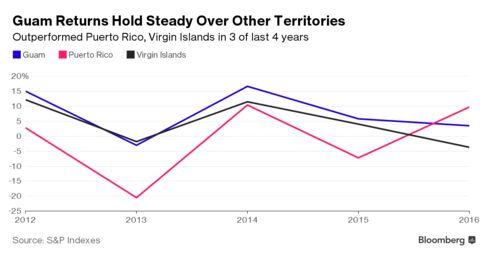
With an active military presence of about six thousand personnel already stationed on the island, Guam’s financial resume reads a bit differently than its Caribbean territory counterparts of Puerto Rico and the U.S. Virgin Islands, both of which have been plagued with debt amid population declines and chronic budget deficits. Guam’s $1.1 billion of debt, issued by various arms of the government, amounts to some $6,000 per person; far less than Puerto Rico’s $20,000 and the Virgin Islands’ $23,000. Guam has posted eight consecutive years of economic growth through 2014, according to the Bureau of Economic Analysis, as well as an expanding population, which could increase even more as military personnel and their families spill over from Japan.
Guam’s bonds maturing in 2039 have rallied over the past year, coming off of a peak yield of 4.15 percent in September. They last traded at an average yield of 3.24 percent, or 1.81 percentage points above benchmark securities, data compiled by Bloomberg show. For some investors, though, that yield premium isn’t enough, as Promesa still creates some pressure for the territory.
"It may or may not be enough at the moment," said David Ashley, a Santa Fe, New Mexico-based portfolio manager at Thornburg Investment Management, which holds some Guam Section 30 debt among its $12 billion in munis. "There should be more of a risk premium on Guam."
Territory officials have been meeting with investors in the U.S. ahead of the sale to quell concerns. Jay Rojas, administrator of the Guam Economic Development Authority, said that they are delivering the message that Guam’s economic outlook is strong and just because Promesa passed, the Pacific territory shouldn’t be viewed negatively.
"Guam’s story is good," Rojas said. "We are unique, we are different, we are alive."
Talks of the military relocation started back in 2006, when territory officials estimated that the move could bring in as much as some 19,000 people between the Marines, their dependents, and other government workers. That projection has since been scaled back several times, with Rojas now estimating an increase of 7,000 to 9,000 by 2028 once the 13-year, $8.7 billion project is complete.
"We’re not speculating," said Ted Chapman, another analyst for S&P. "The final impact and deadline is just potentially a moving target."

Guam Downplays Puerto Rico Risk Amid Return to Municipal Market

Tuesday, August 02, 2016

Puerto Rico bondholders devastated, but see hope in US plan

Attorney Santiago Mari sighed as he punched numbers into his calculator and saw the result.
The value of his retirement account has dropped 75 percent due to the collapse in Puerto Rican bonds that make up much of his personal portfolio, he said. He’s long abandoned plans for an early retirement. And he’s far from alone.
“You have a whole lot of Puerto Ricans who invested millions of dollars in bonds that they’re unable to sell,” said Puerto Rico financial adviser Jose Ivan Acosta.
While hedge funds hold much of Puerto Rico’s troubled debt, individual investors own an estimated $15 billion in bonds — 22 percent of the island’s overall $68 billion public debt. Many eagerly bought Puerto Rico bonds because they are exempt from state, local and federal taxes and were widely considered safe.
“They made it sound like it was the last remaining Coca Cola in a desert, that it was safe because it was backed by the government,” Mari said.
That changed as the U.S. territory’s government and its public utilities piled on debt to cover deficits during a 10-year economic slump. New taxes and higher utility rates pushed businesses to close and the tax base dwindled as more than 200,000 Puerto Ricans left for the U.S. mainland. With falling revenue, the government this year imposed a debt moratorium after a series of defaults on bond payments that began last year.
Prices for Puerto Rican bonds have plummeted, devastating many investors in Puerto Rico and on the mainland. Some have had to delay retirement, find alternative sources for their children’s college funds or rejoin the workforce.
“My dream was to retire at 55 years old, and I worked hard for that,” said 57-year-old Eduardo Rodriguez, a former maintenance worker who now works in a supermarket. “What can I do? They say men don’t cry, but we do.”
Many hold out hope that a new federal aid package signed by President Barack Obama in June will at least limit their losses. The measure creates a federal control board to oversee Puerto Rico’s finances, supervise some debt restructuring and negotiate with creditors. Puerto Rico bonds rallied by some 20 percent that day and remained at that level even after the governor announced a moratorium on general obligation debt, Acosta said.
The news has encouraged Mari who, unlike some of his friends, has retained his bonds.
“I still have hope within my despair,” Mari said. “The solution has to come from the outside. If it’s left in local hands, they will plunder what little remains.”
While it’s too early to know what changes the control board will implement, a restructuring process of any kind would be positive, Acosta said.
“Honestly, anything is better than what we have right now,” he said.
Some analysts cautioned about reading too much into the bond price rally, however.
“It was a momentary, reflex reaction as opposed to a market-moving event,” said Jim Colby, who runs the $2.2 billion VanEck Vectors High Yield Municipal Index, an exchange-traded fund in New York.
He said Puerto Rico general obligation bonds, which many consider Puerto Rico’s safest, are trading at around 65 cents on the dollar, and that future prices might be close to that. But “there’s really no telling right now what kind of haircut, what kind of valuation is going to be given to any of the bonds of any of the series that are currently outstanding but not paying their interest.
“It’s going to be a long time before we really have a clear picture,” he added.
Of the estimated $15 billion debt held by Puerto Rico investors, $3.8 billion of the original $7 billion issued belongs to the Government Development Bank, which is operating under a state of emergency, and another $1 billion to the Public Finance Corporation, which was the first government agency to default. Only a small portion represents general obligation debt that is expected to receive top priority once the anticipated restructuring begins.
Raymond Watson, a former director of Puerto Rico’s Highway Transportation Authority, bought general obligation debt because he believed it was the most secure. The 80-year-old said he was aghast when the governor last month declared a moratorium on that debt even though it is supposedly backed by the island’s constitution.
“That is almost as sacred as the Bible,” he said, adding that he and his wife face high medical bills and worry about being forced to declare bankruptcy. “We are not indulging in any kind of luxuries. We have cut back greatly on eating out, even if it’s at Burger King. We used to take a cruise almost yearly. None of that. We are now prisoners in our own home.”
Watson holds out hope that the federal aid measures will help.
At a minimum, they could repair Puerto Rico’s credibility by stabilizing the island’s finances and providing long-overdue transparency, which in turn could help it re-enter the market and allow people to recuperate some of their investment, Acosta said.
That’s an encouraging prospect for Mari, who said some bonds he bought at $10 are now worth $1 or $2.
“I am holding on until the end,” he said. “The uncertainty is killing me.”
___
Danica Coto on Twitter: www.twitter.com/danicacoto
Copyright 2016 The Associated Press. All rights reserved. This material may not be published, broadcast, rewritten or redistributed.
By Danica Coto


In this July 26, 2016 photo, attorney Santiago Mari talks to a client in front of a federal courthouse in San Juan, Puerto Rico. He is one of tens of thousands of Puerto Rico bond holders who see a glimmer of hope in a new restructuring plan recently approved by the U.S. government that could help recover some of their losses. (Danica Coto/Associated Press)
Puerto Rico bondholders devastated, but see hope in US plan

Monday, August 01, 2016

The New Puerto Rico

The Puerto Rico you knew was a tropical destination. White sandy beaches and vibrant blue hues from the sky were the picturesque scene you’d expect. Pastel colored houses and people chattering about in the cobblestone streets of Viejo San Juan were just the norm.
The Puerto Rico I experienced two months ago was true to the new stigma of debt, poverty, and disparity. Everyone knows the U.S. territory is suffering with a debt toll of $70 billion. From years of mismanagement by the government, the people of Puerto Rico are left with this tiresome burden.
What news reports do not show is just how desolate Condado, Piñones, and Isla Verde have become. Granted I stayed mainly in the country’s capitol, where one would expect it to be populous and buzzing during the vacation season. Surprisingly, I saw nothing but vacant bars, restaurants, and rooftops during “happy hour”. Taxi drivers were nothing short of desperate for their next customer. It was apparent Puerto Rico had become deserted. Even as a first timer I knew something was off. It wasn’t until my friend said, “Last time I came here there were so many people. I’ve never seen the streets so empty” that I came to terms with how bad the island was suffering.
The debt crisis in Puerto Rico has not only crippled the country but it has crippled the tourism industry tenfold. Abandoned hotels and apartment complexes stood high while overlooking the North Atlantic Ocean. Endless “For Sale” signs displayed without a consumer base financially able to buy. The most shocking part was the actual absence of tourists. Puerto Rico is no longer the quick Caribbean getaway it once was. While close in proximity to the United States it is apparent we aren’t going there. Not only have the Puerto Rican government and its people given up but Big Brother America has closed its doors as well.
Puerto Rico cannot sustain a tourism industry when their own flee to the United States to seek refuge for the centuries old notion of the “American Dream”. Puerto Rico is in crisis and they need help.
Manessa Lo.
The New Puerto Rico