Saturday, April 02, 2016

Puerto Rico denies market rumour

Alive (but not quite well).
Puerto Rico’s de facto finance authority said that it would not shutdown or be privitised amid a flurry of market rumours that legislation to do just that was set to be introduced on Friday.
The Government Development Bank for Puerto Rico faces a $422m bond payment that officials on the island have warned it may be unable to make. A default on the group’s debt could cripple activity on the island, US capital markets correspondent Eric Platt reports.
Melba Acosta Febo, president of the GDB, said:
This irresponsible rumour is damaging to the Bank as an institution, as well as needlessly harmful to our employees and their families. Bank management has met with employees and informed them that, due to the fragility of the Bank’s liquidity, all available options are currently being reviewed.
She added:
It is important that everyone in Puerto Rico understand that the GDB’s fiscal standing, as well as the Commonwealth’s fiscal standing, is delicate due to the fiscal crisis we are confronting. For this reason, the GDB’s Board of Directors and management continue to urgently evaluate all available options to safeguard public finances. We will continue to move forward on several initiatives simultaneously as no final decisions have been made at this time.
Bonds sold by the bank that mature in 2023 last traded at 21 cents on the dollar. At the start of 2015, the bonds were valued above 60 cents on the dollar.

Puerto Rico denies market rumour

Puerto Rico Credit Union Builds Confidence With A New Headquarters [Radio]

STEVE INSKEEP, HOST:

People in Puerto Rico have learned to live with an economic crisis. The government there says it can't pay its bills. Unemployment is high. Banks are trying to keep their customers from panicking. So how do you do that? You know, you say, don't panic. It gets people thinking about panic. Robert Smith of NPR's Planet Money podcast reports from Puerto Rico.

ROBERT SMITH, BYLINE: Nobody wants to leave their money with a nervous banker. And so in Puerto Rico these days, if you are responsible for millions of dollars of deposits, you try to project some confidence. For instance, in the tiny town of Corozal, the head of the credit union is the only one on the plaza wearing a tie. Eddie Alecea strolls with the sidewalks, waves at all his customers, the people who work in the rosary story, the bus driver.

EDDIE ALECEA: The driver's a member of our institution, too.

SMITH: It's all good, even though there are plenty of reasons to worry.

Around the square there are empty storefronts

ALECEA: Yes. It's a lot of places empty. That was Payless.

SMITH: Payless shoe store.

ALECEA: Yes, Payless shoe store. The next is Banco Santander, also closed last year.

SMITH: And then there is the scariest thing of all. Eddie's credit union lent a lot of money to the Puerto Rican government - bought bonds. All the banks and all the credit unions did. And last year, the government said, yeah, we're not going to be able to pay all that money back. All across the island, people started to ask, wait a minute. If I put my money in the credit union and they put it in government bonds, is the money still there? One retiree, Salma Carthegna, remembers sitting with her friends for lunch when they heard the news.

SALMA CARTHEGNA: My friends said that if I have money in a cooperativa...

SMITH: A credit union.

CARTHEGNA: I should take my money out because my money was not safe anymore.

SMITH: Big banks in Puerto Rico are backed by U.S. government insurance, the FDIC. But the cooperativas, which serve about a third of the island, are not covered by the FDIC. They have a local form of insurance. So Salma rushed down to her credit union and found a line of people all wondering if their money was safe.

CARTHEGNA: They were worried. I was worried.

SMITH: This is the crucial moment for any banking institution. The country was on the verge of a panic. And the classic way to handle this is just to project calm. In Corozal, Eddie Alecea put out an order. If anyone wanted to take their money out, they had to come look him in the eye. Eddie says he'd sit down with them, open the big accounting book and show them everything.

ALECEA: If I told you that we are growing, you are going to understand that this institution is going to continue doing business for the next years.

SMITH: And just in case, behind the scenes Puerto Rico's credit unions were starting to work together. They were calling each other, offering to share cash in case one branch had too many withdrawals. Aurelio Gonzales runs a credit union outside of San Juan, and he said if he needed it, he could have had armored trucks deliver more money within an hour. But what he really worried about was some other branch starting a bank run.

AURELIO GONZALES: I do my best here, but I can't control the other credit unions.

SMITH: Because all it takes is for one credit union to lock the doors and put up a sign that says, we'll be back tomorrow.

GONZALES: Yes. That's the problem.

SMITH: Only a few of his customers pulled out in the end. But it could start all over again if the government of Puerto Rico defaults on more bonds. Back in Corozal, Eddie Alecea is not taking any chances. After we walk around the plaza, he shows me a construction project, their new headquarters for the credit union.

Is part of this to build confidence?

ALECEA: It's part of our expression of how solid is our institution.

SMITH: In the world of banking, looking solid is most of the fight. Robert Smith, NPR News.

Copyright © 2016 NPR. All rights reserved. Visit our website terms of use and permissions pages at www.npr.org for further information.
NPR transcripts are created on a rush deadline by a contractor for NPR, and accuracy and availability may vary. This text may not be in its final form and may be updated or revised in the future. Please be aware that the authoritative record of NPR’s programming is the audio.
As Puerto Rico faces a debt crisis, the island's banking institutions are trying to keep their customers calm. One great trick: making your building look solid.

Puerto Rico Credit Union Builds Confidence With A New Headquarters

Puerto Rico Says Government Development Bank Will Stay Open

Puerto Rico’s Government Development Bank will stay open and is examining all available options to improve its liquidity, according to Governor Alejandro Garcia Padilla.
The GDB, which lends to the commonwealth and its municipalities, owes investors a $422 million bond payment May 1 that Garcia Padilla has said can’t be paid. Officials are negotiating with investors to restructure the bank’s obligations and potentially enter into a forbearance agreement that would put off legal suits, Garcia Padilla told reporters Friday in San Juan.
“The rumors that the GDB will close are misleading and put in jeopardy the efforts of this administration to reach an agreement with bondholders,” the governor said. “We are doing all we can to avoid a receivership of the GDB.”
The commonwealth’s Commission of Financial Institutions, the bank’s regulator, stated in its most recent review of the GDB that the bank is insolvent and will face a liquidity shortfall of $1.3 billion in June. That determination allows the island’s Treasury Secretary to ask a court to appoint a receiver to oversee the GDB. It’s a move the administration has said it won’t make at this time. The bank in November warned that it was at risk of receivership.
“GDB representatives continue to engage with a considerable group of our creditors about the restructuring of the GDB’s debt,” Melba Acosta, the GDB’s president, said in a statement Friday. “As we have stated publicly, the government is also considering additional measures to address this situation, such as declaring a temporary moratorium on payments, and amending the GDB charter.”

Congressional Bill

The GDB serves as Puerto Rico’s financial adviser and structures municipal-debt sales for the island. The bank’s cash crunch has hampered its ability to lend to the commonwealth and provide short-term funds. The bank is also overseeing negotiations with creditors to reduce the island’s $70 billion debt load. Puerto Rico’s economy has struggled to grow since 2006 and 45 percent of residents live in poverty. With an 11.7 percent unemployment rate, people are leaving the island to find work on the U.S. mainland.
The House Natural Resources Committee Tuesday made public adiscussion draft of a bill that would set up a federal control board to oversee any debt restructuring and review yearly budgets. After the May 1 GDB payment, Puerto Rico and its agencies will owe another $2 billion of principal and interest.
“It is important that everyone in Puerto Rico understand that the GDB’s fiscal standing, as well as the commonwealth’s fiscal standing, is delicate due to the fiscal crisis we are confronting,” Acosta said. “For this reason, the GDB’s Board of Directors and management continue to urgently evaluate all available options to safeguard public finances.”

Wal-Mart Decision

The GDB is experiencing a liquidity shortfall that will reach a negative $1.3 billion in June, according to a Monday court opinion of Wal-Mart Stores Inc.’s successful suit against Puerto Rico to end a tax that applied its highest rate on the retailer. The opinion quoted from the commission’s November report, which isn’t public.
The commission’s report found that the bank’s “liquidity levels are critically deficient in relation to its weakened financial conditions caused by an elevated debt exposure and obstructed access to capital markets,” the court opinion quoted from the report.
The bank has disputed the findings. Acosta is cited in a footnote in the report as saying the report was “obviously written by someone who doesn’t understand the GDB.”
Michelle Kaske and Alexander Lopez

Puerto Rico Says Government Development Bank Will Stay Open

Draft House Legislation Falls Short of Priorities for Puerto Rico

Congress should not lose sight of key conservative priorities as it considers whether (and how) to respond to the economic and fiscal crisis in Puerto Rico. The troubled territory has been a laboratory for progressive politics and crony capitalism for decades. Predictably, the government has smothered the private sector, and workers receive a lower share of income in Puerto Rico than in any of the 50 states.[1] Puerto Rico needs to be reformed, not rescued.

A discussion draft recently circulated by the House Committee on Natural Resources contains both good and bad policy ideas.[2] This Issue Brief reviews the draft in the context of conservative priorities and proposes a modest way forward.

Oversight Board

The discussion draft is built around the creation of a powerful Oversight Board, modeled after the District of Columbia Financial Responsibility and Management Assistance Authority, which achieved a notable turnaround for the federal district from 1995 to 2001.

Such a powerful board—with authority to invalidate fiscal acts of Puerto Rico’s legislature and to enact its own—should be considered with caution. Although neither political party in Puerto Rico has shown the capacity to curb the Commonwealth’s bureaucracy or replace its progressive, crony-capitalist economic framework, effectively overruling elected officials should be a last resort.

The current discussion draft gives the Oversight Board enough power to be blamed for failure, but potentially too little power to succeed. Merely balancing its budget will not move Puerto Rico toward sustained growth and might accelerate emigration by increasing tax collection without economic reforms that make it easier to work and do business.

If Congress leaves economic reform to Puerto Rico’s elected legislature, it should also leave budgetary decisions to that body so that the predictable continued decline of the island’s economy can be properly blamed on the relevant decision makers. A half-empowered Oversight Board could be worse than the status quo.

Conservative Priorities

Putting aside the question of whether or not to create an oversight board, Congress should focus on three priorities in considering potential legislation:

1. Offering No Bailouts. The discussion draft does not contemplate any direct bailouts and thus meets this key conservative priority. Congress should continue to stand firm and set a clear precedent that local governments and creditors can expect no financial help from Washington to cover their mistakes. Proposals to increase transfer payments to Puerto Rico are indirect bailouts and ought to be refused as well.

2. Promoting Reforms. The discussion draft instructs the Oversight Board to pursue several vital reforms of public administration. However, it misses most opportunities for economic reform.

  • Good ideas in public administration included in the draft:
    • Requiring current audited financial statements.
    • Requiring more accurate and uniform disclosure of Puerto Rico’s unfunded pension liabilities.
    • Providing a strong budgeting commitment mechanism.
    • Instructing the Oversight Board to help Puerto Rico overhaul its budget process.
  • Additional reforms Congress should consider:
    • Unwinding or privatizing public corporations where possible.
    • Requiring reforms in other areas of public administration, such as by drastically reducing the number of political appointments, enacting civil service reform, de-unionizing Puerto Rico’s public employees, and establishing serious penalties for corruption.
    • Merging the three budgetary institutions of Puerto Rico’s government, which currently share information poorly: the Government Development Bank, the Office of Management and Budget, and the Department of Treasury.
    • Requiring more accurate and uniform disclosure of municipal and state unfunded pension liabilities nationwide as a condition of receiving preferential tax treatment.
On economic reforms, the discussion draft gives the Oversight Board no authority to change non-budgetary laws, and exempts Puerto Rico from only one of the onerous federal requirements that hamper its development.

  • Good ideas included in the draft:
    • Exempting Puerto Rico from the Department of Labor’s overtime rule.
    • Expediting permitting for infrastructure projects.
  • Additional reforms Congress should consider:
    • Exempting all workers (or at least those up to age 30) from the federal minimum wage. Merely extending the training wage in Puerto Rico is a trivial gesture that will not help workers or employers.
    • Exempting Puerto Rico from the job-killing, price-inflating maritime Jones Act.
    • Encouraging fixes to the problems identified in the World Bank’s “Doing Business” and “Paying Taxes” reports.[3]
    • Eliminating lack of English language fluency as a basis for federal disability insurance.
    • Prioritizing reform of economic regulations equally with changes to fiscal laws and policies.
3. Maintaining Legal Continuity. The discussion draft drastically alters legal claims by retroactively applying proceedings substantially equivalent to 26 U.S.C. Chapter 9 bankruptcy to all of Puerto Rico’s debts within the auspices of the Oversight Board. Puerto Rico does appear to lack the resources to make all the payments it has promised, and will thus continue to default on some payments. Congress should not give Puerto Rico extraordinary legal protections from its creditors. Such an unprecedented federal intervention between debtor and creditor could set a dangerous precedent for other troubled state and local governments, and thus severely disrupt the municipal bond market.

There is a legitimate worry that litigation over the 18 different bond classes could take years to settle in courts. An appropriate response for Congress is to offer Puerto Rico and its creditors tools that make it easier to reach an agreement. Neither an Oversight Board nor a future bankruptcy judge, however, should be given the coercive powers of Section 1129(b) of the Bankruptcy Code. Under 1129(b), if a municipality comes to an agreement with one party—such as the pensioners—the rest of the claimants can be forced to accept a default plan in which they had no say.

A far better approach would be to offer creditors the opportunity to vote unanimously to add retroactive collective action clauses to each existing bond indenture. Each class that approved such a clause would strengthen its ability to negotiate with a unified voice, and to accept a deal from the debtor without ever entering bankruptcy court. Such a proposal could help all parties avoid existing legal processes that are expensive and time-consuming.

Moreover, the draft institutes an immediate stay on litigation, effectively stripping creditors of their access to the courts for up to 18 months. During this time, there is nothing to prevent Puerto Rico’s government from defaulting on all its bond payments—about $7 billion—and digging successor governments into an even deeper hole. A stay such as this would set a dangerous precedent and send tremors through the municipal bond market across the United States.

The discussion draft achieves few successes in maintaining legal continuity. It misses the opportunity to improve the negotiating environment and it puts in place “super Chapter 9” bankruptcy proceedings akin to those proposed by the U.S. Treasury Department.

  • Good ideas included in the draft:
    • Requiring consideration of current audited financials before filing a bankruptcy petition.
    • Encouraging negotiation between debtors and creditors.
  • Bad ideas included in the draft:
    • An 18-month stay of litigation that strips a basic civil right from creditors and reduces the government’s incentive to negotiate deals.
    • Imposition of new “super Chapter 9” bankruptcy provisions that can effectively re-write bond contracts without creditor vote or approval.
    • Giving an Oversight Board unilateral authority to waive requirements and initiate bankruptcy proceedings.
    • Allowing, as in Chapter 9, for bankruptcy judges who are not bound, but merely guided, by the relative legal strength of various claims.

A Modest Fix

Congress does not have to solve all of Puerto Rico’s problems, but it can take limited steps that improve economic conditions and promote negotiated restructuring. In a limited approach, Congress could shelve the Oversight Board for the time being and leave bankruptcy law alone.

Modest but potentially successful legislation might consist of the following pieces:

  1. Federal Economic Reforms.
    • Make more accurate and uniform pension disclosure a condition of receiving preferential tax treatment for all municipal bonds so that potential investors know the true liabilities;
    • Allow local control of the minimum wage;
    • Craft exemptions from overtime rules and the maritime Jones Act.
  2. Instructions to Puerto Rico’s Legislature to Enact Some Simple Reforms.
    • Make available audited current financial statements;
    • End privileges that allow some customers free access to public utilities;
    • Enact a civil service law and reduce the number of political appointments to a few hundred.
  3. Negotiation Between Creditors and Debtors.
    • Offer creditors the opportunity to vote to add retroactive collective action clauses to each existing bond indenture.
Such a narrow approach would not solve all of Puerto Rico’s problems, but it would leave legal claims intact and would only limit Puerto Rico’s self-government by requiring basic good-government reforms. Congress can easily attach future financial sanctions to guarantee that the legislature enacts reforms promptly.

Conclusion

Rather than reaching for a high-risk solution to the entire crisis, Congress could focus on taking a few certain steps and following up as necessary. Whatever scope is chosen, though, Congress must avoid bailouts, promote pro-growth economic reforms, and maintain continuity in legal rights.

—Salim Furth, PhD, is Research Fellow in Macroeconomics in the Center for Data Analysis, of the Institute for Economic Freedom and Opportunity, at The Heritage Foundation. Rachel Greszler is Senior Policy Analyst in Economics and Entitlements in the Center for Data Analysis.

About the Author

Salim Furth, Ph.D.Research Fellow, Macroeconomics
Center for Data Analysis
Rachel GreszlerSenior Policy Analyst, Economics and Entitlements
Center for Data Analysis
By Salim Furth, Ph.D. and Rachel Greszler

Draft House Legislation Falls Short of Priorities for Puerto Rico

Friday, April 01, 2016

UPDATE 1-Puerto Rico's PRIFA bond trustee files for $6.4 mln insurance payment

The trustee for bonds issued by Puerto Rico's PRIFA infrastructure authority said in a statement on Thursday it filed an insurance claim for $6.393 million for unpaid debt under a policy written by Financial Guaranty Insurance Company.

U.S. Bank Trust National Association, the trustee, reported on Jan. 5, 2016 that PRIFA had failed to make a full payment on special tax revenue bonds, some of which were insured by FGIC. The bond payments were officially due on Jan. 1, 2016.


"The Trustee submitted a claim under the FGIC Policy for a $6,393,666.43 deficiency for the interest payments due on the Bonds," said U.S. Bank.

"Such deficiency was slightly less than the total interest amount due, as the Trustee had residual amounts on hand which it allocated pro rata across all the Bonds entitled to payment of interest," the bank added.


The claim was filed for PRIFA's Series 2005A-C bonds. The claim payment in respect of unpaid interest is roughly 22 percent, according to data filed by the trustee. The unpaid interest claim on the 2005A series was $417,483.36 while the unpaid interest claim on the 2005C series was $989,123.25.


In January U.S. Bank also said there were insufficient funds for payouts on Series 2006 bonds, however Thursday's statement made no mention of that series. At the time, U.S. Bank said the expected non-payment for all three bond series was expected to be about $36 million.

U.S. Bank said it set April 11, 2016 as the Special Record Date, and April 12, 2016 as the Special Payment date. (Reporting By Daniel Bases; Editing by Chizu Nomiyama and Meredith Mazzilli)

UPDATE 1-Puerto Rico's PRIFA bond trustee files for $6.4 mln insurance payment

REFILE-Puerto Rico's PRIFA bond trustee files for $6.4 mln insurance payment

The trustee for bonds issued by Puerto Rico's PRIFA infrastructure authority said in a statement on Thursday it filed an insurance claim for $6.393 million for unpaid debt under a policy written by Financial Guaranty Insurance Company.

U.S. Bank Trust National Association, the trustee, reported on January 5, 2016 that PRIFA had failed to make a full payment on special tax revenue bonds, some of which were insured by FGIC. The bond payments were officially due on Jan. 1, 2016.


"The Trustee submitted a claim under the FGIC Policy for a $6,393,666.43 deficiency for the interest payments due on the Bonds," said U.S. Bank.

"Such deficiency was slightly less than the total interest amount due, as the Trustee had residual amounts on hand which it allocated pro rata across all the Bonds entitled to payment of interest," the bank added.


The claim was filed for PRIFA's Series 2005A-C bonds.


In January U.S. Bank also said there were insufficient funds for payouts on Series 2006 bonds, however Thursday's statement made no mention of that series. At the time, U.S. Bank said the expected non-payment for all three bond series was expected to be about $36 million.

U.S. Bank said it set April 11, 2016 as the Special Record Date, and April 12, 2016 as the Special Payment date. (Reporting By Daniel Bases; Editing by Chizu Nomiyama)

REFILE-Puerto Rico's PRIFA bond trustee files for $6.4 mln insurance payment

Puerto Rico `Not Serious' on Consensual Plan, Says Insurer

Assured Guaranty Ltd. is seeking financial information from Puerto Rico, and is looking to Washington for help.
The bond insurer, which guarantees repayment on about $3.8 billion of commonwealth securities, sent a letter Wednesday addressed to Cleary Gottlieb Steen & Hamilton LLP, which is representing Puerto Rico in its attempt to restructure $70 billion of debt, detailing multiple requests for information. The letter signed by Bruce Stern, Assured’s executive officer, was also sent to U.S. Treasury Secretary Jacob J. Lew, House Speaker Paul Ryan and other federal lawmakers working on legislation to address the island’s fiscal crisis.
Assured says that it has failed to receive complete financial information that it is entitled to as insurer of commonwealth securities after repeated appeals during the last 18 months, beginning with a request for Puerto Rico Highways & Transportation Authority maintenance agreements in September 2014. Assured is also seeking current balances for accounts that repay Highways debt and Puerto Rico Convention Center District Authority bonds after the two agencies began using reserve funds to make their Jan. 1 debt-service payments. Assured needs the data to plan for possible draws on its insurance policies, Stern wrote in the letter.

Oversight Bill

“The financial situation of the commonwealth and its public agencies remains opaque,” Stern said. “In the absence of a legitimate reason for this opacity, Assured is left to speculate what ulterior purpose the continued refusal to provide basic and readily-available financial information serves.”
Stern sent the letter as the House Natural Resources Committee plans to introduce on April 11 its bill that would establish a federal oversight board to manage any Puerto Rico debt restructuring and weigh in on annual budgets. The goal is to end the commonwealth’s practice of borrowing to fill budget deficits. U.S. territories, including Puerto Rico, don’t have access to municipal bankruptcy.
Puerto Rico has been in discussions with Assured and its advisers during the last two years as part of financial diligence on a variety of commonwealth issuers and to work out a restructuring plan, Barbara Morgan, a spokeswoman at SKDKnickerbocker in New York, which represents Puerto Rico’s Government Development Bank, said in an e-mail.
“The timing of Assured’s letter is no doubt part of their lobbying strategy on the Hill against the Natural Resources Committee’s proposed legislation, but its allegations about the commonwealth stonewalling and withholding information are baseless,” Morgan said.
Betsy Nazario, a spokeswoman at the GDB in San Juan, and Shannon Lynch, a spokeswoman at Cleary Gottlieb, didn’t immediately return phone calls and e-mails.

Creditor Counterproposal

Governor Alejandro Garcia Padilla in June said the island was unable to repay its obligations on time and in full. Two agencies have missed bond payments since then and the government has redirected revenue from the Highways and Convention Center authorities to instead pay general-obligation bonds, which have the highest priority under its constitution.
Creditors, including mutual funds, bond-insurance companies, and hedge funds are working together on a unified counterproposal that would reduce Puerto Rico’s debt after island officials last week offered their latest debt-restructuring plan to the different parties. Puerto Rico has said it wants to reach an agreement with its creditors, an assertion that Stern questions.
The responses of Cleary Gottlieb, Puerto Rico and the island agencies, “suggests the commonwealth and its public corporations are not serious about working towards a meaningful consensual restructuring,” Stern wrote.
Assured guaranteed about $3.8 billion of Puerto Rico securities, as of Dec. 31, as measured by gross par outstanding, according to financial documents on the company’s website.
Michelle Kaske

Puerto Rico `Not Serious' on Consensual Plan, Says Insurer

Tuesday, March 29, 2016

U.S. Supreme Court takes up Puerto Rico bribery case

The U.S. Supreme Court on Monday agreed to consider a former Puerto Rico state senator's claim that he cannot be retried on corruption charges involving a trip to Las Vegas to watch a boxing bout after his original conviction was thrown out.

The court said it would hear an appeal filed by Hector Martinez Maldonado, who served in Puerto Rico's Senate from 2005 until his 2011 conviction, and businessman Juan Bravo Fernandez, the former president of a private security company.

Bravo Fernandez sought to bribe Martinez Maldonado in order to win passage of bills that would benefit his business, according to prosecutors. The case focused in part on allegations that Bravo Fernandez paid for Martinez Maldonado to travel to Las Vegas in 2005 to watch a boxing match involving Puerto Rican fighter Felix "Tito" Trinidad.

In 2011, both were convicted for their role in the alleged bribery scheme, but the Boston-based 1st U.S. Circuit Court of Appeals threw out their convictions in 2013.

Federal prosecutors said they would seek a new trial. But Martinez Maldonado and Bravo Fernandez said a new trial should be barred because it would violate the constitutional protection against "double jeopardy," which prevents people from being tried on charges for which they already have been acquitted.

Their lawyers say double jeopardy applies because the jury had acquitted the two men of some of the criminal charges concerning conduct closely related to the actions on which the retrial would be focused.

The appeals court ruled in favor of the prosecution last year.

It is the third case concerning Puerto Rico that the Supreme Court has taken up recently. Last week, the justices heard oral arguments over the U.S. Caribbean territory's bid to revive a law that would allow it to cut billions of dollars in debt at public utilities..

The court is also considering a second criminal case that concerns double jeopardy.

The case the court agreed to hear on Monday is Bravo Fernandez v. United States, U.S. Supreme Court, No. 15-537.

(Reporting by Lawrence Hurley; Editing by Will Dunham)

By Lawrence Hurley

U.S. Supreme Court takes up Puerto Rico bribery case

'Hamilton' creator writes testament to Puerto Rico debt pain

The composer and star of "Hamilton," one of Broadway's most popular musicals, is ramping up his call for Congress to provide relief to debt-ridden Puerto Rico.

In a New York Times op-ed published Monday, Lin-Manuel Miranda asked that the commonwealth, home to more than 3.5 million people, be afforded the same options as a U.S. city or state.
"If Puerto Rico were an American city, it could declare bankruptcy, as Detroit did in 2013," Miranda wrote. "If it were a state, the federal government would surely have already declared emergency measures to help the most vulnerable. But since it is a territory of the United States, there is no system in place to handle the financial and humanitarian crisis that is happening right now."
Both Democrats and Republicans, from House Speaker Paul Ryan to Sen. Elizabeth Warren, have expressed support for action that would offer the island, where Miranda's parents were born, a lifeline. But with more than $70 billion in debt obligations and economic misery mounting, the process appears stalled.
In his Times piece, Miranda quotes from the real Alexander Hamilton's famous plea, delivered in a letter from his home in St. Croix in the Virgin Islands amid hurricane devastation nearly 250 years ago, when he asked, "O ye, who revel in affluence, see the afflictions of humanity and bestow your superfluity to ease them."
Earlier this month, the playwright went to Washington to stand with Senate Democrats pushing a bill that would allow the commonwealth to declare bankruptcy.
"What we need is the ability to restructure and get Puerto Rico out of the hole it's in," said Miranda, joining Warren and N.Y. Sens. Chuck Schumer and Kirsten Gillibrand at a news conference. "So I'm urging Congress. If Hamilton tickets will help, I'm happy to do that too."
'Hamilton' creator writes testament to Puerto Rico debt pain

Puerto Rico’s Debt Crisis

Re “A Lifeline for Puerto Rico” (editorial, March 13):
As stakeholders work toward a solution to Puerto Rico’s debt crisis, it is critical that we adhere to the principle that any restructuring should require the approval of a majority of creditors and should respect the rights and concerns of all creditor classes.
In contrast, any House bill that does not permit fair negotiations and instead includes the “cram down” provisions favored by the Obama administration that would force nonconsensual debt restructurings on creditors will fail to preserve Puerto Rico’s access to the capital markets, which is critical for the commonwealth’s economic future and its ability to meet citizens’ needs. It would also fail to address the fundamental operational and fiscal problems that have hamstrung Puerto Rico’s economy.
With the right structure in place, fair deals can be reached between the commonwealth and its creditors. A case in point is the restructuring agreement reached between the Puerto Rico Electric Power Authority and its creditors that I helped negotiate. This nearly $8 billion deal provides a good precedent. It was approved last month by the Puerto Rican legislature and is progressing well.
Any legislation must include the ability to reach and preserve consensual deals like this and allow all stakeholders to work toward a successful resolution of Puerto Rico’s debt issues.
STEPHEN SPENCER
Minneapolis
The writer is a financial adviser to major creditors of Puerto Rico.
Puerto Rico’s Debt Crisis - The New York Times

Federal Judge in Puerto Rico Calls Walmart Tax Unlawful

A federal judge in San Juan on Monday threw out a new tax that Puerto Rico had tried to impose on the American retailing giant Walmart, calling it unlawful.
Walmart had argued that the new tax would confiscate more than 100 percent of its profit from operations in Puerto Rico, making it one of the most onerous taxes on earth.
The judge, José Antonio Fusté of the United States District Court in Puerto Rico, said in his opinion on Monday that it gave him no pleasure to throw out the tax, considering the commonwealth’s dire financial condition. But he said it was unlawful and that Puerto Rico’s crisis was not an excuse “to take revenue that it’s not entitled to, to pay for essential services.”
The new tax was more than triple the old rate, he said, “designed to capture Walmart Puerto Rico, the biggest fish in the pond.”
If Walmart paid it on time, and waited to get a refund through the usual channels, it would most likely never see the money again, he added.
Puerto Rico is expected to go through a court-supervised debt restructuring soon, and any request for a tax refund from Walmart would almost certainly get lost in the crowd of bondholders, labor unions, lawyers and others jockeying to recover their money.
Walmart expressed satisfaction with the decision. “Today’s ruling is a victory not only for Walmart Puerto Rico but also for our customers, our more than 14,000 Puerto Rican associates, and the many Puerto Rican suppliers and farmers who depend so heavily on us,” Lorenzo Lopez, a spokesman, said.
The company did not explicitly threaten to leave Puerto Rico if it did not prevail, but it did argue in court that no business could operate for long in a place that confiscated all of its profit.
Walmart, based in Bentonville, Ark., is Puerto Rico’s largest employer outside the government, operating 48 large, busy stores under several names. People joke that since Walmart’s arrival on the island in 1992, they no longer have to go anywhere else, because they can eat all their meals and buy everything they need there.
Walmart is also the island’s biggest remitter of tax revenue. About $15 billion of Puerto Rico’s outstanding debt is backed by a dedicated sales tax that Walmart helps to collect.
Juan Zaragoza, Puerto Rico’s treasury secretary, said in a statement that the treasury believed the federal court had no jurisdiction and should not have handled the case.
“For this reason, from the beginning, we contemplated the possibility of appealing a decision unfavorable to the interests of the people of Puerto Rico,” Mr. Zaragoza said. Officials were still analyzing the lengthy opinion, he said, but would appeal soon. “We will raise on appeal all the procedural errors that, in our opinion, took place during the trial,” he said.
The dispute began in 2015, when Puerto Rico amended its alternative minimum tax for companies. That type of tax tries to catch those who might otherwise use loopholes to avoid paying what they owe. Companies calculate their taxes each way, then pay the higher amount.
The tax changes included a big increase in the rates for companies operating big-box stores on the island. Walmart said in its lawsuit that the highest new rate was reserved for businesses on the island with revenue of more than $2.75 billion, and the only company that met that description was Walmart.
Puerto Rico has had trouble balancing its budget every year for at least a decade. It accumulated a $72 billion debt, in part, by issuing long-term bonds just to get the cash to balance its budget, a practice widely considered unsustainable. At the time the legislature was amending the alternative minimum tax, it was trying to plug a $125 million budget hole.
Walmart also cited evidence that Puerto Rican lawmakers had sought to raise its taxes high enough to pay for other businesses on the island to get a tax reduction. Walmart argued that this violated its rights under the Equal Protection Clause of the United States Constitution, and Judge Fusté agreed.
Puerto Rican officials said the tax changes were appropriate because big companies like Walmart, with branches all over the world, let their supplier branches sell goods to their retail branches at artificially inflated prices. That made the retail outlets look as if they had little or no profits, and therefore had to pay little or no income tax.
They also said the case did not belong in federal court. The right procedure, they said, was for Walmart to pay its tax, apply for a refund and then, when that was denied, bring suit in a Puerto Rican court.
“That is true, so long as the tax-refund procedure will afford Walmart Puerto Rico a plain, speedy and efficient remedy,” Judge Fusté said.
He then described at length the way Puerto Rico has been “kiting checks,” shifting money from one creditor to pay another and “warehousing” money in a vault to claim that it had made payments without deducting the funds from its books.
“The government has been cannibalizing itself at an astonishing rate,” the judge said. He concluded that if Walmart paid the tax on demand, it would be sending the money to an insolvent government that would never pay it back.


A Walmart in San Juan, P.R. Walmart employs more than 14,000 people in Puerto Rico, second only to the government. Credit Dennis M. Rivera for The New York Times


Federal Judge in Puerto Rico Calls Walmart Tax Unlawful

Wednesday, March 23, 2016

As Cuba rises, Puerto Rico falls

President Barack Obama dangles U.S. dollars before the Castros while Congress stonewalls Puerto Rico’s pleas for debt restructuring. The Tampa Bay Rays take the field in Havana as San Juan fends off New York hedge funds wielding legal baseball bats. The Rolling Stones play a free concert for Cubans; Puerto Rico can’t get no satisfaction.

As Cuba rises and Puerto Rico falls, it’s worth considering the diverging trajectories of these two ex-Spanish colonies that the Puerto Rican poet Lola Rodriguez de Tio described more than 100 years ago as “two wings of the same bird.” Even as the resumption of diplomatic ties with the U.S. opens new possibilities for Cuba, Puerto Rico’s current status as a U.S. commonwealth has turned into an ugly dead end.

Puerto Rico is defaulting in slow motion on $70 billion worth of debt. Its economy has shrunk nine of the past 10 years. A few hundred kilometers to the west, meanwhile, economic reforms are creating new livelihoods for self-employed Cubans, whose material conditions are improving. Buoyed by the arrival of new tourists, remittances, and foreign investments, Cuba’s economy grew by 4 percent last year.

And when the U.S. embargo is lifted, Cuba — which for much of the 19th and 20th centuries was the Caribbean’s predominant economy — is likely to take a growing bite out of Puerto Rico’s fortunes, in tourism, manufacturing and services. And that’s before accounting for Puerto Rico’s existing fiscal straits, which will lead to shrinking government services, higher costs imposed by utilities under siege from creditors and a string of broken social promises and busted pensions.

True, Cubans don’t have democracy. Then again, at the national level, neither do Puerto Ricans: Despite being U.S. citizens, they can’t vote for president or in Congress, which these days mostly ignores them. Cubans may face the threat of arbitrary detention and abuse. But they’re much less likely than Puerto Ricans to be shot dead on the street, or to be victimized by drug traffickers or other criminals.

In fact, by many other yardsticks, you’re better off being born in Cuba than Puerto Rico. Don’t take my word for it. Look at the World Factbook put out by those raving socialists at the Central Intelligence Agency. Lower infant mortality? Check! Same with lower unemployment, higher literacy, and a lower overall death rate.

Things weren’t supposed to turn out this way for the island that President John F. Kennedy touted three months after the Bay of Pigs invasion as “a source of hope and inspiration to those of us deeply concerned with charting new courses of social progress for our Hemisphere.”

The proximate cause of Puerto Rico’s current distress is its crushing debt, which has tripled since 2000. And yes, irresponsible and corrupt legislators and executives (and the voters who elect them) deserve much of the blame.

But the larger problem has been Puerto Rico’s relationship with its federal overlords, who have oscillated between patronizing micromanagement and malign neglect — devising ill-suited development strategies, granting and then revoking economic benefits, imposing regulations that undermined the island’s competitiveness and creating disincentives for work.

Consider the Washington-backed effort to turn Puerto Rico into a manufacturing hub. During the late 1940s, U.S. companies were given federal and local tax breaks to locate on the island. But U.S. minimum wage laws and trade agreements with other nations gradually eroded Puerto Rico’s competitive advantages. Moreover, instead of investing in the island, U.S. companies brought their profits back to the mainland.

In 1976, the U.S. tried again, sweetening the pot for companies with the Federal Tax Reform Act. That created new jobs in chemicals, pharmaceuticals and electronics, but at huge fiscal cost as mainland corporations gamed tax laws. When the U.S. phased out the tax breaks, the island’s manufacturing employment took a big hit — a blow that Puerto Rico’s legislators are quick to blame for the island’s decline, not least because it conveniently absolves them for their own bad decisions.

The Republican-controlled U.S. Congress is now debating what to do about Puerto Rico’s fiscal mess. The island’s top officials have all but begged for the ability to restructure the debt of its municipalities under Chapter 9 of the U.S. bankruptcy code — a power Puerto Rico long had until Congress took it away. Better yet would be the ability also to restructure its general obligation debt, which it can’t realistically pay.

Congress seems unlikely to allow restructuring. Instead, the Republican majority wants to impose a fiscal control board that takes over Puerto Rico’s fiscal affairs. Analysts at Puerto Rico’s Center for a New Economy have argued against this approach’s “colonial and imperialistic overtones,” which also contradict the GOP’s devolutionary, small-government philosophy. Instead, they advocate passing a “fiscal responsibility law” with strict enforcement provisions.

As smart as this idea looks on paper, the island’s repeated failures to put its own fiscal house in order undermine that case. On the other hand, imposing a control board without granting debt relief risks accelerating Puerto Rico’s downward spiral.

That brings us back to the central question of Puerto Rico’s sovereignty. A control board for Puerto Rico would be all-too-consistent with its quasi-colonial status: Its legislators and executives behave irresponsibly in part because the buck doesn’t stop with them. The island depends on the federal government for a quarter of its revenues, on terms that Washington sets, while it’s straightjacketed by federal regulations that hurt its competitiveness and estrange it from neighboring economies.

Making Puerto Rico a state wouldn’t necessarily cure it of bad fiscal behavior (see: Illinois). And independence would bring huge challenges. But remaining a commonwealth isn’t working either. More than a half-century after JFK called Puerto Rico a “source of hope and inspiration,” its predicament should be a source of shame for every American. Its U.S. citizens have rates of poverty and unemployment that dwarf those on the mainland, and diminishing prospects that make a mock of the American Dream. They don’t even enjoy the full benefits of the U.S. Constitution.

Their lot won’t fundamentally improve until they seize control of their own destiny and choose between statehood or independence. And when they finally make that choice, Congress should honor it, either welcoming Puerto Rico as the 51st state or allowing it to be independent.

Once Cuba gained its independence from U.S. control in 1902, it became theoretically free to make its own mistakes, notwithstanding the colossus to the north looking over its shoulder. And Lord knows Cuba made plenty of them, even before its current detour through socialist privation and repression. Over the years, Cuba has nonetheless delighted in tweaking Uncle Sam in the United Nations over Puerto Rico’s “colonial” status, and is doubtless enjoying some quiet schadenfreude over its neighbor’s troubles.

Yet these two islands can lift each other up. In addition to their shared history and culture, they face some similar demographic and economic challenges, and have some complementary strengths — Puerto Rico’s pharmaceutical industry and Cuba’s nascent biotechnology sector, for instance. An unlikely partnership, perhaps. But as Obama has noted about Cuban policy, we know what hasn’t worked. Maybe it’s time to try something different for Puerto Rico too.

BY 
As Cuba rises, Puerto Rico falls

Friday, March 18, 2016

Puerto Rico needs freeze on lawsuits to face debt crisis: governor

The U.S. Congress must protect Puerto Rico from investor lawsuits so that the island's government can face a debt crisis and address what the U.S. territory's governor describes as a building humanitarian crisis, he said on Thursday.

Leaders in Congress agree that Puerto Rico needs an independent board to help face $70 billion in debt and a 45 percent poverty rate, but Governor Alejandro Garcia Padilla said the island needs more urgent help.

"Congress can legislate a stay on any legal action until that oversight board kicks in," Padilla told reporters on a conference call.

ADVERTISING
Financial woes mean Puerto Rico cannot confront the Zika virus as it should, Padilla said, citing estimates that more than 20 percent of island residents could be infected this year with the virus linked to birth defects.

School septic tanks, a mosquito breeding ground, are overflowing in Puerto Rico, which lacks money to pay contractors to empty them, Padilla said.

"The humanitarian crisis in Puerto Rico is real and continues to grow with each passing day."

The government of Puerto Rico highlighted the territory owes vendors, including those who provide gasoline to police and fire departments and maintain schools, $1.9 billion. In addition, it has yet to pay out $50 million in 2014 tax refunds.


The White House and Congress agree that Puerto Rico cannot face its financial crisis alone but leaders have not agreed on whether the island should be able to seek relief in the courts.

Puerto Rico cannot use bankruptcy laws to address its debt problems, tools that were available 20 years ago.

Paul Ryan, speaker of the U.S. House of Representatives, has promised to have a Puerto Rico rescue bill before the end of the month and Padilla has applauded that commitment.


That bill, though, will create an oversight board to negotiate with creditors rather than granting Puerto Rico immediate protection akin to bankruptcy, according to Congressional sources familiar with the draft legislation.

Democratic leaders this week outlined a different plan: allow Puerto Rico time, perhaps as much as a year, for some breathing room to work out a deal with a stay on its debt payments.

Republican and Democratic leaders, along with the Treasury Department, will likely have to hash out details of a bill but Padilla said granting a stay on investor lawsuits was a needed interim step.


Congressional Republicans working on the Puerto Rico legislation have not decided whether they have the authority to freeze investor lawsuits or whether doing so would cause more confusion, said the sources.

Puerto Rico negotiated a restructuring of debt owed by the power utility, known by its initials as PREPA, but even then it was a partial solution.

Padilla said PREPA, which accounts for 14 percent of the territory's overall debt load, took 19 months to reach a deal with 62 percent of the power utility's creditors.

"That is maybe the showcase on why Congress need(s) to approve the framework, the legal framework and to help with the holdouts," Padilla said. Negotiations are ongoing, he said.


(Reporting by Patrick Rucker in Washington and Daniel Bases in New York; Editing by Meredith Mazzilli and Matthew Lewis)

Puerto Rico needs freeze on lawsuits to face debt crisis: governor

Thursday, March 17, 2016

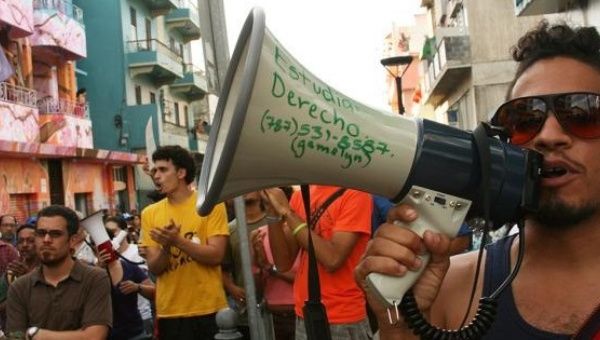
Puerto Rico Students Shut down University over Austerity Cuts

Thousands of college students from the University of Puerto Rico (UPR) approved a three-day, full-campus shutdown Tuesday to protest recent austerity measures, which they say endanger the higher education system.

The students held a general student assembly, after which they marched through the university and closed all entrances to the campus. The students also called for the resignation of top university officials and announced they would consider an indefinite strike if their demands are not met.

At about 6:00 am Wednesday, the eight gates of the UPR were closed a reported 1,968 students decided to demand the immediate payment of remittances to the UPR by the Department of Finance, and the elimination of the freezing of the so-called “formula 9.6%."

The formula 9.6% requires the state to assign the University of Puerto Rico 9.6% of its annual revenues. The basis of this law is that the state has the social obligation to invest in a public institution of higher learning, to create and maintain a state university, without which no modern society can prosper.

RELATED: Sanders Unveils New Puerto Rico Plan, Says No to Austerity

"We must ensure the public funding of the university and cuts cannot be accepted as a solution to the crisis," said Naphtali Sanchez, representative of education to the negotiating committee that was established Monday in the assembly.


General Assembly 2010 to vote whether or not to strike | photo:California Student Union Website /Oduarto Gamelyn

to the detriment of essential public services. In July, the government faces a debt repayment of US$1.9 Billion.

At the main entrance of the campus, the student Victor Velez Perez outlined some of the consequences the austerity measures have had on the quality of educational services during the past nine years.

RELATED: Why We Need to Ditch Austerity and Take on the Global 1%

"The administration is not guaranteeing us our own, permanent teachers. We need to have teachers who stay with us to foster that sense of permanence. Having contract teachers, transitory teachers, it affects our training," said Velez Perez.

At the meeting, the students also rejected a study commissioned by the Board of Governors of the UPR to the Association of Governing Boards of Universities and Colleges, which recommends consolidating functions of regional campuses, including other reforms.

A number of teachers have announced support for the strike, such as Professor Rafael Bernabe, a gubernatorial candidate for the Party of the Working People (PPT).


Student during 2010 anti-austerity protests in Puerto Rico.

Student during 2010 anti-austerity protests in Puerto Rico. | Photo: California Student Union Website /Oduarto Gamelyn


The students are calling for people all over the country to join the protest against "unpayable debt" and austerity.

Puerto Rico Students Shut down University over Austerity Cuts

Friday, March 11, 2016

House Republicans plan Puerto Rico bill markup in early April

Republicans at House Natural Resources Cmte plan to circulate draft components of Puerto Rico bill in next two weeks and make bill language public by March 31, according to a cmte aide.

  • Cmte will have legislative hearing and mark up the bill in early April, aide says
  • NOTE: House Speaker Paul Ryan urged committees with jurisdiction to come up with a solution to Puerto Rico’s fiscal problems by end of first quarter
    • Natural Resources Cmte Chair Rob Bishop said he considers creating oversight board with powers to help restructure some of Puerto Rico’s $70b debt
Kasia Klimasinska

House Republicans plan Puerto Rico bill markup in early April