Puerto Rico will need help from Washington to maintain future market access and avoid a descent into a "third-world" economic conditions, municipal bond fund managers said.
Puerto Rico's fiscal forecast grew cloudier with a $422 million default on Government Development Bank debt on May 2, municipal analysts said this week, as they waited for action from Congress.
Proposed legislation, which has been stalled since the House Natural Resources Committee cancelled an April 14 vote because of a lack of support, seeks to balance competing interests by creating an oversight board that can both get Puerto Rico's fiscal house in order and start a debt restructuring process.
The default on GDB debt worsened the island's already-bleak status as a municipal issuer, making the situation all the more urgent, fund managers said.
"If there is a major default, the federal government will have no choice but to guarantee P.R.'s bonds going forward if the [territory] ever expects to issue sizable debt on the open market," said David Tawil, president of Maglan Capital.
Tawil was among municipal experts asked to assess Puerto Rico's prospects of recovery and forecast the commonwealth's fiscal status five years from now. Some forecasts were dire, while others assumed government intervention would ameliorate problems. Most put the island's future ability to tap the bond market as a prime concern.
Tawil currently has no exposure to Puerto Rico debt and had been avoiding ownership for two and a half years. But he said that a series of factors, including the outcomes of Congressional bills, Supreme Court rulings, and the Presidential election, may convince him to re-establish ownership.
"A default on [General Obligation] debt would make such access near impossible as well as impede any stabilization to the recovery process," said Jeffrey Lipton, managing director, head of municipal research and strategy at Oppenheimer & Co.
Lipton, who declined to comment on his holdings, said the commonwealth must preserve its "issuance portal" at all costs.
"The GDB, which has historically acted as the Commonwealth's fiscal agent, has already been operating under a state of emergency with withdrawals limited to fund health care, public safety and education expenses so as to preserve extremely thin liquidity," Lipton said.
Following the latest default, Lipton said market attention has now shifted to July 1, when about $2 billion in debt service comes due. "There is growing concern over the status of the $805 million that is owed by the Central Government on GO debt," Lipton said. "The eventual fate of the GO debt service may also be influenced by the content of the Congressional legislation that we hope will find its way to the President's desk soon."
The climate and favorable geography of the island the commonwealth will always be a draw for tourism, but that won't be enough to turn around the economy, Tawil said.
"Unless there is a major stimulus from the U.S. federal government, in one form or another, the island will be a beautiful third-world country, with the majority of residents living in poverty and rife with crime," Tawil said. In the absence of federal stimulus, the local economy will lack the fiscal and economic strength to retain and attract talent, "and only those with no other option will remain."
Lipton predicted that remedial legislation would be the starting point for debt restructuring and potentially lead to a recovery.
"The debt solution should not take on a 'one size fits all approach' given the various structures, liens and revenue sources," Lipton said. "It must also provide the economic tools to reverse the course of outmigration and provide the necessary incentives to attract and retain a corporate presence that chooses to do business on island. There needs to be a more aggressive effort to flush out the underground economy and capture a meaningful percentage of this lost revenue."
In addition, Lipton said Congress should be moving more expeditiously to provide relief. "At the heart of the legislation will be the creation of a Federal Control Board," he explained. "This has been a key impediment to getting the legislation through as the Republicans want a much more powerful control board while the Democrats argue to preserve control within the hands of the Puerto Rico government."
Mark Tenenhaus, director of municipal research at RSW Investments, said the firm hasn't purchased any Puerto Rico debt since its inception in 2005. He said the island needs better tax collection policies and progress on pension funding to help re-establish the confidence needed for future debt acceptance and economic growth.
"While no bailout will be forthcoming from the federal government, some sort of bankruptcy-like scenario will ultimately be forthcoming – that is step 1," Tenenhaus said.
That, he said, could lead to an "orderly" transition to a new debt structure, though market access at reasonable levels is still in the distant future.
"It will also do nothing to set a framework for a fundamental change in the economy or fiscal affairs of the commonwealth," Tenenhaus said. "Resolving the pension issues are paramount and a source of potential ongoing discourse between bondholders and the commonwealth."
Tenenhaus said he doesn't see any near term solutions that would "halt the exodus of productive citizens to the mainland looking for better opportunities.
"Hopefully in five years," he added, "the beginning of economic recovery and structural general fund fiscal operations will be in evidence."
By Christine Albano
How Puerto Rico Can Avoid a Descent Into Third-World Economy
Saturday, May 14, 2016

Lawmakers Miss Their Own Deadline on Puerto Rico Debt Bill
House Republicans have missed a self-imposed deadline for a plan to help Puerto Rico manage $70 billion in debt.
By mary clare jalonick
Lawmakers Miss Their Own Deadline on Puerto Rico Debt Bill
Legislation was expected this week to create a control board to help manage the U.S. territory's financial obligations and oversee some debt restructuring. It would have been the third version of the House bill, which has come under fire from conservatives who feared it would set a precedent for financially ailing states and Democrats concerned the control board would be too powerful and favorable to creditors.
House Speaker Paul Ryan said in a statement Friday that Republicans want to ensure the bill is the "best, most responsible legislation to tackle Puerto Rico's fiscal crisis while protecting American taxpayers."
Ryan said negotiations continue with Democrats and the Obama administration on the issue. He said it will be introduced in "the coming days."
House Natural Resources Committee Chairman Rob Bishop, R-Utah, has led negotiations on the bill and has said he wants bipartisan support. The aim is to write legislation that could pass both the House and the Senate before Puerto Rico defaults on a $2 billion debt payment due July 1. The territory missed a nearly $370 million bond payment May 1 — the largest so far in a series of missed payments since last year.
In an interview Friday for C-SPAN's "Newsmakers" program, Bishop said he believes the House needs to move forward but lawmakers want to make sure the legislation doesn't have any remaining constitutional or legal issues.
"We have one shot at getting this right," Bishop said. "Once this bill starts moving I think it moves through Congress very quickly."
Bishop said the final version yet to be released will be similar to previous versions, including the control board setup.
"That basic concept of what we want to do has been agreed to by everybody that's a player, and so I think regardless of what the final version is, that structure will be there," Bishop said on C-SPAN.
He said the bill will not set a precedent for ailing states, as some have feared. He said the legislation is designed to apply only to Puerto Rico.
Puerto Rico has been mired in economic stagnation for a decade. Financial problems grew worse as a result of setbacks in the wider U.S. economy, and government spending in Puerto Rico continued unchecked.
Under the bill being drafted, the control board is expected to direct the island to create a fiscal plan, including adequate funding for pensions. The island has underfunded public pension obligations by more than $40 billion.
Creditors and some Republicans have expressed concern that they would take a back seat to the pension obligations, while the Obama administration has pushed to make sure that pensions are also a priority.
Bishop has said the aim of the legislation is to make sure they are all paid.
"We're not in the process of picking winners and losers in this, and that's why you have the board in the first place, so they can make an orderly process of that," Bishop said.
The bill is also expected to retain provisions to allow the island to lower federal minimum wage requirements for some younger workers and transfer federal land on the island of Vieques to the territory, despite Democratic opposition.
Treasury Secretary Jack Lew has been part of the negotiations, and traveled to the island on Monday to push Congress on the issue. He toured a San Juan elementary school struggling with insects and limited electricity and a hospital unable to provide some basic services to infants. He said economic troubles in Puerto Rico can only get worse if Washington doesn't act soon.
The Senate has not yet acted on the issue, and Senate Majority Leader Mitch McConnell has said the chamber is waiting for the House to act.
———
This story has been changed to correct the amount of debt to $70 billion, not million.
By mary clare jalonick
Lawmakers Miss Their Own Deadline on Puerto Rico Debt Bill
Wednesday, May 11, 2016
Treasury Secretary Jack Lew Visits Puerto Rico Amid Debt Crisis : NPR [Radio]
ROBERT SIEGEL, HOST:
Treasury Secretary Jack Lew is in Puerto Rico today to get a firsthand look at the impact of the island's financial crisis. Last week, the U.S. territory missed a $400 million debt payment. An even larger payment, nearly $2 billion, comes due July 1 and, needless to say, Puerto Rico won't be able to pay that either. This week, Congress is expected to take up the latest draft of a bill dealing with the crisis.
NPR's Greg Allen is traveling with the Treasury secretary, and he joins us now from San Juan. And Greg, as the negotiations around the bill are going on in Washington, what does Secretary Lew want out of this trip to Puerto Rico?
GREG ALLEN, BYLINE: Well, Robert, you know, Secretary Lew has been here before to meet with the governor and other top officials on the island. And they're all pretty much on the same page, that Puerto Rico needs Congress to give the island tools to restructure its more than $70 billion in debt.
But on this trip, Lew is not just meeting with Puerto Rican officials. He's here to visit places like schools and hospitals. His main purpose is to show what's at stake if Congress doesn't act. One concern is how well Puerto Rico is prepared to deal with things like the Zika virus. Here's what Secretary Lew has to say about it.
JACK LEW: If you're an island where there's widespread exposure to Zika and hospitals are losing personnel and unable to get enough of the drugs they need to treat patients and the areas where mosquitoes breed, there's no money to deal with mosquito eradication - those are very important realities. It's not a future problem. It is something happening now.
SIEGEL: Well, talk about what he's alluding to there, Greg. How is the financial crisis affecting the health care system in Puerto Rico?
ALLEN: Well, while he's here, Secretary Lew is visiting Puerto Rico's largest hospital, Centro Medico in San Juan. He's there to see, you know, the problems that hospitals are dealing with day in and day out here. A majority of people in Puerto Rico receive Medicare, Medicaid or both, so you've got, like, 60 percent plus on the island on some kind of public health insurance.
But the problem is the island - which is, by the way, a U.S. territory - has never received reimbursements comparable to what the states receive. For years, the government has accumulated operating deficits in health care and then it's covered them by selling debt Wall Street. Payments to insurance companies now and to doctors and hospitals are very low, and with the crisis - the financial crisis - the island's health insurance agency is behind in making its payments.
So we've got hospitals doing layoffs, wards being closed, doctors are leaving the islands for jobs on the mainland. It's estimated at least one doctor a day leaves Puerto Rico for jobs elsewhere. And officials are hoping that they'll get some relief from Congress also on this issue of Medicaid and Medicare funding.
SIEGEL: Well, what's holding up the legislation in Congress, Greg?
ALLEN: Well, there's a lot of sensitive things around this bill. Fiscal conservatives backed by some of Puerto Rico's creditors on Wall Street have been calling it a bailout. And that's a word that Treasury Secretary Lew and other proponents say is wrong, unfair and just not true, that it's not a bailout. Here's what Lew has to say about it.
LEW: Looking at Puerto Rico, they need to have their debt restructured because they're insolvent. It's been made clear that there's no interest on the part of Congress right now in spending a penny of taxpayer dollars. And there is nothing about the legislation that's moving through Congress that is a bailout. This is a plan for an orderly restructuring with an oversight authority to get Puerto Rico in a place where it can have a stable foundation to start thinking about a sound, economic future.
ALLEN: Well, Robert, the bill under discussion doesn't use any federal money to cover Puerto Rico's debts. What it would do is create a financial control board that would help the island restructure its $70 billion debt, even if that means imposing terms, ultimately, on creditors. And that's something that hedge funds and other creditors on Wall Street don't like. They want to set their own terms. Washington doesn't have a lot of time to get this done. It needs to have something in place by the time the next big debt payment is due on July 1.
SIEGEL: Thank you, Greg.
ALLEN: You're welcome.
SIEGEL: That's NPR's Greg Allen in San Juan, Puerto Rico.
Greg Allen
Treasury Secretary Jack Lew Visits Puerto Rico Amid Debt Crisis : NPR
Treasury Secretary Jack Lew is in Puerto Rico today to get a firsthand look at the impact of the island's financial crisis. Last week, the U.S. territory missed a $400 million debt payment. An even larger payment, nearly $2 billion, comes due July 1 and, needless to say, Puerto Rico won't be able to pay that either. This week, Congress is expected to take up the latest draft of a bill dealing with the crisis.
NPR's Greg Allen is traveling with the Treasury secretary, and he joins us now from San Juan. And Greg, as the negotiations around the bill are going on in Washington, what does Secretary Lew want out of this trip to Puerto Rico?
GREG ALLEN, BYLINE: Well, Robert, you know, Secretary Lew has been here before to meet with the governor and other top officials on the island. And they're all pretty much on the same page, that Puerto Rico needs Congress to give the island tools to restructure its more than $70 billion in debt.
But on this trip, Lew is not just meeting with Puerto Rican officials. He's here to visit places like schools and hospitals. His main purpose is to show what's at stake if Congress doesn't act. One concern is how well Puerto Rico is prepared to deal with things like the Zika virus. Here's what Secretary Lew has to say about it.
JACK LEW: If you're an island where there's widespread exposure to Zika and hospitals are losing personnel and unable to get enough of the drugs they need to treat patients and the areas where mosquitoes breed, there's no money to deal with mosquito eradication - those are very important realities. It's not a future problem. It is something happening now.
SIEGEL: Well, talk about what he's alluding to there, Greg. How is the financial crisis affecting the health care system in Puerto Rico?
ALLEN: Well, while he's here, Secretary Lew is visiting Puerto Rico's largest hospital, Centro Medico in San Juan. He's there to see, you know, the problems that hospitals are dealing with day in and day out here. A majority of people in Puerto Rico receive Medicare, Medicaid or both, so you've got, like, 60 percent plus on the island on some kind of public health insurance.
But the problem is the island - which is, by the way, a U.S. territory - has never received reimbursements comparable to what the states receive. For years, the government has accumulated operating deficits in health care and then it's covered them by selling debt Wall Street. Payments to insurance companies now and to doctors and hospitals are very low, and with the crisis - the financial crisis - the island's health insurance agency is behind in making its payments.
So we've got hospitals doing layoffs, wards being closed, doctors are leaving the islands for jobs on the mainland. It's estimated at least one doctor a day leaves Puerto Rico for jobs elsewhere. And officials are hoping that they'll get some relief from Congress also on this issue of Medicaid and Medicare funding.
SIEGEL: Well, what's holding up the legislation in Congress, Greg?
ALLEN: Well, there's a lot of sensitive things around this bill. Fiscal conservatives backed by some of Puerto Rico's creditors on Wall Street have been calling it a bailout. And that's a word that Treasury Secretary Lew and other proponents say is wrong, unfair and just not true, that it's not a bailout. Here's what Lew has to say about it.
LEW: Looking at Puerto Rico, they need to have their debt restructured because they're insolvent. It's been made clear that there's no interest on the part of Congress right now in spending a penny of taxpayer dollars. And there is nothing about the legislation that's moving through Congress that is a bailout. This is a plan for an orderly restructuring with an oversight authority to get Puerto Rico in a place where it can have a stable foundation to start thinking about a sound, economic future.
ALLEN: Well, Robert, the bill under discussion doesn't use any federal money to cover Puerto Rico's debts. What it would do is create a financial control board that would help the island restructure its $70 billion debt, even if that means imposing terms, ultimately, on creditors. And that's something that hedge funds and other creditors on Wall Street don't like. They want to set their own terms. Washington doesn't have a lot of time to get this done. It needs to have something in place by the time the next big debt payment is due on July 1.
SIEGEL: Thank you, Greg.
ALLEN: You're welcome.
SIEGEL: That's NPR's Greg Allen in San Juan, Puerto Rico.
Copyright © 2016 NPR. All rights reserved. Visit our website terms of use and permissions pages at www.npr.org for further information.
NPR transcripts are created on a rush deadline by Verb8tm, Inc., an NPR contractor, and produced using a proprietary transcription process developed with NPR. This text may not be in its final form and may be updated or revised in the future. Accuracy and availability may vary. The authoritative record of NPR’s programming is the audio record.
Treasury Secretary Jack Lew is in Puerto Rico to highlight the need for Congressional action to help the island restructure its $70 billion debt. Lew is getting a first-hand look at some of the problems the government is facing, including underfunded schools and hospitals plus an emerging Zika crisis.Greg Allen
Treasury Secretary Jack Lew Visits Puerto Rico Amid Debt Crisis : NPR
Treasury Secretary Jacob Lew Tours Puerto Rico to Urge Action in Congress
Treasury Secretary Jacob Lew used a trip to Puerto Rico on Monday to warn that a spiraling debt crisis could send the island’s already moribund economy into a tailspin.
The trip, intended to prod Congress to act ahead of larger defaults this summer, included stops at the island’s largest hospital, an elementary school and a business district pockmarked with vacant storefronts. Authorities worry that continued migration of Puerto Ricans, who are U.S. citizens, to the American mainland will chip away at the island’s economy.
Mr. Lew’s main audience was back in Washington, where lawmakers are finalizing legislation this week pushed by House Speaker Paul Ryan (R., Wis.) to allow Puerto Rico some authority to restructure its nearly $70 billion in debt. The legislation would also create a federal oversight board to ensure local compliance with balanced-budget standards.
Puerto Rico has been mired in a recession for a decade and borrowed heavily as revenue consistently fell short of forecasts. Despite the shaky economy, investors snapped up its debt for years thanks to generous tax incentives. The borrowing spree plugged annual deficits but did little to create economic opportunity on the island.
Some bondholders have said the Treasury is exaggerating the risks of a humanitarian crisis by pointing to some of the island’s bustling shopping centers and beautiful beachfronts.
Monday’s trip painted a different picture. Mr. Lew also toured an elementary school where teachers told him they can’t turn on the lights in the cafeteria when it rains. Many schools can’t afford screens for windows or cleaning of septic tanks, hampering mosquito-abatement efforts that are critical to preventing the spread of the Zika virus.
Funding shortfalls and delayed payments from the government to suppliers have been particularly acute in the health-care sector. By some estimates, Puerto Rico is losing more than one doctor per day. Hospitals across the island have had to shut down wings and cut workers’ pay or lay them off altogether as insurance providers face long waits for government reimbursements.
Zika will test Puerto Rico’s fragile public-health infrastructure and could leave its hotels and restaurants reeling if tourists stay away. Last week, Major League Baseball said it would move games scheduled in San Juan later this month to Miami after players raised concerns about traveling to Puerto Rico due to Zika.
Because Puerto Rico is not a state, its municipalities and public corporations can’t file for bankruptcy protection, and because it is not a country, it can’t seek assistance from the International Monetary Fund. Puerto Rico not only faces a large debt load, but its pension system also has more than $40 billion in unfunded obligations and is likely to exhaust its reserves later this decade.
Puerto Rico Gov. Alejandro García Padílla warned that without the tools to restructure its debt, Puerto Rico would ultimately need taxpayer assistance. “If Congress does not act, then we will need a bailout, and it will be very expensive for US taxpayers,” he told reporters while touring an elementary school.
House Republicans are preparing to reintroduce legislation Wednesday that has been the product of unusually bipartisan negotiations between both parties and the Treasury Department. Some bondholders have objected strongly to provisions that would force them to accept upfront losses on debts by allowing debts to be written down.
Mr. Lew said Monday that advertisements attacking the bill as a “bailout” were deceptive and had crossed a line because the bill puts no taxpayer dollars at risk.
GOP leaders scrapped a series of initial votes on the bill last month after some lawmakers raised similar concerns. “There is a group in the Republican conference that doesn’t want to touch this at all out of fear for whatever comes next,” said Rep. Mick Mulvaney (R., S.C.).
While Republicans have tried to rally the conference behind a bill, conservatives remain skeptical have raised concerns it might elevate the standing of pensioners ahead of bondholders.
By Nick Timiraos Treasury Secretary Jacob Lew Tours Puerto Rico to Urge Action in Congress
Thursday, May 05, 2016
Puerto Rico’s Distress
To the Editor:
Re “As Puerto Rico Defaults, Eyes Turn to Washington” (Business Day, May 3):
The Government Development Bank recently missed most of a $422 million payment to bondholders, becoming the third public entity in Puerto Rico to default in the last nine months, and larger defaults appear imminent.
As Puerto Rico’s representative in Congress, I am pained by the adversarial approach the island’s governor has taken toward the people and institutions who lent us money.
I view Puerto Rico and its creditors as passengers on the same distressed ship; we are going to sail safely to shore together, or we are going to sink together.
This is an American problem requiring a principled and pragmatic American solution. There is bipartisan legislation pending in the House of Representatives that would empower Puerto Rico to restructure its debts in a fair and orderly manner, while establishing an independent oversight board to help the island manage its finances.
It is easy to be cynical about the ability of Congress to place the national interest above special interests that prefer the status quo, but I am confident that there is a critical mass of Republican and Democratic legislators with the courage to act.
PEDRO R. PIERLUISI
San Juan, P.R.
Puerto Rico’s Distress
Tuesday, May 03, 2016
Congress Should Have Fixed Puerto Rico's Looming Default But Went Home Instead
As we all should be aware by now Puerto Rico is effectively bankrupt. And as the tragedy of the situation is the law doesn’t allow Puerto Rico to actually go bankrupt. This is something that Congress really should sort out and they really should have done so before this weekend, when Puerto Rico has announced that it simply will not be able to pay a maturing bond. It will be in at least partial default as a result. Which is actually where all the real problems start: because there is no obvious manner in which a default can be dealt with. And that’s one of the most important parts of this whole capitalism thing. We know very well there will be mistakes made. True, some of them will be made by politicians splurging borrowed money they’ve not had to tax out of their voters, others of them will be made by business people just getting matters howlingly wrong like opening a fur bearing trout farm. But we must endure the mistakes because the experimentation is what allows us to find out those few things that do work. The importance is thus how well and how quickly do we clear up the mess of the mistakes. It is vastly better that we have a possibly unfair, conceivably even unkind, solution which is quick and certain than that we have the failure just festering away at the bottom of the economy. Better, if you like, to burst the boil than allow it to develop into septicemia (if that’s not too mixed a medical metaphor).
But that’s not quite what Congress did:
House members left Washington Friday for a week-long recess without taking action on a fiscal rescue for Puerto Rico, days before the territory’s development bank is set to default on a payment to bondholders and deepen the economic crisis there.The Government Development Bank has said it would default on nearly $390 million due May 1, a move that could unleash a cascade of problems throughout the Puerto Rican financial system.
There’s some who think the problems don’t really start until July 1 but that’s not really the way these things work:
Puerto Rico’s approximately 18 debt-issuing entities have debts — approximately $72 billion — they cannot repay. The Government Development Bank might miss a $422 million payment due in May, and the central government might miss a $2 billion payment in July. Congress will not enact a “bailout,” meaning an infusion of U.S. taxpayers’ money.
Why it won’t work that way is because of things like this:
A default would mean that Puerto Rico’s access to capital markets would shut down, which would terminate the $1.2 billion to $1.4 billion in tax revenue anticipation notes the government issues yearly, economist Gustavo Velez said.
As Argentina recently found out those parri passu clauses can be a real bind. Being in default on one bond issue can mean that you can’t pay anyone. And if you can’t do that then you can’t even issue covered bonds (ie, bonds “covered” for their repayment by a specific revenue stream).
All of which leaves that large problem which Congress really should have tried…and succeeded of course….to sort out. And there’re three points that need to be made in order to reach a solution.
The first is that the mistake (s) has (have) already been made. The politicians borrowed too much money, spent it on unproductive things and now they can’t pay it back. Sure, it would be lovely to stick them in the stocks, make fun of them, wouldn’t it be joyous to garnishee their pensions (not all of those suggestions are entirely serious) but we do have to start from the point that the errors have already happened. There is nothing that can be done which will make this problem go away. If someone or somewhere doesn’t have enough money to pay their debts then those debts just aren’t going to be paid.
The second is that someone, somewhere, is going to lose that money which cannot be repaid. And there’re only two possible groups here. Puerto Rico doesn’t have the money, the economy there won’t stand a higher taxation burden to repay it over time and sadly the pensions of those now retired politicians who spent it all aren’t large enough to cover the tab. That means that either the general taxpayer to Uncle Sam is going to have to pick up the tab or those holders of those bonds are going to have to. There’re just no other groups hanging around this particular corner that we can stick with the bill.
My preference would be that it’s the bondholders. Not because they’re capitalist plutocrats (most of them aren’t, PR bonds are widely held among the general population) and not because I approve of governments spending the heck out of all the money they can borrow. But on the simple grounds that that’s capitalism folks. You lend money to people who cannot pay it back you lose it. And that the spendthrifts are politicians isn’t a bad lesson to learn. The more people who do learn it the more that lesson will be a brake upon the next group that intends to exhaust the Treasury.
The third is that that is only the immediate choice. After that it’s still going to be necessary to revitalise the island economy. And that’s going to cause an even greater catfight than the current one over who gets to lose money. Because the two sine qua nons of getting that domestic economy sorted out are going to mean riding roughshod over two of the great shibboleths of currently fashionable public policy. The first is the minimum wage, the second is the
Both productivity and median wages are much lower in Puerto Rico than they are on the mainland. If it were true that a higher minimum wage grows the economy by growing aggregate demand then of course PR should be very rich indeed. Because PR has the same minimum wage level as the mainland. In fact, it’s rather higher today as a portion of the local median wage than the $15 an hour one mooted will be on the mainland. Thus, if those predicted delightful effects of the higher minimum wage were true then we’d already be seeing them in Puerto Rico. This isn’t quite the case as you can tell from the fact that we’re discussing the bankruptcy of the place. PR needs a lower minimum wage, one more in line with local productivity and local median wages. The Jones Act states that, with certain exceptions, transport between American ports must be done in American, built from American steel, ships crewed by Americans. This started out as a system of ensuring that the country had a merchant marine in times of war and has degenerated into a nice protection scheme for US steel, shipbuilding and seamens’ unions. I would scrap the whole thing but at the very least Puerto Rico needs to be exempted from this requirement. For the island is competing with all the other Caribbean islands that are not so crippled by transport costs. And it’s not just me saying these two things: at least one report done at the request of the local government has said the same thing.
The economy of Puerto Rico needs to be freed from some of the shackles that Federal law places upon it. But that’s for the longer term: in the short the only important decision is who gets to lose the money already lost? The people who lent it or the US general taxpayer? There isn’t anyone else out there with the resources to cover the bill for those past mistakes. Thus it’s those two groups, in some formulation, who are going to lose their money. And it really might be a good idea if Congress managed to get this sorted out because as a result of past decisions there they’re the only people with the power to do so. Either change the law so the island can go bankrupt, thus sticking it to the bondholders, or vote the resources for Puerto Rico to pay its debts. There ain’t no one else around.
Congress Should Have Fixed Puerto Rico's Looming Default But Went Home Instead
Puerto Rico Makes Its Most Significant Default Yet
Puerto Rico’s governor on Sunday declared a moratorium on a $422 million debt payment due Monday by the island’s Government Development Bank, the most significant default yet for the U.S. territory facing a massive economic crisis.
Governor Alejandro Garcia Padilla said in a televised speech that he signed the moratorium on Saturday in what he characterized as a “painful decision” based on inaction from the U.S. Congress, which continues to debate a legislative fix for Puerto Rico’s $70 billion debt load.
Garcia Padilla, addressing Puerto Rico’s 3.5 million people in Spanish, said the island’s American citizens had sacrificed much for the nation throughout history and asked Congress on many occasions for tools to restructure its financial liabilities.
“We do not want a bailout. We haven’t asked for a bailout. We haven’t been offered a bailout,” he said as the U.S. territory’s economic crisis enters its most dire stretch yet.
Puerto Rico, a tropical paradise in economic purgatory, faces a $70 billion debt bill it knows it cannot pay, a staggering 45 percent poverty rate and a shrinking population as citizens flee to the mainland.
The legality of this move to invoke the moratorium, which effectively means defaulting on the debt, is almost certain to be challenged by the GDB’s creditors, and could spawn costly lawsuits and perpetuate more economic uncertainty for the island.
“One of our operating assumptions is that protracted or chaotic litigation will reduce aggregate recoveries,” Moody’s Investors Service senior credit officer Ted Hampton said.
Though island agencies have defaulted in the past, they have been small and isolated. The failure to pay by the GDB could reverberate through the local economy as it serves as Puerto Rico’s primary fiscal agent.
“Agencies being able to access money to cover costs on a week-to-week basis is the only thing keeping Puerto Rico’s doors open,” said Height Securities analyst Daniel Hanson.
GDB has held talks with groups holding some of its $4 billion in bonds to try to restructure the debt consensually. The moratorium covers Monday’s payment on the GDB’s 2011 Series B Senior Notes.
The missed payment at GDB could mean the beginning of the end to how the bank conducts operations. It could be wound down by a receiver and its deposits shifted to a new entity.
Some creditors say government reforms could allow the island to pay its debts without hurting its people, while Garcia Padilla, whose administration has not published annual financial statements since fiscal year 2013, insists it needs relief from debt payments.
“The government has known the GDB was a ticking time-bomb and yet nothing constructive was done to forestall a default,” said Arturo Porzecanski, economist and sovereign debt expert at American University in Washington, adding that “the approach is symptomatic of all that is wrong with how Puerto Rico has dealt with its deteriorating financial situation.”
The default ratchets up pressure on Congress to find a legislative solution for Puerto Rico, which owes another $1.9 billion of debt on July 1, including about $777 million in general obligation debt backed by its constitution.
U.S. House Speaker Paul Ryan initially called for a plan by March 31. However, draft legislation from the House Natural Resources Committee, which would put Puerto Rico’s finances under federal oversight and allow it to restructure debt through a bankruptcy-like process, has faced opposition from liberal and conservative wings of both parties.
Congress is in recess until the week of May 9th.
“If Congress fails to authorize a mechanism to restructure our debt, the 3.5 million American citizens who live in Puerto Rico will continue to suffer,” Garcia Padilla said. (Reporting by Nick Brown and a contributor in San Juan and Daniel Bases in New York; Editing by Chizu Nomiyama and Diane Craft)
Puerto Rico Makes Its Most Significant Default Yet
Governor Alejandro Garcia Padilla said in a televised speech that he signed the moratorium on Saturday in what he characterized as a “painful decision” based on inaction from the U.S. Congress, which continues to debate a legislative fix for Puerto Rico’s $70 billion debt load.
Garcia Padilla, addressing Puerto Rico’s 3.5 million people in Spanish, said the island’s American citizens had sacrificed much for the nation throughout history and asked Congress on many occasions for tools to restructure its financial liabilities.
“We do not want a bailout. We haven’t asked for a bailout. We haven’t been offered a bailout,” he said as the U.S. territory’s economic crisis enters its most dire stretch yet.
Puerto Rico, a tropical paradise in economic purgatory, faces a $70 billion debt bill it knows it cannot pay, a staggering 45 percent poverty rate and a shrinking population as citizens flee to the mainland.
The legality of this move to invoke the moratorium, which effectively means defaulting on the debt, is almost certain to be challenged by the GDB’s creditors, and could spawn costly lawsuits and perpetuate more economic uncertainty for the island.
“One of our operating assumptions is that protracted or chaotic litigation will reduce aggregate recoveries,” Moody’s Investors Service senior credit officer Ted Hampton said.
Though island agencies have defaulted in the past, they have been small and isolated. The failure to pay by the GDB could reverberate through the local economy as it serves as Puerto Rico’s primary fiscal agent.
“Agencies being able to access money to cover costs on a week-to-week basis is the only thing keeping Puerto Rico’s doors open,” said Height Securities analyst Daniel Hanson.
GDB has held talks with groups holding some of its $4 billion in bonds to try to restructure the debt consensually. The moratorium covers Monday’s payment on the GDB’s 2011 Series B Senior Notes.
The missed payment at GDB could mean the beginning of the end to how the bank conducts operations. It could be wound down by a receiver and its deposits shifted to a new entity.
Some creditors say government reforms could allow the island to pay its debts without hurting its people, while Garcia Padilla, whose administration has not published annual financial statements since fiscal year 2013, insists it needs relief from debt payments.
“The government has known the GDB was a ticking time-bomb and yet nothing constructive was done to forestall a default,” said Arturo Porzecanski, economist and sovereign debt expert at American University in Washington, adding that “the approach is symptomatic of all that is wrong with how Puerto Rico has dealt with its deteriorating financial situation.”
The default ratchets up pressure on Congress to find a legislative solution for Puerto Rico, which owes another $1.9 billion of debt on July 1, including about $777 million in general obligation debt backed by its constitution.
U.S. House Speaker Paul Ryan initially called for a plan by March 31. However, draft legislation from the House Natural Resources Committee, which would put Puerto Rico’s finances under federal oversight and allow it to restructure debt through a bankruptcy-like process, has faced opposition from liberal and conservative wings of both parties.
Congress is in recess until the week of May 9th.
“If Congress fails to authorize a mechanism to restructure our debt, the 3.5 million American citizens who live in Puerto Rico will continue to suffer,” Garcia Padilla said. (Reporting by Nick Brown and a contributor in San Juan and Daniel Bases in New York; Editing by Chizu Nomiyama and Diane Craft)
Puerto Rico Makes Its Most Significant Default Yet
Puerto Rico Contagion Will Cost Taxpayers
Republicans have approached the looming fiscal crisis in Puerto Rico with the goal of returning the island to solvency without costing taxpayers any money. Unfortunately, the plans being discussed by the House of Representatives of late will not achieve either goal.
Puerto Rico insists (with Treasury's support) that any legislation to fix their plight include giving a debt haircut to all creditors, even those investors who own the just over $18 billion of secured debt that is backed by the full faith and credit of the Commonwealth. For perspective that's slightly more than 25% of the island's $72 billion of debt. The bill negotiated by the House Natural Resources Committee acquiesces to these demands; even though it parrots the rhetoric that this in no way constitutes a bankruptcy ,the bill incorporates over 100 line items from Chapter 9.
However, summarily setting aside a constitutional guarantee in Puerto Rico would set a precedent for other states to do likewise when they face their own debt problem, a day that is unfortunately coming sooner rather than later.
Several states have explicit promises both to bondholders and state pension recipients that they will not see their promised payments reduced. Clearly, a state that becomes insolvent cannot honor both promises--want to bet which one gets dropped first?
These events are not that far away. There are already law firms working on a possible Chapter 9 bankruptcy in Chicago, and Illinois' enormous pension problems will likely result in it needing to restructure debt in the next few years as well. The recent Chicago Board of Education bond issuance even required specific language that discussed contingencies in a non-existent bankruptcy regime. The likely outcome there--especially in a Clinton Administration, where the cast of characters in Treasury may not change all that much--will be to protect the pensions of current and retired government workers first and foremost and renege on the promises made to the lenders. How could anyone conclude differently?
The market will react to a Puerto Rican resolution that haircuts general obligation debt by demanding a higher return for municipal bonds, including states' general obligation bonds that are currently not covered by any sort of Chapter 9 bankruptcy. It's why six governors have asked that Puerto Rico's general obligation bonds be excluded from bankruptcy; The Island's two biggest newspapers also oppose such a policy, arguing that doing so would jeopardize the government's eventual return to bond markets. Each has pointed out that Detroit is almost three years removed from its bankruptcy and the debt cram down that the government imposed there has made it impossible for the city to return to bond markets without the help of the state of Michigan. There is no hope that private capital will return to Puerto Rico for essential services, from vendors, or for infrastructure if the Constitution of the Commonwealth is allowed to be circumnavigated.
A common argument against the precedent-setting nature of PROMESA--the name of the legislation currently being debated--recently cited by Pacific Investment Management Company (PIMCO), is that because states are sovereign entities, a restructuring framework applied to Puerto Rico cannot set a precedent for them. This is nonsense: Congress would set a precedent merely by demonstrating a willingness to retroactively change rules and abridge contracts to allow Puerto Rico to walk away from its debts, and it could create a similar bankruptcy framework for states with relatively minor tweaks. Defenders of a super chapter 9 who insist that state sovereignty would preclude the states from access to a similar structure are obfuscating: Horace Cooper, senior fellow at the Heartland Institute, suggests that the federal government could easily pass legislation allowing a state to file bankruptcy as long as the federal government does not force it to do so.
There is evidence that the mere introduction of this legislation is already having adverse effects on the market. The cost of credit default swaps on Illinois general obligation debt, which essentially function as insurance against default, has gone up nearly 100% this year, signaling a burgeoning uncertainty over the protections afforded to "full faith and credit" debt.
State and local governments issue about $400 billion of new municipal debt each year. If we assumed even a minor 10 or 15 basis point average increase in financing costs due to a general obligation bondholder haircut it would constitute an additional $4-$8 billion in debt service costs over the duration of that debt. Add that up over the next few years and the net result is that the Puerto Rican rescue is going to cost taxpayers plenty.
And it's not like the federal government will to get off scot-free either: extending the Earned Income Tax Credit and the Child Tax Credit to Puerto Rico--which does not currently participate in either program because its residents don't pay federal income taxes--will cost $12 billion over the next decade, and this is likely to get thrown into a final deal. Thus far Treasury has ignored requests to come up with commensurate spending cuts to pay for those spending increases per PAYGO rules.
The Puerto Rican government has gone to great pains to paint the general obligation bondholders as merely rich hedge fund investors, but the reality is that hedge funds own just 12% of these bonds, with Puerto Rican residents themselves owning nearly forty percent. And the notion that who owns the bonds (or when they bought the bonds) should impact the extent to which explicit, constitutional guarantees are honored is simply inane for a society built upon the rule of law.
The way out of this mess is simple: Congress should impose the same version of Chapter 9 bankruptcy that applies to the 50 states on Puerto Rico so as to give it bankruptcy protection to negotiate its non-general-obligation debts. This was, in fact, precisely what nearly 60 House and Senate Democrats proposed in 2015 with the Puerto Rico Uniformity Act of 2015. When House Republicans grudgingly came to accept such an approach, Democrats--abetted by the Treasury-- moved the goal post and began insisting that only Super Chapter 9 is sufficient. It should also ignore cries of colonialism and impose a strong and independent fiscal control board invested with the power to fix the commonwealth's budget problems.
A gross repudiation of the rule of law--which is precisely what a Puerto Rican settlement that punishes the holders of guaranteed bonds would be-- is not only unnecessary but it would also cost U.S. taxpayers and potentially prolong the island's economic morass.
By Ike Brannon
Puerto Rico Contagion Will Cost Taxpayers
Puerto Rico insists (with Treasury's support) that any legislation to fix their plight include giving a debt haircut to all creditors, even those investors who own the just over $18 billion of secured debt that is backed by the full faith and credit of the Commonwealth. For perspective that's slightly more than 25% of the island's $72 billion of debt. The bill negotiated by the House Natural Resources Committee acquiesces to these demands; even though it parrots the rhetoric that this in no way constitutes a bankruptcy ,the bill incorporates over 100 line items from Chapter 9.
However, summarily setting aside a constitutional guarantee in Puerto Rico would set a precedent for other states to do likewise when they face their own debt problem, a day that is unfortunately coming sooner rather than later.
Several states have explicit promises both to bondholders and state pension recipients that they will not see their promised payments reduced. Clearly, a state that becomes insolvent cannot honor both promises--want to bet which one gets dropped first?
These events are not that far away. There are already law firms working on a possible Chapter 9 bankruptcy in Chicago, and Illinois' enormous pension problems will likely result in it needing to restructure debt in the next few years as well. The recent Chicago Board of Education bond issuance even required specific language that discussed contingencies in a non-existent bankruptcy regime. The likely outcome there--especially in a Clinton Administration, where the cast of characters in Treasury may not change all that much--will be to protect the pensions of current and retired government workers first and foremost and renege on the promises made to the lenders. How could anyone conclude differently?
The market will react to a Puerto Rican resolution that haircuts general obligation debt by demanding a higher return for municipal bonds, including states' general obligation bonds that are currently not covered by any sort of Chapter 9 bankruptcy. It's why six governors have asked that Puerto Rico's general obligation bonds be excluded from bankruptcy; The Island's two biggest newspapers also oppose such a policy, arguing that doing so would jeopardize the government's eventual return to bond markets. Each has pointed out that Detroit is almost three years removed from its bankruptcy and the debt cram down that the government imposed there has made it impossible for the city to return to bond markets without the help of the state of Michigan. There is no hope that private capital will return to Puerto Rico for essential services, from vendors, or for infrastructure if the Constitution of the Commonwealth is allowed to be circumnavigated.
A common argument against the precedent-setting nature of PROMESA--the name of the legislation currently being debated--recently cited by Pacific Investment Management Company (PIMCO), is that because states are sovereign entities, a restructuring framework applied to Puerto Rico cannot set a precedent for them. This is nonsense: Congress would set a precedent merely by demonstrating a willingness to retroactively change rules and abridge contracts to allow Puerto Rico to walk away from its debts, and it could create a similar bankruptcy framework for states with relatively minor tweaks. Defenders of a super chapter 9 who insist that state sovereignty would preclude the states from access to a similar structure are obfuscating: Horace Cooper, senior fellow at the Heartland Institute, suggests that the federal government could easily pass legislation allowing a state to file bankruptcy as long as the federal government does not force it to do so.
There is evidence that the mere introduction of this legislation is already having adverse effects on the market. The cost of credit default swaps on Illinois general obligation debt, which essentially function as insurance against default, has gone up nearly 100% this year, signaling a burgeoning uncertainty over the protections afforded to "full faith and credit" debt.
State and local governments issue about $400 billion of new municipal debt each year. If we assumed even a minor 10 or 15 basis point average increase in financing costs due to a general obligation bondholder haircut it would constitute an additional $4-$8 billion in debt service costs over the duration of that debt. Add that up over the next few years and the net result is that the Puerto Rican rescue is going to cost taxpayers plenty.
And it's not like the federal government will to get off scot-free either: extending the Earned Income Tax Credit and the Child Tax Credit to Puerto Rico--which does not currently participate in either program because its residents don't pay federal income taxes--will cost $12 billion over the next decade, and this is likely to get thrown into a final deal. Thus far Treasury has ignored requests to come up with commensurate spending cuts to pay for those spending increases per PAYGO rules.
The Puerto Rican government has gone to great pains to paint the general obligation bondholders as merely rich hedge fund investors, but the reality is that hedge funds own just 12% of these bonds, with Puerto Rican residents themselves owning nearly forty percent. And the notion that who owns the bonds (or when they bought the bonds) should impact the extent to which explicit, constitutional guarantees are honored is simply inane for a society built upon the rule of law.
The way out of this mess is simple: Congress should impose the same version of Chapter 9 bankruptcy that applies to the 50 states on Puerto Rico so as to give it bankruptcy protection to negotiate its non-general-obligation debts. This was, in fact, precisely what nearly 60 House and Senate Democrats proposed in 2015 with the Puerto Rico Uniformity Act of 2015. When House Republicans grudgingly came to accept such an approach, Democrats--abetted by the Treasury-- moved the goal post and began insisting that only Super Chapter 9 is sufficient. It should also ignore cries of colonialism and impose a strong and independent fiscal control board invested with the power to fix the commonwealth's budget problems.
A gross repudiation of the rule of law--which is precisely what a Puerto Rican settlement that punishes the holders of guaranteed bonds would be-- is not only unnecessary but it would also cost U.S. taxpayers and potentially prolong the island's economic morass.
By Ike Brannon
Puerto Rico Contagion Will Cost Taxpayers
Puerto Ricans leaving island at historic rate
Puerto Ricans are leaving the island for the mainland United States at a historic rate.
Puerto Ricans leaving island at historic rate
The commonwealth's Institute of Statistics revealed Sunday the results of its analysis on 2014 migration, which found that Puerto Rico lost almost 2% of its population that year.
About 84,000 people moved from Puerto Rico to the United States in 2014, according to the report, while only 20,000 moved back to the island, resulting in a net migration of 1.8%.
On average, 230 people left per day -- enough to fill two daily flights out of the island.
The result is the highest net migration recorded in the past decade, the Institute said.
It's the economy
"The economic factor is the main factor pushing people towards leaving Puerto Rico," demographer Raul Figueroa, who works as an independent consultant, told CNN.
Unemployment, the lack of opportunities, especially for the youth, and quality of life are major factors, he said.
Puerto Rico, now 10 years into a recession, is deep in debt and often compared to Greece and Detroit.
More Puerto Ricans now live in the mainland United States than on the island itself, which eases the transition of Puerto Ricans who move.
In the 1950s, most Puerto Ricans moved to New York, Figueroa said, but "Florida has been the main destination in the last 10 years."
Mario Marazzi-Santiago, the Institute's executive director, said negative migration has been a reality for a while.
"(This report) confirms what we had already been observing and anticipating in the past few months," he said in a statement.
The Institute's report gathers data from the U.S. Census Bureau and the U.S. Bureau of Transportation Statistics.
Under its status as a commonwealth, Puerto Rico is subject to U.S. federal laws, though island residents are exempt from some federal taxes. Puerto Rico has a nonvoting representative in Congress.
'The longer I'm here, the harder it is to leave'
Cassandra Jimenez, 24, left Puerto Rico in 2014 and moved to Marietta, Georgia, to pursue a chiropractic degree.
"In Puerto Rico, no university offers this program. I had to come to the States to be able to pursue this career," she told CNN.
With two more years to go, she said she doesn't see herself necessarily moving back to the island.
"I'm not 100% sure yet, but I find the quality of life here better, so I'm more likely to stay than go back," she said.
Her boyfriend, also Puerto Rican, moved to Georgia straight out of college in 2013 for a job as an electrical engineer.
"Even before graduating, I already had a job here," said Luis Miguel Soto, 26.
Soto recalled that many of his classmates at the University of Puerto Rico in Mayaguez spent a lot of time looking for jobs as engineers.
"When construction stops, engineering jobs stop," he said.
Will he move back to Puerto Rico?
"The longer I'm here, the harder it is to leave," he said, making reference to growing wages. "And the more I'd have to leave behind."
Half million people left in 1950s
For the past six decades, Puerto Rico has looked at the 1950s as a point of reference for mass exodus. Back then, close to half a million inhabitants left for the mainland.
But most recent data suggests that Puerto Rico may be experiencing an even greater wave of migration, the Institute of Statistics said.
Between 2010 and 2014 more people moved from the island to the United States than in the first half of the 1950s, when the net migration was estimated at 237,000, according to the organization.
In the first half of the current decade, 263,000 people flew to the United States and didn't return.
These numbers, said Marazzi-Santiago, point to what may be known by the end of the decade as "the greatest exodus in Puerto Rico's history."
Settling in San Antonio
Silvia Nunez moved from Puerto Rico to New York in 2015 because of lack of jobs. The cost of living took her by surprise.
"I had a plan, but it didn't work out," she said.
After trying New Jersey, she ended up moving to San Antonio, Texas, where she finds life less expensive than in Puerto Rico.
"The wages are higher. Most of the time, you start working at a rate of $9.25 an hour," Nunez said.
She also feels safer, and is paying less than half what she used to pay for utilities in Puerto Rico.
Nunez described San Antonio as a great city for those who are not fluent in English.
"You'll need to speak English if you want to find a better job, but you can still get one without speaking the language."
The only downside to her experience, she said, is that health care is more expensive.
Teachers add to 'brain drain'
While students make up two-thirds of Puerto Rico's total population decline, between 1,000 and 4,000 teachers also left in 2014.
A similar number of retailers moved to the States the same year, the Institute of Statistics said.
More people with a degree greater than a high school diploma flew out of Puerto Rico in 2014. Those who moved back couldn't make up the difference, so 17,000 "brains" were lost.
And for the fourth year in a row, there was an increase in the number of professionals who left the island -- about 12,000 people including managers, salespeople, health care workers and educators, the Institute said.
"In the following years, when the history about the current migratory wave is written, it will be described as the Second Great Migration, or the Second Great Exodus of Puerto Rico," Marazzi-Santiago said.
The Institute of Statistics' full report is available here.
Puerto Ricans leaving island at historic rate
Friday, April 29, 2016
Puerto Rico Debt Deadline Looms With Washington Still Haggling - The New York Times
In December, House Speaker Paul D. Ryan instructed lawmakers to find a “responsible solution” to Puerto Rico’s debt crisis in the first three months of this year, giving the island plenty of time to prepare for a May 1 deadline on a $422 million debt payment.
So much for that.
That deadline is imminent, but Republicans in the House and Democrats in the administration are still haggling over the terms of a bill to rescue Puerto Rico. Missing the payment risks further destabilizing its shrunken economy. And there are concerns that the passage of any legislation could be delayed until the island nears the tipping point of its debt woes: a $2 billion debt payment due on July 1.
The May 1 payment consists mainly of principal and interest due from Puerto Rico’s Government Development Bank, a uniquely powerful institution that has played a leading role in the island’s borrowing and financial affairs for decades. Its activities are so numerous and critical that analysts have worried for months that the bank’s failure would have untold ripple effects across the island. Puerto Rico’s governor, Alejandro García Padilla, who has warned about defaults for months, has expressed frustration with Washington’s inability to act quickly.
“On Monday there will be a default,” he said on Wednesday. The bank has until the close of business on Monday, since the May 1 due date falls on a Sunday.
But the bigger issue may be that second, larger debt bill due in July, roughly $800 million of which is constitutionally guaranteed, giving the payment of it legal priority even over the funding of essential public services, such as police patrols, ambulances or drinking water. Investors who hold the guaranteed debt say they are prepared to fight to enforce their legal rights, no matter how much it may shock and anger the island’s residents.
“There’s too much discord,” said Matt Fabian, a managing director at Municipal Market Analytics, referring to the rancor over the rescue bill. “This was supposed to be a very controlled process, and it just got out of hand.”
In addition to lobbying Congress, some of the bondholders are sponsoring television ads that depict the rescue of Puerto Rico as an odious taxpayer bailout. And some other creditors are in quiet talks with representatives of the Puerto Rican government, testing the waters for a sweeping negotiated debt reduction that might obviate congressional action.
Despite the power and importance of the Government Development Bank, its debts are not backed by any taxing power or constitutional guarantee. If it defaults on the looming $422 million payment, its creditors have little legal recourse. And much of the bank’s debt, in the form of municipal bonds, is held by more than 100 credit unions on the island — financial institutions that tend to serve mom-and-pop savers in Puerto Rico’s poor and remote communities.
“The island’s credit unions represent the nest egg of nearly 1,000,000 Puerto Rican families (one of every four Puerto Ricans) that trust their livelihood and savings in these financial institutions,” said the credit unions’ primary regulator in a statement released last year, when the sector held Government Development Bank debt with a face value of slightly more than $500 million, according to regulatory records. The regulator’s spokesman did not answer messages Thursday.
Historically, the credit unions were required to invest only in very safe assets. But in 2009 their regulators made an exception, allowing them to buy and hold riskier bonds, as long as the bonds were issued by some branch of the Puerto Rican government. The change gave the Government Development Bank a new way to raise money, by selling its bonds to the credit unions.
As a result, those institutions wound up with outsize exposure to the bank, which itself was found insolvent last year by Puerto Rico’s Commissioner of Financial Institutions. Officials on the island have been seeking a way to protect the credit unions from the bank’s expected default, but it is not clear what the mechanism would be, or whether it could even be put in place in time.
A payment default by the Government Development Bank would add to the list of extreme measures that Puerto Rico has undertaken to stretch its dwindling cash while waiting for Congress to enact its rescue package. It has already removed assets from its workers’ compensation pool and public pension system to pay bills, taken cash from low-priority bonds to make payments due on high-priority bonds, and extended a highway privatization, giving up future toll revenue in exchange for upfront payments of $115 million.
On Monday, holders of roughly $9 billion of bonds issued by the island’s Electric Power Authority are scheduled to buy $111 million more in bonds as part of a complicated agreement to keep the power company liquid and preserve a consensual restructuring deal. Those investors must decide by Monday whether handing over $111 million is worth it, under the current confused and deteriorating circumstances. But Puerto Rico has warned that if the new money does not materialize it may sue the creditors.
Photo
The Government Development Bank. A $422 million payment on its debt is due May 1. Credit Ana Martinez/Reuters
This group of bondholders, mainly mutual funds and other financial institutions, has emerged as one of four main creditor groups with a stake in the rescue legislation.
This group of bondholders, mainly mutual funds and other financial institutions, has emerged as one of four main creditor groups with a stake in the rescue legislation.
Another major group consists of bond insurers, known as “monolines,” which have insured about one-fifth of Puerto Rico’s total $72 billion of outstanding bonds. Their backing promised to make the affected investors whole every time Puerto Rico defaulted on an insured bond. Along with the first group, the monolines are deeply concerned about the methods the rescue legislation would use to ensure that different types of creditors are treated fairly.
A third creditor group consists of financial institutions that bought roughly $3.5 billion of general-obligation bonds that Puerto Rico sold in 2014, its last borrowing before losing virtually all market access after ratings agencies downgraded it to junk status. The 2014 bonds were purchased eagerly by hedge funds because they promised a high yield and because general-obligation bonds are explicitly guaranteed by Puerto Rico’s constitution.
Holders of this block now argue that Congress should not interfere with Puerto Rico’s constitutional promises; the Treasury Department has argued that none of Puerto Rico’s bonds should be exempt from the bill’s restructuring framework.
The fourth major creditor group consists of investors who hold so-called Cofina bonds, which were sold from 2006 onward, backed by a dedicated sales tax. These bonds were advertised as virtually default-proof, but as Puerto Rico’s troubles have mounted over the last year, the Cofina investors have grown worried that the island may decide to divert their sales tax revenue to pay some other creditor group, such as the general-obligation bondholders, who say the constitution gives them first calling rights on all the island’s resources.
The Cofina bondholders’ secret weapon is an agreement that the bonds will “accelerate” in the event of a payment default, meaning that instead of waiting for a 30-year maturity, the holders would immediately be entitled their full present value. This feature makes the Cofina bondholders the only group that would actually benefit from a default on their holdings — and a wild card in the deck that Congress keeps shuffling.

Puerto Rico Debt Deadline Looms With Washington Still Haggling
Thursday, April 28, 2016
House conservatives voice skepticism over Puerto Rico bill
House conservatives say they’re worried that a bill to institute financial oversight over Puerto Rico and restructure its debt could set harmful precedents that stifle the bond market and trample states rights.
They also fear a last-ditch bailout of Puerto Rico could be necessary if the legislation fails to help it.
The House is expected to miss a crucial May 1 deadline to pass a bill to help Puerto Rico settle more than $70 billion in debt.
Several dark money groups have run ad ads panning the Puerto Rico Oversight, Management and Economic Stability Act (PROMESA) as a bailout, though no taxpayer money will be sent to Puerto Rico under the current proposal.
Rep. Dave Brat (R-Va.), a member of the conservative House Freedom Caucus, said PROMESA isn’t a bailout on its face, but he’s concerned that one could be necessary if the fiscal oversight board it establishes fails to clean up Puerto Rico’s debt.
"I don't think it's fair to say it's going to be a bailout upfront. I think that's accurate, but the major is concern is will it end up being a backstop?,” Brat said Wednesday. “If we go along with setting up a control board and something goes wrong...who’s the backstop?
“And who was the backstop for when federal policy utterly failed and lost half the stock market’s value in half a day?” he said. “The American people.”
Some conservatives aren’t opposed to debt restructuring in principal, but worry about certain precedents the bill could set.
Rep. Raul Labrador, another Freedom Caucus member, said he could only support a bill that respects debt payment priorities written into Puerto Rico’s constitution and doesn’t prioritize payments to pensioners. He cited concerns that doing so could lead to violations of state constitutions and stifle the bond market.
"Whatever we do on Puerto Rico cannot affect our states and cannot affect the way that we're going to respond to any fiscal crisis in the future for any of the states,” said Labrador, a member of the House Natural Resources Committee, which is handling the bill. “I think if we can get those two things, most conservatives can support a bill that gives the debt restructuring mechanism to the island of Puerto Rico."
Freedom Caucus Chairman Jim Jordan (R-Ohio) echoed Labrador’s concerns about prioritizing pension payments over bond payments.
"If you move them up and treat them different like they did in Detroit, then now it's not one thing that happened in Detroit. It's becoming a pattern...and my understanding is that is has implications for the entire bond market,” said Jordan, citing Detroit’s bankruptcy in 2014. “ And that is a real concern."
Labrador also said he was squabbling over the specificity of the bill’s language with Natural Resources Committee leaders who he said are risking executive overreach to gain Democratic support.
The fight that I'm having right now with the people who drafted this bill is that they want the language to be loose enough that we can get enough votes from the Democrats,” said Labrador. “Well guess what? If the language is loose enough, you're going to be able to get around the language."
By Sylvan Lane
House conservatives voice skepticism over Puerto Rico bill
They also fear a last-ditch bailout of Puerto Rico could be necessary if the legislation fails to help it.
The House is expected to miss a crucial May 1 deadline to pass a bill to help Puerto Rico settle more than $70 billion in debt.
Several dark money groups have run ad ads panning the Puerto Rico Oversight, Management and Economic Stability Act (PROMESA) as a bailout, though no taxpayer money will be sent to Puerto Rico under the current proposal.
Rep. Dave Brat (R-Va.), a member of the conservative House Freedom Caucus, said PROMESA isn’t a bailout on its face, but he’s concerned that one could be necessary if the fiscal oversight board it establishes fails to clean up Puerto Rico’s debt.
"I don't think it's fair to say it's going to be a bailout upfront. I think that's accurate, but the major is concern is will it end up being a backstop?,” Brat said Wednesday. “If we go along with setting up a control board and something goes wrong...who’s the backstop?
“And who was the backstop for when federal policy utterly failed and lost half the stock market’s value in half a day?” he said. “The American people.”
Some conservatives aren’t opposed to debt restructuring in principal, but worry about certain precedents the bill could set.
Rep. Raul Labrador, another Freedom Caucus member, said he could only support a bill that respects debt payment priorities written into Puerto Rico’s constitution and doesn’t prioritize payments to pensioners. He cited concerns that doing so could lead to violations of state constitutions and stifle the bond market.
"Whatever we do on Puerto Rico cannot affect our states and cannot affect the way that we're going to respond to any fiscal crisis in the future for any of the states,” said Labrador, a member of the House Natural Resources Committee, which is handling the bill. “I think if we can get those two things, most conservatives can support a bill that gives the debt restructuring mechanism to the island of Puerto Rico."
Freedom Caucus Chairman Jim Jordan (R-Ohio) echoed Labrador’s concerns about prioritizing pension payments over bond payments.
"If you move them up and treat them different like they did in Detroit, then now it's not one thing that happened in Detroit. It's becoming a pattern...and my understanding is that is has implications for the entire bond market,” said Jordan, citing Detroit’s bankruptcy in 2014. “ And that is a real concern."
Labrador also said he was squabbling over the specificity of the bill’s language with Natural Resources Committee leaders who he said are risking executive overreach to gain Democratic support.
The fight that I'm having right now with the people who drafted this bill is that they want the language to be loose enough that we can get enough votes from the Democrats,” said Labrador. “Well guess what? If the language is loose enough, you're going to be able to get around the language."
By Sylvan Lane
House conservatives voice skepticism over Puerto Rico bill
Congress Is Running Out of Time to Save Puerto Rico
On Sunday, Puerto Rico will likely default again on some of its debts, which now total over $70 billion. The island will struggle to provide vital public services like water and electricity if it can provide them regularly at all. Its economy has not grown in over a decade, and there is a $28 billion gap in funding over the next five years alone. Over the next decade, many people will face very real consequences from the developing crisis, and as always, the pressure to emigrate to the continental United States remains high. For many, the situation is fight-or-flight.
No state has recently faced such dire straits as Puerto Rico, even during the Great Recession. But Puerto Rico is not a state. It is an entity that is often almost completely at the whim of Congress, the most dysfunctional body in national politics today. Congress has toyed with policy on the island for decades, leaving a confusing and contradictory set of legislation and precedents behind. Today, gridlock politics in Congress threaten to deny Puerto Rico the very tools it needs to fight its battle.
For much of the rest of the country, congressional deadlock is at worst an infuriating reality of the current partisan divide. It may be an enemy of progress, but not necessarily its sole determinant. The American economy has rebounded despite years of bitter fighting and sequesters and budget showdowns, and for most Americans, life has improved, despite a political environment that favors inaction and bluster. In Puerto Rico, however, the crisis will approach life-or-death if it is allowed to continue. Public hospitals and health-care facilities may close, exacerbating an ongoing crisis that already sees Puerto Rican patients receiving far worse health care than their mainland counterparts. Many of those who remain on the island after the mass exoduses of the past half-decade are the poorest, the sickest, and the oldest, and the island’s population and tax base are still plummeting. To add injury to injury, Puerto Rico has become the primary American front in the public-health fight against Zika, just as the health, economic, and social infrastructure needed to fight the virus are eroding.
Puerto Rico has few political mechanisms to solve its own problem, and the crisis is far beyond the reach of most of the tools that it does have. Raising taxes on a declining and impoverished tax base can’t close its massive deficit. Vague proposals to spur economic growth and industry seem unrealistic given the nature of the challenges ahead, and the island has lost many of the tax incentives that once made it such an attractive destination for business subsidiaries. Puerto Rico has attempted to solve its debt issues by granting itself bankruptcy powers under rules that grant service providers in the states the ability to seek relief, but that decision remains under Supreme Court review and has been opposed in no uncertain terms by the federal government. With even its power of self-determination under review, Puerto Rico has only one real option for assistance: Congress.
However, the existing plans in the House and the Senate seem designed to underwhelm, if they can even garner enough support to pass in the first place. Responding to public pressure from the popular playwright and actor Lin-Manuel Miranda, House Speaker Paul Ryan said that his plan would help the island. But it refuses to grant a bailout, instead offering a byzantine process to install an appointed financial-oversight board for Puerto Rico that could vote to allow it to restructure its debts and would control its finances. Essentially, the solution is soft colonialism by a new name. The plan also exempts Puerto Rican workers under 25 years old from the labor protections of a federally-mandated minimum wage and overtime regulation, with the goal of making Puerto Rico’s job market more competitive in comparison to its neighbors. This provision alone might make the legislation difficult to pass in Congress, and even if it is removed the plan is still very much at risk of falling victim to ordinary partisan obstructionism.
So far, a bailout or any real injection of funds into Puerto Rico has been deemed a non-starter, even though the territory has always been much poorer and in much worse financial straits than states. Even without any bailout provisions, the bill still stalled after being introduced in the GOP-led Natural Resources Committee by Republican Chairman Rob Bishop. Democrats have expressed reservations about the sweeping powers of the oversight board and its minimum wage provisions, but the real hold-up seems to be complex wrangling between the Republican leadership and multiple other constituencies, including the conservative Freedom Caucus and groups representing different bondholders. Some of the most conservative legislators see the bill as a path towards a bailout or oppose assistance to the territory in any terms. Representatives of those who hold the territory’s general obligation bonds oppose the bill as well, because it would allow Puerto Rico to restructure its debts and delay payment, as well as limit the ability of bondholders to sue if it defaults. The concerns of ordinary Puerto Ricans, by contrast, have largely been ignored.
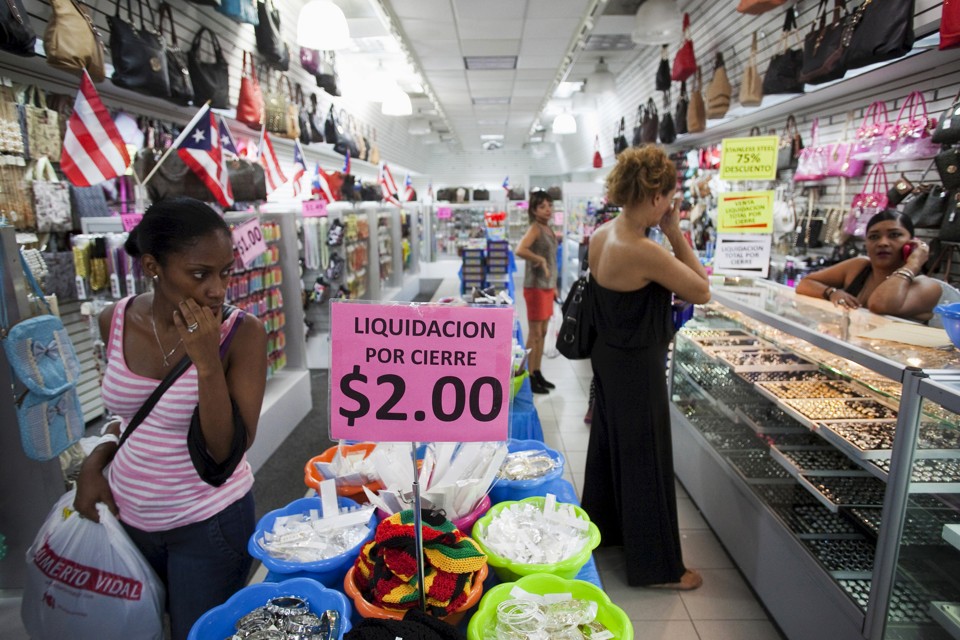
As Puerto Rico reaches another debt cliff, political dysfunction on the mainland spells disaster.
Congress Is Running Out of Time to Save Puerto Rico
Congress isn’t new to this debate; its past actions helped create the issues that have culminated in Puerto Rico’s current crisis. After the island was taken as a possession after the Spanish-American War, the Supreme Court decided in a series of “Insular Cases” that the totality of citizenship rights and state powers only applied to states and people living in so-called “incorporated territories,” which were retroactively defined as Alaska and Hawaii. Puerto Rico was left as an “unincorporated territory,” despite Congress establishing a formal independent government and constitution—actions which Puerto Rico’s highest court holds made it a de facto incorporated territory. That argument has gone unacknowledged by the Court, Congress, and the executive branch.
In the years since, the federal government has assigned and overridden territorial powers and burdens at whim. In 1984 Congress specifically carved Puerto Rico out from Chapter 9 municipal bankruptcy protections that it once had, offering no reason for singling out the territory. Also in 1996, Congress passed legislation to phase out Section 936 of the federal tax code, a law that exempted U.S. industries from taxes on income in Puerto Rico. With no replacement plan to promote development or growth, Puerto Rico’s economy suffered. Those two decisions have led almost directly to the current debt crisis.
Federal decisions have also eroded Puerto Rican finances and health care in other ways. Puerto Ricans have been required by Congress to pay Medicare payroll taxes like every other citizen, but Medicare spending has been cut in the island. Medicaid, the program that pays for much of the health care of poor and low-income people, has a cap at just 20 percent of true costs in Puerto Rico, an amount well below the national average and the rates set in the fifty states. The Medicaid underpayment deficit alone accounts for almost one-fifth of the current total deficit in the territory. A legislative medical-funding scheme could both help right the financial ship in Puerto Rico and help its crippled health-care system face the siege of Zika.
Congress, in essence, has kept from Puerto Rico the privileges of self-determination afforded to states, while refusing to use its expansive authority in the territory to lift its population up to the economic and medical standards enjoyed by those on the mainland. This is a political limbo. On the one hand, Puerto Rico clearly does not have the tools to handle its own affairs and Congress and the courts have been loathe to grant it additional powers of sovereignty. On the other, Congress keeps a hard line of minimal intervention and minimal support. As an end result, Puerto Ricans get a controlling power that dominates not through direct, overbearing intervention, but through its conspicuous absence.
Granted, the government of Puerto Rico is not blameless in this saga. Its public-services monopolies are extraordinarily inefficient; the territorial government has not been good with spending, budgeting, or long-term fiscal planning; and the two major parties––for statehood and the status quo––have supported some congressional reforms with the goal of forcing the other side’s hand, instead of promoting good governance. However, the federal government still has a certain responsibility to its citizens, regardless of the actions of their home state or territory. Whether this responsibility is taken seriously with respect to Puerto Rico will reveal whether the United States has truly moved on from its colonialist past.
As it currently stands, without swift federal intervention Puerto Rico will be left as a floundering, sinking no-man’s land, instead of a thriving home to millions of proud Americans. Congress’s dysfunctions might run so deep that they keep it from even addressing a humanitarian crisis in the country, a total failure of the body’s special duty towards Puerto Rico. Congress’s current plan might provide short-term relief, but it is a bit of a Hobson’s choice. The bill on the table could still further entrench a colonialist solution––less and less territorial oversight over finances––and may not even entirely fix the problem. But Puerto Ricans are at the mercy of Congress in finding some solution. Even if statehood is not the final answer, the people living in Puerto Rico deserve the same helping hand that would be given to the people of any state.As Puerto Rico reaches another debt cliff, political dysfunction on the mainland spells disaster.
Congress Is Running Out of Time to Save Puerto Rico
Subscribe to:
Posts (Atom)