Friday, April 28, 2017

Donald Trump Upsets Puerto Rico Officials With Tweets


BY 
President Donald Trump has a new Twitter feud and not with a specific person but the island officials of Puerto Rico.
On Wednesday night, Trump tweeted, “Democrats are trying to bail out insurance companies from disastrous #ObamaCare, and Puerto Rico with your tax dollars. Sad!” He continued his rant the next day and tweeted, “The Democrats want to shut government if we don’t bail out Puerto Rico and give billions to their insurance companies for OCare failure. NO!”
The tweets come as Democrats and Republicans meet in Congress this week to work on a deal to help Puerto Rico in the light of their Medicaid shortfall. In their multi-billion dollar debt crisis, the island is set to run out of Medicaid funding by the end of the year leading to half-million residents losing their health coverage.
Democrats seek to include funding for Puerto Rico’s Medicaid plan in the next spending bill. The deal must be agreed upon by Friday to avoid a government shutdown.
With the island receiving less than half in Medicare funds and even less in Medicaid than the other states, Trump was met by a frenzy of criticism on social media including government officials.
Puerto Rico Governor Ricardo Rosselló replied in a tweet, “The American citizens of Puerto Rico deserve to be treated fairly. Health and civil rights are not partisan issues.” Others who joined in with disapproval include Carlos Mercader, the director of the Puerto Rico Federal Affairs Administration (PRFAA), and Former San Juan Mayor Hernan Padilla.onald Trump Upsets Puerto Rico Officials With Tweets

Friday, April 21, 2017

Puerto Rico pushes to privatize operation of public services

Puerto Rico is ready to sign dozens of new deals to privatize the operation of public services as government funds dwindle amid a decade-long recession, the island's governor told some 800 investors attending a two-day financial summit Thursday.
Gov. Ricardo Rossello said public-private partnerships could create up to 100,000 new jobs and generate some $5 billion in the next three years for a U.S. territory mired in economic crisis and its government facing a $70 billion public debt load that it is struggling to restructure.
"We are not leaving things to chance," he said, noting that Puerto Rico has no access to capital markets. "We are building a government that recognizes we can't do everything."
Most public-private partnerships on the U.S. mainland involve transportation projects, but officials said the scope would be much wider in Puerto Rico and that the projects would not require legislative approval. The government hopes to privatize services including the operation and maintenance of several highways and the unreliable ferry service from Puerto Rico to the popular islands of Culebra and Vieques. Other projects would target waste management, student housing, parking and recreation facilities, information technology, renewable energy and natural gas projects.
"We've been so aggressive about this because we have no other option," said Omar Marrero, executive director of the Authority of Public-Private Partnerships. "Either we swim together, or we sink together."
Government officials have pledged that 25 percent of revenues from those deals will go to the island's crumbling public pension system that is underfunded by $40 billion and expected to run out of money this year.
Officials have identified at least 30 projects that would benefit from being run by a private company and said they would guarantee badly needed maintenance and upgrades the government cannot afford. Puerto Rico can no longer keep financing the bulk of the island's development, said Elias Sanchez, the government's representative to a federal control board overseeing the island's finances.
"It's just not viable," he said. "Our fiscal situation is so challenging that there's no way the government can be the lead in investments or projects ... That can only be led by the private sector."
It's been roughly four years since Puerto Rico last signed a deal to privatize the operation of public services without complete privatization. The previous governor signed a deal to privatize operations at Puerto Rico's main international airport and its busiest highway, a move that allowed a previous administration to eliminate 60 percent of the Ports Authority's debt and pay $1 billion worth of highway debt.
Government officials sought to ease any concerns about Puerto Rico's economic crisis by noting that the federal control board has to approve any projects, and that a financial package approved by U.S. Congress last year allows the government to award expedited permits to projects considered critical to the economy.
Puerto Rico pushes to privatize operation of public services

Thursday, April 20, 2017

Puerto Rico Draws Bondholders' Ire for Comments on Debt Talks

  • Territory facing May 1 deadline to avoid mire of lawsuits
  • Lawyer says statements suggest island ‘comfortable in default’
Puerto Rico’s negotiations with bondholders don’t appear off to a promising start.
Less than a week after an initial meeting between creditors and the crisis-wracked Caribbean island, a lawyer for a group of hedge funds and other owners of Puerto Rico’s general-obligation bonds issued a statement criticizing Elias Sanchez, a top aide to Governor Ricardo Rossello, for speaking publicly about the talks at a conference in San Juan.
Sanchez said the government hasn’t made any restructuring offers to debt holders -- a disclosure that was cast as at odds with the confidential nature of the discussions.
“Mr. Sanchez’s disregard for the rules of the mediation agreement and his distortion of Promesa befits a government getting comfortable in default, not one aspiring to be taken seriously again in the capital markets,” Andrew Rosenberg, a partner at Paul Weiss Rifkind Wharton and Garrison, who advises a group of bondholders, said in an email Wednesday.
Comments made by Sanchez and Rossello were appropriate and didn’t reveal confidential information, John Rapisardi, a partner at O’Melveny & Myers LLP, wrote in a letter today to Judge Allan Gropper, who is retired and serving as mediator for the Puerto Rico debt talks.
“Mr. Sánchez was simply reiterating what has been, and continues to be, the government’s desire and perspective: to receive constructive proposals from creditors so all parties can move forward in good faith with negotiations that will lead to a consensual agreement,” Rapisardi said in the letter.
The tiff shows the long odds of Puerto Rico meeting the stated goal of securing an agreement to restructure its debt by May 1, when the island risks being bogged down by a torrent of lawsuits that the U.S. financial rescue legislation, known as Promesa, has kept temporarily on hold. It took Puerto Rico over a year just to reach a deal with the creditors of its electric company -- a much smaller task than contending with its entire $70 billion debt, which was issued by more than a dozen arms of the government.
If a voluntary agreement can’t be struck, Puerto Rico can seek to have its obligations written down in court, thanks to another provision of the Promesa law.
On Tuesday, Rossello said he’s still seeking to craft an agreement before May 1, but he’s waiting for a proposal from creditors, according to a report in El Nuevo Dia, the island’s biggest daily newspaper.
“That is the desire, but the ball is now in their court,” Rossello said at a conference, according to the newspaper. “Now they have to make an offer. Without it, we cannot move forward.”
Puerto Rico Draws Bondholders' Ire for Comments on Debt Talks

Wednesday, April 19, 2017

Keeping Puerto Rico honest

ANALYSIS/OPINION:
Congress wisely declined to bail out Puerto Rico when its leaders turned to Washington with hat in hand for help with its $70 billion debt. Instead, they created an oversight board to compel the island commonwealth to solve its self-inflicted fiscal mess. Unfortunately, both the oversight board and the territory’s government have failed to adhere to congressional requirements and are not taking the bold steps necessary to spur economic growth and fix Puerto Rico’s finances.
The Puerto Rico Oversight, Management and Economic Stability Act (PROMESA) was passed by Congress last year and aimed to restore fiscal responsibility to the commonwealth. In addition to creating the oversight board and tasking it with overseeing the island’s finances, the act provided a stay on litigation in order to give the government time to negotiate with bondholders. Crucially, it also mandated that any fiscal plan would “respect the lawful priorities or lawful liens, as may be applicable in the constitution, other laws, or agreements of a covered territory.”
Some debt restructuring is a necessary component of any realistic solution for Puerto Rico. How exactly that is accomplished makes a big difference, however. The island will eventually need access to bond markets again, which means excessive haircuts aren’t going to work. Nor can it play favorites and advantage certain debt-holders over others or ignore the legally established priorities. There won’t be many willing to lend to Puerto Rico in the future if rules are ignored.
Unfortunately, the government and the oversight board have not attempted to work with debt-holders in good faith. Instead, they’ve put forward a plan that ignores PROMESA’s requirement of respect for lawful priorities by advantaging certain interests over the general obligation debt that is guaranteed by the island’s constitution. The plan also only provides $800 million in debt service per year while keeping nearly 94 percent of revenue for other expenditures. There is virtually no fiscal reform — in fact, the budget plan calls for significant increases in payroll and operational expenses over the next decade — and no significant changes to the island’s pension system with its whopping $48 billion debt.
The plan does not represent the serious reforms that PROMESA was designed to bring about.
To make matters worse, the plan proposes a side deal to creditors of the Puerto Rico Electric Power Authority (PREPA), that would limit its bondholders to a 15 percent haircut while other debt-holders are likely to face haircuts of 77 percent under the current plan. A recent agreement reached between PREPA and its creditors imposing the 15 percent haircut and a new charge on consumers should likewise be rejected by the oversight board.
By Andrew F. Quinlan
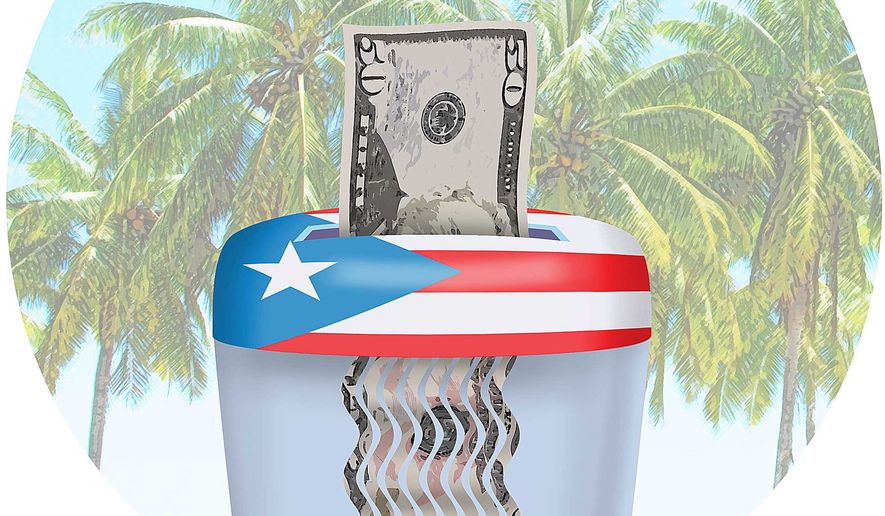
Fiscally Irresponsible in Puerto Rico Illustration by Greg Groesch/The Washington Times
Congress must insist the commonwealth stick to its fiscal oversight deal
Keeping Puerto Rico honest

Tuesday, April 18, 2017

Puerto Rico rewriting statehood plebiscite language after U.S. rejection

In a development that may affect Puerto Rico’s economy and its bonds’ tax status, the territory’s government is rushing to respond to the U.S. Department of Justice's rejection of status plebiscite language.
U.S. Acting Deputy Attorney General Dana Boente sent a letter Thursday to Gov. Ricardo Rosselló saying that the Department of Justice wouldn’t notify Congress that it approved the ballot or suggest that Congress release funds to hold the plebiscite and educate voters on it .
By 
Robert SlavinPuerto Rico rewriting statehood plebiscite language after U.S. rejection

Thursday, April 13, 2017

Buffalo schools head to Puerto Rico in search of bilingual teachers

The steady influx of Spanish-speaking students from Puerto Rico into Buffalo classrooms is driving a drastic increase in the population of pupils learning English.
Now, school officials hope to convince teachers from the island to follow.
Buffalo Public Schools administrators are taking their recruiting efforts to Puerto Rico this week, hoping to solve the pressing demand for bilingual teachers. It's a job category that's difficult to fill because the pool of potential candidates is small and in great demand all over the country.
"Our population of Spanish-speakers is growing the fastest," said Nadia Nashir, the district's assistant superintendent overseeing multilingual education. "We have students right now who are learning from teachers who can't communicate with them in their native language.  We recognize this is a problem and we know our kids can't wait any longer."
The recruiting effort underscores what has become a persistent challenge for Buffalo schools as the population of Spanish-speaking students grows faster than the district can hire educators who speak their native language to teach them.
It also reflects ongoing efforts to diversify the city's teaching force to better reflect the student population. Last week, district leaders announced a new partnership with SUNY Buffalo State that aims to identify high school students interested in going into the profession. Given that students of color make up more than three-quarters of the district's enrollment, the effort is expected to eventually produce more minority teachers.
Although about 19 percent of Buffalo students are Hispanic, just 4 percent of teachers are. And Hispanic students constitute the largest group of students learning English.
"The bottom line is we have 60 percent of our students who don't speak English and we can't recruit enough staff to accommodate them," said Principal Kathryn Foy of Herman Badillo Bilingual Academy on the West Side.
A first-grader concentrates on school work at Herman Badillo Bilingual Academy. Hispanic students now account for 85 percent of the school's population, and virtually all of them are from Puerto Rico. (Robert Kirkham/Buffalo News)
Each week, Foy welcomes a few new students from Puerto Rico into her classrooms. The vast majority speaks Spanish and little to no English. Hispanic students now account for 85 percent of the school's population, and virtually all of them are from Puerto Rico.
What's happening in Foy's classrooms is a direct result of the continued migration of people from Puerto Rico over the past decade, as a weak economy and prolonged recession have forced many people to the mainland. The Pew Research Center reports that between 2005 and 2015 the island had a net population loss of 446,000.
Some came to Buffalo, where between 2010 and 2015 the population of Puerto Ricans increased about 20 percent – double the growth seen the previous decade.
The children in that group have driven a 60 percent increase in the population of Buffalo students learning English over the past six years. Although that group includes immigrants and refugees from other countries, students whose first language is Spanish account for the largest proportion at 33 percent, and the vast majority of them are from Puerto Rico.
The district places many of those newcomers at Herman Badillo, which serves students in pre-kindergarten through eighth grades, because as a bilingual school it has more resources to support them as they learn English, while also mastering other subjects in their native language.
Ideally, the students would spend their day working with a bilingual teacher who could teach them some subjects in their native language while they work on becoming fluent in English.
"Research shows that using a student's native language is the best way for them to learn," Nashir said.
A bilingual teacher assistant helps teach a unit in a Spanish speaking area of a classroom at Herman Badillo Bilingual Academy. (Robert Kirkham/Buffalo News)
But it is so difficult finding bilingual teachers that Foy has had to staff classrooms with educators who only speak one language, typically English. In those instances she hires Spanish-speaking aides to work with students when needed. She also invites Spanish-speaking student teachers to assist in her classrooms.
"We've been pretty creative here," she said.
Buffalo administrators hope their recruiting efforts in Puerto Rico will help.
The city is following the lead of other urban school systems, including Dallas and Houston, that have visited the island to recruit teachers who have recently been put out of work as the government there closed hundreds of schools because of economic instability.
The recruiters also hope Buffalo will appeal to potential candidates because it already has a large Puerto Rican community. They have been relying on connections from within the community to help get the word out.
Potential candidates were already filling interview spots in the weeks leading up to the visit. Administrators believe that interest was generated from word of mouth and social media.
Any potential recruits will be eligible to obtain a conditional certification while they work toward their New York State credentials.
"We have such a large population of Puerto Rican students here," said Jamie Warren, the district's associate superintendent for human relations. "We're hoping that's a draw for them."

By

Herman Badillo Bilingual Academy ESL teacher Shawna Hnatyszyn teaches a test preparation unit to her students. (Robert Kirkham/Buffalo News)
Buffalo schools head to Puerto Rico in search of bilingual teachers

Reviving the American dream in Puerto Rico through entrepreneurship

Travel to Old San Juan, Puerto Rico, and you'll find ice cream lovers lined up to buy artisanal gelato and sorbet Popsicles in tropical flavors such as pineapple, papaya and coconut at the colorful shop Señor Paleta.
Señor Paleta, founded in 2014, has grown from a tiny operation selling at festivals and private events into a profitable company, surrounded by new and exciting businesses springing up in the area's century-old buildings. Today it employs 40 people at four locations, generating nearly $1 million in revenue. Despite Puerto Rico's debt crisis, the company is now in a position to consider manufacturing.
"Everyone was always saying that in crisis there are opportunities," says co-founder Ramon Ortiz, a pharmacist by training who launched the business with physician Jennifer Serrano. "I thought once we validated our product, got our clients and were seeing some sales, we could build on that."
Now that Puerto Rico's Governor Ricardo Rosselló has introduced a fiscal proposal that will cope with the island's debt and balance the budget, and our decisions are being disciplined by a federal fiscal control board, we need to start thinking about what it will take to create a sustainable economy where more companies like Señor Paleta can grow. If we don't throw more support behind entrepreneurship, young people will continue to flee the island for opportunities elsewhere instead of staying here and contributing to our future growth.
Here are three steps I would suggest, based on my 20 years of experience in building and running a Puerto Rico-based company that now has about 160 employees and will soon begin doing business in the Dominican Republic and Panama.
1. Build a stronger entrepreneurial ecosystem. In an environment where investment capital is scarce, we need to nurture more organizations whose emphasis is on building a support system for entrepreneurs. Without a formal focus on creating more business incubators and accelerators and luring more equity investors, any start-up activity will happen too slowly to move the needle for the economy.
We've had a good start with the Foundation for Puerto Rico, a not-for-profit whose mission is "to transform Puerto Rico … by driving economic and social development through sustainable strategies." The foundation was launched five years ago by one concerned citizen. It has already recruited many private companies and individuals and successfully influenced government policy.
There are other business organizations that are thriving in Puerto Rico, but while inspirational, these examples are too few and scarce to create the critical mass of start-ups necessary to shift the downward trend of the economy. Business leaders in our community need to come together to form more forward-looking organizations that will help the entrepreneurial community grow.
2. Think beyond our own companies. Puerto Rico is home to some of the most innovative and battle-tested businesses in the world. Their leadership teams know what it takes to survive and grow in a challenging environment. In an economy of "survival of the fittest," what's left now are the fittest.
In these strange times, we need the majority of business leaders to accept a higher level of accountability for reviving the economy, through commitment, innovation and a broader view of success that includes contributing to the island's social and economic advancement. Many more leaders must take up the mantle and usher in a true private-sector renaissance. Simple steps, such as looking for suppliers and vendors on the island, using one's connections to help other local firms tap into demand or meet investors, and expanding one's own business beyond Puerto Rico can all make a difference.
This is not about utopian corporate selflessness; it's about enlightened selfishness. If the private sector does not carry the economy on its back, we cannot expect to see a better fiscal future in Puerto Rico that helps all of our businesses grow.
3. Minimize the role of government. Ensuring liquidity for the government to pay its employees and debt immediately is vital. However, in order for the private sector to drive the economy, the government must get out of the way of economic growth. The Puerto Rican government has great potential to harm the economy and slow a recovery, and unfortunately, that is exactly what it has done for more than a decade. The government must change its identity from a primary employer to the main facilitator of private-sector employment. And it must act consistently and holistically with its support and the elimination of economically hostile policies and laws, such as restrictive labor laws, ever-changing tax policies and an almost exclusive emphasis on funding the government for one more month instead of growing the economy.
Of course, it's unrealistic to imagine government stepping out of the way completely. There are some useful roles it can play to help spur the economy. As I mentioned in a previous commentary, our government needs to promote homegrown entrepreneurs instead of dying manufacturing jobs. It can facilitate this by funding incubators, hosting events to attract investors and introducing them to the local entrepreneurs, refocusing the public university system to emphasize entrepreneurial skills and revamp a municipal and central tax system currently hostile to start-ups. These changes will go a long way to paving a road for a nascent new private sector in the process of recreating itself.
The ingredients are here for our economy to thrive. The government has finally been backed into a corner and is taking the politically unpopular steps needed to foster a turnaround. Many of the weaker companies have been eliminated through a 10-year war with recession. Only a vibrant, skilled set of entrepreneurs are left. Through resourcefulness, inovation and force of will, many companies are growing again. It's a perfect time for capital to reengage in Puerto Rico.
Now it is up to local business leaders to show investors there are great opportunities in Puerto Rico. Puerto Rico could have a very bright future ahead if entrepreneurship is allowed to take hold and local private-sector leaders become more actively involved. We all need to adopt the philosophy of enlightened selfishness.
— By David Bogaty, owner of WorldNet, a voice, data, cloud and internet services firm in Puerto Rico, and a member of the CNBC-YPO Chief Executive Network
A pedestrian walks past a merchandise rack in the Rio Piedras neighborhood in San Juan, Puerto Rico.
Erika P. Rodriguez | Bloomberg | Getty Images
A pedestrian walks past a merchandise rack in the Rio Piedras neighborhood in San Juan, Puerto Rico.
Señor Paleta is just one example of the scalable firms started by local entrepreneurs that are blossoming in Puerto Rico despite the challenges of a chronically declining economy. Far from Silicon Valley, we are home to innovative companies in sectors from telecom to software that are expanding into fast-growing economies in Latin America. We have also seen the growth of businesses aimed at supporting entrepreneurship, like the co-working space Piloto 151, which occupies an old Spanish building surrounded by balconies and balustrades. These enterprises are creating needed jobs and tax revenue — and are contributing to a small but growing and vibrant environment for investment.
David Bogaty
Reviving the American dream in Puerto Rico through entrepreneurship

Sunday, April 09, 2017

Congress must act on Puerto Rico before it's mired in litigation

It is no secret that Puerto Rico is in financial crisis.  The U.S. territory owes $70 billion to a variety of creditors while the economy is in a recession. The commonwealth defaulted on its debt last July, marking the first time that any U.S. state or territory defaulted on general obligation bonds since the Great Depression.
While the bond markets did not collapse as a result—mostly because the default was widely expected—there is still the specter of considerable risk to the municipal bond market if Puerto Rico fails to restructure its debt in a manner that is fair to all of its debt holders.
Anyone who wants Puerto Rico to turn the page on this bleak chapter and start a path toward economic recovery, development, and growth would be wise to pay close attention to the current discussions and negotiations of the Puerto Rico Oversight Board and the ramifications of its proposed solutions.


The Oversight Board was created by Congress at the behest of President Obama as what seemed the only viable method for getting Puerto Rico out of its financial troubles. Under the Puerto Rico Oversight, Management, and Economic Stability Act (PROMESA), seven appointees were tasked with approving a fiscal plan that reduces spending while putting in place pro-growth reforms.
The proposed plan for such reforms was to come from Puerto Rican officials, mainly recently elected Governor Ricardo Rosselló, who was elected on a platform of doing whatever is necessary to fix the Puerto Rican crisis.  On Feb. 28 of this year, Rosselló laid out his initial plan for the Commonwealth. It was rejected by the Oversight Board, which said it “relied on overly optimistic revenue and economic growth forecasts.”
Two weeks later, months after the initial deadline to create a fiscal plan, the PROMESA board approved a plan that includes limited spending cuts.  While the cuts might be a good start, they don’t go far enough, as some fear the plan’s projections are unrealistic.
The plan would lead to a dramatic reduction of the amount that will be repaid to creditors (a “haircut” in finance jargon).  Some of the proposed reductions are well over 70 percent, amounts so large that it is highly likely to severely limit Puerto Rico’s future ability to borrow, as it is difficult to envision how potential investors could have enough confidence to commit to making serious investments.
In addition, the Puerto Rican government has been working on a deal apart from the restructuring plan, with owners of Puerto Rico Electric Power Authority (PREPA) bonds. The fact that this deal will give PREPA bond owners around a 7-8 percent haircut while non-PREPA bond owners take a 77 percent haircut is hard to understand, especially since Puerto Rico could potentially save billions of dollars by negotiating better concessions from PREPA creditors. A reasonable PREPA deal would also leave room for the commonwealth to negotiate a fair deal with its other creditors, and stave off drastic increases in future borrowing costs. 
Puerto Rico has very little time to negotiate with creditors, as the government will be exposed to litigation on May 1, an option that some bond holders are almost certain to exercise. Such a move would come in addition to some unfortunate in-fighting between creditors: general obligation bondholders have already filed a lawsuit against holders of sales tax-backed bonds (known as COFINA bonds).
With COFINA bonds being the most widely held locally, public pensions that owe $45 billion in benefits, and many retirees living under the poverty line, such expensive litigation could throw yet another wrench in the works and make recovery out of reach for Puerto Rico.
With a crisis of such magnitude and with multiple dimensions, the only real answer might be for Congress to push for more oversight to avoid an even deeper mess. As a U.S. territory, Puerto Rico has nowhere to go but to the federal government and mainland taxpayers, so Congress may not have much choice in the long term. 
For Puerto Rico to have a chance at real economic recovery, it is going to need substantive tax reform, a large reduction in government overspending, and a comprehensive, transparent, realistic restructuring plan for its creditors.
The clock is ticking on the Oversight Board, and ultimately, on Congress.
Mario H. Lopez is president of the Hispanic Leadership Fund, an advocacy organization that supports public policy that fosters liberty, opportunity, and prosperity for all Americans.

The views expressed by contributors are their own and are not the views of The Hill.
BY MARIO LOPEZ, OPINION CONTRIBUTOR
Congress must act on Puerto Rico before it's mired in litigation

Friday, March 31, 2017

Puerto Rico fight over utility raises risk for bond insurers

When Puerto Rico struck a deal more than a year ago to cut the government electric company’s $9 billion debt, one group was spared the hit: bond insurers, whose guarantees the island needed to win back the faith of investors.
That agreement and the precedent it set are now at risk as Governor Ricardo Rossello threatens to use the bankruptcy-like powers the U.S. has since given the territory to seek additional concessions from MBIA and Assured Guaranty. That’s triggered a decline in bond insurers’ shares over speculation about the scale of the losses they face as Puerto Rico moves toward the bigger effort to slash its entire $70 billion debt.
“For an outsider coming in, like the governor, it probably doesn’t seem to him like the people of Puerto Rico got the best deal here,” said Chas Tyson, an analyst with Keefe, Bruyette & Woods.
The push to reopen the Puerto Rico Electric Power Authority’s December 2015 agreement -- the only one the island has reached -- marks an opening salvo in Rossello’s effort to pull the government out of a crisis that’s promising to impose deep losses on bondholders, who snapped up the territory’s high-yielding debt for years even as the economy contracted. Puerto Rico has already defaulted on a major swath of its debt and the fiscal recovery plan approved this month by U.S. financial overseers would cover less than a quarter of what it owes between 2018 and 2026, assuming the government can accomplish its goals of cutting spending and raising revenue.
Analysts say bond insurers have enough cash to weather their exposure to Puerto Rico and that’s reflected in the price of guaranteed commonwealth bonds, some of which trade for over 100 cents on the dollar.
But insurers’ shares have slid amid speculation the resolution will be more costly than previously anticipated. Since the end of January, MBIA has fallen 18 percent and Assured 5 percent, while Ambac Financial Group Inc., which also insures Puerto Rico debt, has declined 11 percent. The S&P 500 Index has gained nearly 4 percent over the same time.
The companies that insured the debt of the utility, known as Prepa, were set to avoid paying out claims under the deal. Owners of uninsured bonds, including Franklin Advisers Inc. and OppenheimerFunds Inc., agreed to accept 85 cents on the dollar by exchanging their securities for new debt backed by a share of residents’ electricity bills.
Instead of covering payments on the other debt they guaranteed, the insurers agreed to fund a $462 million surety bond that would backstop the securities -- providing investors with protection against a default. Assured and MBIA also purchased bonds from Prepa to provide the utility with cash needed to cover debt payments.
Prepa’s uninsured debt is trading around 60 cents, indicating creditors got a good deal relative to the market, said Tyson. “Every dollar that you don’t spend on debt service can be passed on to utility customers in the form of lower prices,” he said.
Rossello’s push has riled insurers and bondholders, who said it cast doubt on his ability to negotiate with other creditors and jeopardizes the government’s ability to return to the capital markets. If his administration can’t strike an agreement, Puerto Rico and the federal oversight board may turn to the courts to reduce what is owed, thanks to a provision included in a U.S. law passed last year to give the island tools to deal with its debt.
Puerto Rico is facing a deadline to reach out-of-court settlements with creditors by May 1, when a legal stay that’s sheltered it from the consequences of most lawsuits is set to lapse. The Prepa deal could also expire on Friday if it’s not extended, as insurers and bondholders have previously agreed to do.
The gulf between Rossello and Prepa’s creditors was on public display at a March 22 congressional hearing in Washington, where Adam Bergonzi, chief risk officer of MBIA’s National Public Finance Guarantee unit, said the governor has done little to reach out to creditors. An adviser to Franklin and Oppenheimer also questioned Rossello’s failure to close the deal. On Tuesday, U.S. Representative Doug LaMalfa, who heads the House panel that held the hearing, urged Rossello to complete the Prepa agreement by Friday’s deadline.
MBIA’s National insures $8.6 billion of principal and interest payments, including $1.8 billion of Prepa debt, and had $4.6 billion of claims-paying resources at the end of 2016, according to the company’s disclosures. Assured guarantees $8.1 billion of principal and interest payments, including $1.1 billion from the utility, and had $11.7 billion to meet claims as of Dec. 31.
Syncora Guarantee Inc., which is also a party to the Prepa deal, had only about $461 million of exposure to Puerto Rico as of Sept. 30. Ambac insures $9.7 billion of principal and interest, $7.3 billion of which comes due from 2047 to 2054, according to a filing. The company reported $8.8 billion of claims-paying resources as of Dec. 31. It doesn’t guarantee Prepa securities.
MBIA spokesman Greg Diamond, Assured Guaranty spokeswoman Ashweeta Durani and Syncora spokeswoman R. Sharon Smith declined to comment. An e-mail and phone message seeking comment from Ambac weren’t returned.
Puerto Rico’s move to extract concessions from the insurance companies may be short-sighted, said Mark Palmer, managing director at BTIG. He said the island may need the companies to guarantee its bonds whenever it wants to resume borrowing for public works, given that investors may be worried that it would default again if the economy doesn’t turn around.
“It makes sense to use insurance where the investors are really taking risks on the insurer and not the municipality,” he said.
The conflict between Puerto Rico and the utility creditors is unlikely to be resolved outside a broad agreement to restructure all of the island’s debts, said Tyson, the analyst with Keefe, Bruyette.
“There’s a pretty wide distance between the governor, the oversight board and the major creditors of Prepa,” he said.
Martin Z. Braun and Jordyn Holman
Puerto Rico fight over utility raises risk for bond insurers

Restoring Puerto Rico

Alexander Hamilton was the founding father that perhaps most influenced the tenets of the American economy. Hamilton’s brilliance is that he realized the economic success of any government depended upon its ability to access capital markets and respect for the rule of law. The framers of the Commonwealth’s Constitution understood this as well, and provided that payment of general obligation debt receive priority over any other debt incurred by the Commonwealth. Yet today, neither the Commonwealth nor the Oversight Control Board appear to be heeding Hamilton’s wisdom nor its Constitution, much to the detriment of the people of Puerto Rico.
For years, Puerto Rico has faced a mounting fiscal crisis as a result of its overspending and indebtedness. This culminated last year when the Commonwealth defaulted on $75 billion of debt, including debt that is protected under its Constitution. When the then-governor upended the rule of law by defaulting on Puerto Rico’s Constitutional debt, he triggered an economic freefall for the Commonwealth. By subsequently seeking to restructure its Constitutional debt – something no state has the legal authority to do - he further damaged Puerto Rico’s reputation.
As governor of New York, I inherited many of the same problems Puerto Rico faces today. Specifically, New York faced massive deficits resulting from bloated budgets, falling credit ratings that led to decreased market access, and an overall lack of transparency and credibility that stifled investment and stymied growth. We had to enhance the credit rating of the state and provide the private sector with the confidence that New York State was a place to invest. So we got to work balancing budgets, cutting taxes, reducing spending and instilling both a commitment to accountability and respect for the rule of law. The result; our budgets were balanced, our credit rating increased three times, New York’s economy grew, and hundreds of thousands of jobs were created.
I believe Puerto Rico, led by Gov. Ricardo Rossello, can accomplish the same type of fiscal rebirth New York experienced during my governorship. To do this, Gov. Rossello should embrace three things: 1) that the only long-term solution to Puerto Rico’s financial difficulty lies in economic growth; 2) that to achieve this growth Puerto Rico must have an economic and legal environment that encourages private sector investment; and 3) and an acknowledgement that a failure to honor the Constitution of Puerto Rico by not prioritizing its general obligation creditors will destroy potential investor confidence and make growth much more difficult to achieve.
In his campaign last year, Rossello pledged to adhere to these principles. He promised policies guided by the rule of law and a commitment to fiscal discipline and transparency. He also committed to good faith adherence to Congressional oversight, which includes language that expressly compels the Commonwealth to respect the legal obligations made to bondholders in the Puerto Rican Constitution.
Unfortunately, the initial steps of the oversight board and new administration fall dramatically short of their pledges. Instead of prioritizing repayment of the Commonwealth’s general obligation debt, as mandated by the Puerto Rico Constitution and the law underpinning PROMESA, the governor’s plan calls for less than $1 billion per year in debt service payments - even though revenues are forecast to exceed $18 billion. The plan does not even attempt the respect the first priority afforded the Commonwealth’s general obligation debt – it in fact treats it as the last priority receiving whatever is left. Moreover, the plan avoids tackling many of the Commonwealth’s nagging systemic issues such as structural reforms and spending reductions while accepting the premise of economic decline over the next 10 years.
The simple fact is that the savings of the Commonwealth/Oversight Board’s fiscal plan comes primarily by dishonoring the Constitutional commitments of Puerto Rico. Unlike previous draft plans offered by the Rossello administration, the fiscal plan that was certified by the Oversight Board falls far short of restoring the Island’s credibility. This plan seems designed to force the Commonwealth into a court-supervised debt restructuring rather than a consensual negotiation with its bondholders. Good faith negotiations with creditors is the only pathway for future investment and growth for the people of Puerto Rico. For his part, Rossello must not hesitate to stand up to the Oversight Board and prioritize the rule of law for the sake of future economic prosperity.
New York and Puerto Rico have always had a special relationship, and I was honored during my time as governor to work with the Commonwealth’s leaders from both parties on issues of mutual interest to our citizens. Today, I’m equally committed to the future growth and prosperity of the Commonwealth, and as a homeowner there, I am personally invested in its success. Violating the Constitution and ignoring PROMESA’s requirements is not a remedy for future success but rather a guarantee for continued decline.
“...what is the most sacred duty and the greatest source of our security in a Republic? The answer would be: An inviolable respect for the Constitution and Laws”
- Alexander Hamilton
Pataki served as governor of New York from 1995-2006. He is an advisor to the Ad Hoc Group of Puerto Rico's General Obligation (GO) Bondholders.
Alexander Hamilton

“[s]tates, like individuals, who observe their engagement (pay off their debts) are respected and trusted, while the reverse is the fate of those who pursue an opposite conduct;”

Restoring Puerto Rico

Restoring Puerto Rico

Thursday, March 30, 2017

Puerto Rico's major bondholders critical of fiscal turnaround plan

Groups of Puerto Rico's creditors issued a rare joint letter late on Monday opposing a plan designed to steer the island out of financial crisis, stoking friction between the U.S. territory, its investors and the board tasked with managing its finances.

In a letter to the federally appointed oversight board, creditors with exposure to $12 billion in Puerto Rican debt said the turnaround plan, approved by the board on March 13, violates the Puerto Rico financial rescue law known as PROMESA by ignoring legal protections on some public debt.

The letter was signed by holders of constitutionally guaranteed general obligation (GO) debt; a group holding junior COFINA debt backed by sales tax revenue; and Assured Guaranty Corp, which insures $3.4 billion of Puerto Rican bonds.

Lawyers representing the UBS Family of Funds and the Puerto Rico Family of Funds said on Tuesday that their clients, who hold roughly $652 million in accreted value of COFINA bonds, "strongly share and support many of the objections and concerns" stated in the bondholders' letter to the oversight board.

The plan “simply ignores one of the enumerated requirements that Congress imposed” under PROMESA, “namely, that it respect the relative lawful priorities” of debt, the letter said.

With Puerto Rico trying to restructure its debt before the May 1 expiration of PROMESA’s freeze on litigation, the letter illustrates a wide gulf between both sides.

Although Puerto Rico's relationship with bondholders has always been rocky, Monday’s letter also pits creditors against the oversight board, a bipartisan group appointed last year to help facilitate restructuring talks and oversee the island’s finances.

Attempts by Reuters to reach representatives of the oversight board for comment were unsuccessful.

Puerto Rico faces $70 billion in debt, a 45 percent poverty rate and rampant emigration. The turnaround plan green-lighted by the board contemplates only $800 million a year to pay debt — a fraction of what the island owes — even after imposing strict austerity measures.

In Monday’s letter, creditors said the plan runs afoul of PROMESA by prioritizing government services ahead of general obligation debt in violation of the island’s constitution. COFINA creditors said it would also unlawfully transfer sales tax revenue, on which they have a lien, into the island’s general fund.

The plan “contains many unexplained numbers and assumptions that creditors need to understand before meaningful negotiations can occur,” the stakeholders said. They added that the plan will “undermine” Puerto Rico’s efforts to regain access to capital markets.

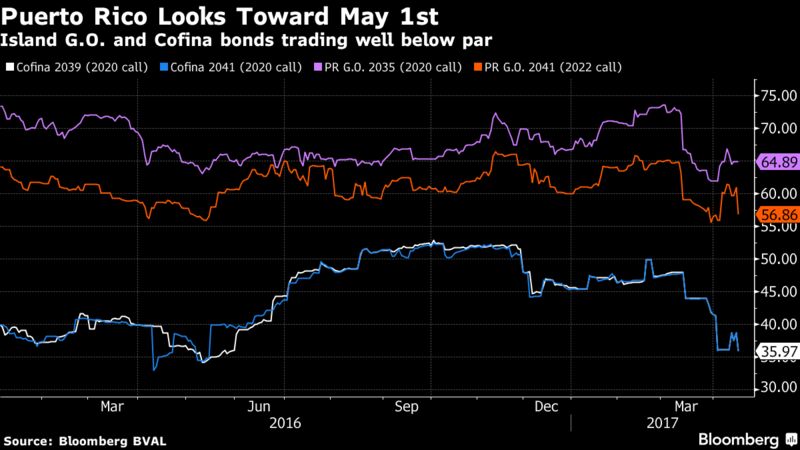
Senior COFINA debt carrying a 5.25 percent coupon that matures in 2057 was bid at 63.5 with a yield of 8.45 percent on Tuesday, down from Monday's bid price of 63.69. 74529JAR6=MSRB, according to Thomson Reuters data.

The 6 percent 2042 subordinated COFINA bond traded off its highs of the day to 42.43, but up from Monday’s last bid of 41.11, yielding 14.695 percent, according to Thomson Reuters data.

After the plan's approval, Puerto Rico’s benchmark 8 percent 2035 GO bond plunged nearly 10 full points to a bid of 63. The bond, in default, has not traded since March 22.

(Reporting By Nick Brown and Daniel Bases; Editing by Dan Grebler and Tom Brown)
By Nick Brown and Daniel Bases
Puerto Rico's major bondholders critical of fiscal turnaround plan

Wednesday, March 29, 2017

Congressman Says Puerto Rico Should Honor Prepa Restructuring Deal

A U.S. lawmaker Tuesday urged Puerto Rico Governor Ricardo Rossello to honor a $9 billion debt restructuring agreement tied to the island’s public electric monopoly, a deal that the governor says needs to be renegotiated.

By ANDREW SCURRIA

Puerto Rico Governor Ricardo Rossello has called for a renegotiation of the $9 billion agreement

Congressman Says Puerto Rico Should Honor Prepa Restructuring Deal

Puerto Rico's major bondholders critical of fiscal turnaround plan

Groups of Puerto Rico's creditors issued a rare joint letter late on Monday opposing a plan designed to steer the island out of financial crisis, stoking friction between the U.S. territory, its investors and the board tasked with managing its finances.

In a letter to the federally appointed oversight board, creditors with exposure to $12 billion in Puerto Rican debt said the turnaround plan, approved by the board on March 13, violates the Puerto Rico financial rescue law known as PROMESA by ignoring legal protections on some public debt.

The letter was signed by holders of constitutionally guaranteed general obligation (GO) debt; a group holding junior COFINA debt backed by sales tax revenue; and Assured Guaranty Corp, which insures $3.4 billion of Puerto Rican bonds.

Lawyers representing the UBS Family of Funds and the Puerto Rico Family of Funds said on Tuesday that their clients, who hold roughly $652 million in accreted value of COFINA bonds, "strongly share and support many of the objections and concerns" stated in the bondholders' letter to the oversight board.

The plan “simply ignores one of the enumerated requirements that Congress imposed” under PROMESA, “namely, that it respect the relative lawful priorities” of debt, the letter said.

With Puerto Rico trying to restructure its debt before the May 1 expiration of PROMESA’s freeze on litigation, the letter illustrates a wide gulf between both sides.

Although Puerto Rico's relationship with bondholders has always been rocky, Monday’s letter also pits creditors against the oversight board, a bipartisan group appointed last year to help facilitate restructuring talks and oversee the island’s finances.

Attempts by Reuters to reach representatives of the oversight board for comment were unsuccessful.

Puerto Rico faces $70 billion in debt, a 45 percent poverty rate and rampant emigration. The turnaround plan green-lighted by the board contemplates only $800 million a year to pay debt — a fraction of what the island owes — even after imposing strict austerity measures.

In Monday’s letter, creditors said the plan runs afoul of PROMESA by prioritizing government services ahead of general obligation debt in violation of the island’s constitution. COFINA creditors said it would also unlawfully transfer sales tax revenue, on which they have a lien, into the island’s general fund.

The plan “contains many unexplained numbers and assumptions that creditors need to understand before meaningful negotiations can occur,” the stakeholders said. They added that the plan will “undermine” Puerto Rico’s efforts to regain access to capital markets.

Senior COFINA debt carrying a 5.25 percent coupon that matures in 2057 was bid at 63.5 with a yield of 8.45 percent on Tuesday, down from Monday's bid price of 63.69. 74529JAR6=MSRB, according to Thomson Reuters data.

The 6 percent 2042 subordinated COFINA bond traded off its highs of the day to 42.43, but up from Monday’s last bid of 41.11, yielding 14.695 percent, according to Thomson Reuters data.

After the plan's approval, Puerto Rico’s benchmark 8 percent 2035 GO bond plunged nearly 10 full points to a bid of 63. The bond, in default, has not traded since March 22.

(Reporting By Nick Brown and Daniel Bases; Editing by Dan Grebler and Tom Brown)
By Nick Brown and Daniel Bases 
Puerto Rico's major bondholders critical of fiscal turnaround plan