Puerto Rico's creditors are not waiting for the island to make the first move in the next round of debt restructuring talks, discussing among themselves possible alternatives to a broad exchange offer being pushed by the U.S. commonwealth, several sources said this week.
Facing $70 billion in debt and a 45 percent poverty rate, Puerto Rico is trying to solve an economic crisis before it hits substantial debt payments in May and July.
Debt restructuring talks with creditors, which have slowed in recent weeks, are expected to pick back up this month, and Puerto Rican leaders have said they will propose a so-called “superbond,” a universal exchange offer available to many sets of stakeholders.
But creditors holding some of the $13 billion in general obligation debt backed by Puerto Rico’s constitution, as well some of the $15 billion of debt at its sales tax authority COFINA, have held preliminary restructuring talks without Puerto Rico advisers present, according to three sources close to the talks. Some holders of Government Development Bank debt were involved as well, two of the sources said.
The talks are preliminary, sources said, and do not mean stakeholders are unwilling to listen to proposals from Puerto Rico, but they may indicate mounting resistance to a superbond. They also reflect skepticism that Puerto Rico’s superbond pitch will come to fruition any time soon, two of the people said.
Restructuring talks have moved slowly on the island, and there were no publicized meetings in the final weeks of 2015, when Governor Alejandro Garcia Padilla focused mainly on lobbying unsuccessfully for U.S. Congress to pass legislative action on Puerto Rico, and on finding a way to avoid default on most of $1 billion of debt payments due on Jan. 1.
Reorg Research, a restructuring industry publication, reported in November that general obligation and COFINA creditors were hoping to unveil their own plans to restructure Puerto Rico's debt, but with major debt payments due in May, pressure is now mounting for formal plans to be proposed.
Sources indicated that local officials are attempting to schedule a meeting with creditors but the date is in flux and some sources doubt the talks will take place any time soon.
The talks by general obligation and COFINA creditors could include a proposal that Congress grant Puerto Rico access to some form of bankruptcy, though it is too early to know for sure, said two of the sources.
Under current federal law, the Caribbean island can neither declare bankruptcy itself nor put its municipal agencies into bankruptcy, to the chagrin of Governor Padilla, who says Puerto Rico needs a restructuring framework to enforce repayment cuts on hedge funds who bought its debt at steep discounts.
Two of the sources said a creditor proposal would not likely include a superbond, with one adding that it would aim to allow more flexibility for different creditor sets to be treated differently.
(Reporting by Nick Brown and Megan Davies; Editing by Lisa Shumaker)
Puerto Rico creditors holding their own restructuring talks: sources
Wednesday, January 13, 2016

Puerto Rico Utility’s Debt Plan Still Fragile, Lawmakers Are Told
Puerto Rico’s troubled electric monopoly, mired in about $9 billion of debt, stands to run out of money by midsummer if its hard-won plans to restructure fall through — something that could happen this month, a top official of the utility told a congressional panel on Tuesday.

A power plant in Palo Seco, P.R. The Puerto Rico Electric Power Authority carries $9 billion of debt, and has a payment of $1 billion due before June 30. Credit Christopher Gregory for The New York Times
Puerto Rico Utility’s Debt Plan Still Fragile, Lawmakers Are Told
Before all that debt can be restructured, the Puerto Rican legislature must first pass an enabling law — a law that, among other things, would lead to the island’s first increase in the base rate for electricity since 1989.
The legislature has about 10 more days to do that, according to the restructuring schedule. But already some lawmakers in San Juan are saying they will oppose the bill.
“I like to be an optimist, but it will be a challenge,” said Lisa J. Donahue, the AlixPartners managing director who is working as the chief restructuring officer of the Puerto Rico Electric Power Authority, known as Prepa.
Asked what would happen to the deal without legislative approval, Ms. Donahue said: “It would fall apart.”
“There are contingencies that must be met, and if they are not met, we’ll be back at the table,” she added, after explaining that getting the deal even this far took negotiators 15 months.
It involves an exchange of debt, with creditors accepting new bonds with an investment-grade rating and a face value 15 percent less than the junk-rated Prepa bonds they now hold. The new bonds would also have a slower payment schedule and a lower interest rate.
“Like Lisa said today, this is a good deal,” said Stephen Spencer, a financial adviser to Prepa’s bondholders, who monitored the hearing Tuesday. “There is always a point when it’s time to stop hemming and hawing and act — and at this point it’s up to the Puerto Rico legislature whether they want to pass the legislation and get this done.”
On its existing debt, Prepa has a little more than $1 billion in principal and interest due before June 30. Without the increase in electricity rates, and other provisions of the restructuring plan, it will not have enough cash to pay.
Puerto Rico just passed a critical debt-payment deadline on Jan. 1, and it managed to make some of the payments due only by defaulting on others. The defaults then prompted two bond insurers to file suit.
The governor of Puerto Rico, Alejandro García Padilla, has warned of a “race to the courthouse” in which more such creditors would sue to enforce their competing claims, leading to “litigation pandemonium.”
Prepa also owed debt payments on Jan. 1, but a group of its creditors helped, in effect, to finance the payments in an effort to keep the fragile restructuring plan in play while waiting for the enabling law to be enacted.
Ms. Donahue was responding to questions from a subcommittee of the House Committee on Natural Resources. It held the hearing Tuesday in response to a directive from the House speaker, Paul D. Ryan, who said in December that he wanted the House committees with jurisdiction over Puerto Rico’s affairs to come up with an appropriate solution by the end of March.
The island as a whole has roughly $72 billion of debt, most of it in the form of municipal bonds; Prepa is one of the largest single issuers.
In the past, Prepa had the authority to set its own rates for electricity. The law required it to set rates high enough to cover its costs, including borrowing costs. But that did not happen.
Instead, Prepa has held its base rate fixed since 1989, with an adjustment added on that rose and fell in tandem with the price of the fuel — mostly oil — that Prepa used to generate power.
“Because Prepa’s profit increases are linked to fuel cost increases, becoming more efficient would result in decreased profitability,” said Doug Lamborn, the Colorado Republican who headed the hearing. He said Prepa, therefore, had no incentive to shift to clean, efficient generation technology. Its plants are antiquated and do not comply with either federal or local clean-air laws.
To make matters worse, Prepa has a longstanding practice of bartering with municipalities on the island. In effect, it has gone for years without paying property taxes for its easements on municipal land, and in exchange has given the municipalities free electricity. The practice costs Prepa hundreds of millions of dollars a year.
Members of the subcommittee wanted to know, among other things, whether the prospects for restructuring Prepa might be better if it had the standing to declare bankruptcy. Currently, the bankruptcy code specifically excludes Puerto Rico from Chapter 9, the chapter that governments use to reduce debt.
Ms. Donahue said she believed access to bankruptcy would simplify the restructuring, because bankruptcy has tools for forcing holdout creditors to accept deals. She said all but 30 percent of Prepa’s creditors, with $2.7 billion of bonds, have agreed to the planned restructuring deal.
Prepa does not have to get all of those holdouts on board for the restructuring to succeed, she said — but it needs many of them, the holders of $2 billion worth of bonds.
But one of the other witnesses, Jorge L. San Miguel, said he thought “delinking” the restructuring from Chapter 9 bankruptcy was critical, because the deal was already fragile, and the possibility of bankruptcy was introducing too much uncertainty.
Mr. San Miguel, a partner in the law firm of Ferraiuoli L.L.C. in San Juan, instead called on Congress to provide external oversight to the utility.
A version of this article appears in print on January 13, 2016, on page B5 of the New York edition with the headline: Debt Plan Still Fragile for Puerto Rico Utility, Lawmakers Are Told. Order Reprints| Today's Paper|Subscribe
Asked what would happen to the deal without legislative approval, Ms. Donahue said: “It would fall apart.”
“There are contingencies that must be met, and if they are not met, we’ll be back at the table,” she added, after explaining that getting the deal even this far took negotiators 15 months.
It involves an exchange of debt, with creditors accepting new bonds with an investment-grade rating and a face value 15 percent less than the junk-rated Prepa bonds they now hold. The new bonds would also have a slower payment schedule and a lower interest rate.
“Like Lisa said today, this is a good deal,” said Stephen Spencer, a financial adviser to Prepa’s bondholders, who monitored the hearing Tuesday. “There is always a point when it’s time to stop hemming and hawing and act — and at this point it’s up to the Puerto Rico legislature whether they want to pass the legislation and get this done.”
On its existing debt, Prepa has a little more than $1 billion in principal and interest due before June 30. Without the increase in electricity rates, and other provisions of the restructuring plan, it will not have enough cash to pay.
Puerto Rico just passed a critical debt-payment deadline on Jan. 1, and it managed to make some of the payments due only by defaulting on others. The defaults then prompted two bond insurers to file suit.
The governor of Puerto Rico, Alejandro García Padilla, has warned of a “race to the courthouse” in which more such creditors would sue to enforce their competing claims, leading to “litigation pandemonium.”
Prepa also owed debt payments on Jan. 1, but a group of its creditors helped, in effect, to finance the payments in an effort to keep the fragile restructuring plan in play while waiting for the enabling law to be enacted.
Ms. Donahue was responding to questions from a subcommittee of the House Committee on Natural Resources. It held the hearing Tuesday in response to a directive from the House speaker, Paul D. Ryan, who said in December that he wanted the House committees with jurisdiction over Puerto Rico’s affairs to come up with an appropriate solution by the end of March.
The island as a whole has roughly $72 billion of debt, most of it in the form of municipal bonds; Prepa is one of the largest single issuers.
In the past, Prepa had the authority to set its own rates for electricity. The law required it to set rates high enough to cover its costs, including borrowing costs. But that did not happen.
Instead, Prepa has held its base rate fixed since 1989, with an adjustment added on that rose and fell in tandem with the price of the fuel — mostly oil — that Prepa used to generate power.
“Because Prepa’s profit increases are linked to fuel cost increases, becoming more efficient would result in decreased profitability,” said Doug Lamborn, the Colorado Republican who headed the hearing. He said Prepa, therefore, had no incentive to shift to clean, efficient generation technology. Its plants are antiquated and do not comply with either federal or local clean-air laws.
To make matters worse, Prepa has a longstanding practice of bartering with municipalities on the island. In effect, it has gone for years without paying property taxes for its easements on municipal land, and in exchange has given the municipalities free electricity. The practice costs Prepa hundreds of millions of dollars a year.
Members of the subcommittee wanted to know, among other things, whether the prospects for restructuring Prepa might be better if it had the standing to declare bankruptcy. Currently, the bankruptcy code specifically excludes Puerto Rico from Chapter 9, the chapter that governments use to reduce debt.
Ms. Donahue said she believed access to bankruptcy would simplify the restructuring, because bankruptcy has tools for forcing holdout creditors to accept deals. She said all but 30 percent of Prepa’s creditors, with $2.7 billion of bonds, have agreed to the planned restructuring deal.
Prepa does not have to get all of those holdouts on board for the restructuring to succeed, she said — but it needs many of them, the holders of $2 billion worth of bonds.
But one of the other witnesses, Jorge L. San Miguel, said he thought “delinking” the restructuring from Chapter 9 bankruptcy was critical, because the deal was already fragile, and the possibility of bankruptcy was introducing too much uncertainty.
Mr. San Miguel, a partner in the law firm of Ferraiuoli L.L.C. in San Juan, instead called on Congress to provide external oversight to the utility.
A version of this article appears in print on January 13, 2016, on page B5 of the New York edition with the headline: Debt Plan Still Fragile for Puerto Rico Utility, Lawmakers Are Told. Order Reprints| Today's Paper|Subscribe
Puerto Rico Utility’s Debt Plan Still Fragile, Lawmakers Are Told
Tuesday, January 12, 2016
Unlike RI, Puerto Rico Takes on Ratings Agencies
The big reason Rhode Islanders are given for the fact that they have to pay for the potentially fraudulent 38 studios bonds, is that failing to do so could hurt the state’s bond rating.
Both Governor Gina Raimondo and House Speaker Nicholas Mattiello have attempted to argue, not without success, that if the state of Rhode Island were to decline to pay the 38 Studios bonds, which it is not even legally obligated to do, the state would be punished by the mighty ratings agencies. That would, in turn, cost Rhode Island more in the long run, due to increased borrowing costs.
But if you buy that reasoning, you should consider yourself gullible. The logic is based on the premise that the ratings agencies, chiefly Moody’s and Standard & Poor’s, are these highly respected institutions that bond buyers rely upon. The premise couldn’t be further from the truth.
Savvy lenders understand that the opinions of the major ratings agencies are to be taken with a grain of salt, and instead employ their own researchers. Even if the ratings agencies were to try and bully Rhode Island, the state would still get decent borrowing rates from lenders. And does anyone really think the Governor actually cares about our bond rating given the fact that she is poised to add another billion in debt to the state?
Bad Reputations
While the ratings agencies already have poor reputations, this last week, in particular, was a particularly bad week in the national press for the ratings agencies. First, the New York Times came out with a scathing article, which asserted that the ratings agencies haven’t made significant reforms to stem the problems that led to their role in the financial crisis of 2008.
Who can forget the fact that the major ratings agencies rated the mortgage backed securities, which really weren’t worth the paper they were printed on, very highly? The New York Times article, written by Gretchen Morgensen, points out that according to a new SEC report, the ratings agencies are taking part in many of the same practices that helped cause The Great Recession.
“Eight years after these companies were found to have put profits ahead of principle when they assigned high grades to low-quality debt securities, some of the same dubious practices continue to infect their operations,” the article states.
Same Issues Remain
As the article explains, the bond issuers pay the ratings agencies to rate their bonds. In typical fashion, it’s almost always a case of consultants telling their clients what they want to hear. If that’s not a conflict of interest, than there is no such thing as a conflict of interest.
And when things go wrong, the rating agencies, in their own defense, state that their ratings are just opinions—no different than the editorial pages of a newspaper. To an extent, they’re right. It’s the market, what people are willing to charge the states and companies in order to loan them money, which sets the actual bond rates.
But to listen to Raimondo or Mattiello, one would think that the ratings agencies are all powerful. Due to their might, they said, we had to pay the 38 studios bonds even though we don’t actually owe the money.
Political Spin
Not all politicians spin things that way. Instead of bowing down to the agencies, like Raimondo does, Alejandro Garcia Padilla, The Governor of Puerto Rico, took aim at the ratings agencies, according to an article published in the Spanish Language publication ElNeuvodia.com, by Nydia Bauza. (Now, the major ratings agencies are seeking to inflict pain on Puerto Rico, which is struggling under a massive debt crisis.)
"Where were they when Puerto Rico took the money without being able to pay? Where was Moody's? Where was Standard & Poor's and Fitch…? They were in the attitude that led to the bankruptcy of Enron, fraud Lehman Brothers: looking away and now want to be rude to Puerto Rico, when all these bond issues, which were made…” (Translated to English)
Where’s the Courage?
The same type of malfeasance was done to Rhode Island in order to make the 38 Studios Fiasco a reality. The bond ratings agencies rated the 38 Studios bonds highly, likely in an attempt to make them attractive to investors. It worked.
The rest is history. Of course the ratings agencies didn’t want to see the bonds not get paid. All that would do would be to draw attention to another colossal mistake by the agencies.
If Rhode Islanders were well served, the bonds wouldn’t have been paid just to cower to the ratings agencies, or to satisfy wealthy Wall Street types, or to prevent a real investigation into what actually happened.
The time has come for Rhode Islanders to demand real answers as to what brought forth the 38 studios nightmare, and stop accepting half baked explanations as to why we need to pay the debt.
 Russell Moore has worked on both sides of the desk in Rhode Island media, both for newspapers and on political campaigns. Send him email at russmoore713@gmail.com. Follow him on twitter @russmoore713.
Russell J. Moore, GoLocalProv MINDSETTER
Unlike RI, Puerto Rico Takes on Ratings Agencies
Both Governor Gina Raimondo and House Speaker Nicholas Mattiello have attempted to argue, not without success, that if the state of Rhode Island were to decline to pay the 38 Studios bonds, which it is not even legally obligated to do, the state would be punished by the mighty ratings agencies. That would, in turn, cost Rhode Island more in the long run, due to increased borrowing costs.
But if you buy that reasoning, you should consider yourself gullible. The logic is based on the premise that the ratings agencies, chiefly Moody’s and Standard & Poor’s, are these highly respected institutions that bond buyers rely upon. The premise couldn’t be further from the truth.
Savvy lenders understand that the opinions of the major ratings agencies are to be taken with a grain of salt, and instead employ their own researchers. Even if the ratings agencies were to try and bully Rhode Island, the state would still get decent borrowing rates from lenders. And does anyone really think the Governor actually cares about our bond rating given the fact that she is poised to add another billion in debt to the state?
Bad Reputations
While the ratings agencies already have poor reputations, this last week, in particular, was a particularly bad week in the national press for the ratings agencies. First, the New York Times came out with a scathing article, which asserted that the ratings agencies haven’t made significant reforms to stem the problems that led to their role in the financial crisis of 2008.
Who can forget the fact that the major ratings agencies rated the mortgage backed securities, which really weren’t worth the paper they were printed on, very highly? The New York Times article, written by Gretchen Morgensen, points out that according to a new SEC report, the ratings agencies are taking part in many of the same practices that helped cause The Great Recession.
“Eight years after these companies were found to have put profits ahead of principle when they assigned high grades to low-quality debt securities, some of the same dubious practices continue to infect their operations,” the article states.
Same Issues Remain
As the article explains, the bond issuers pay the ratings agencies to rate their bonds. In typical fashion, it’s almost always a case of consultants telling their clients what they want to hear. If that’s not a conflict of interest, than there is no such thing as a conflict of interest.
And when things go wrong, the rating agencies, in their own defense, state that their ratings are just opinions—no different than the editorial pages of a newspaper. To an extent, they’re right. It’s the market, what people are willing to charge the states and companies in order to loan them money, which sets the actual bond rates.
But to listen to Raimondo or Mattiello, one would think that the ratings agencies are all powerful. Due to their might, they said, we had to pay the 38 studios bonds even though we don’t actually owe the money.
Political Spin
Not all politicians spin things that way. Instead of bowing down to the agencies, like Raimondo does, Alejandro Garcia Padilla, The Governor of Puerto Rico, took aim at the ratings agencies, according to an article published in the Spanish Language publication ElNeuvodia.com, by Nydia Bauza. (Now, the major ratings agencies are seeking to inflict pain on Puerto Rico, which is struggling under a massive debt crisis.)
"Where were they when Puerto Rico took the money without being able to pay? Where was Moody's? Where was Standard & Poor's and Fitch…? They were in the attitude that led to the bankruptcy of Enron, fraud Lehman Brothers: looking away and now want to be rude to Puerto Rico, when all these bond issues, which were made…” (Translated to English)
Where’s the Courage?
The same type of malfeasance was done to Rhode Island in order to make the 38 Studios Fiasco a reality. The bond ratings agencies rated the 38 Studios bonds highly, likely in an attempt to make them attractive to investors. It worked.
The rest is history. Of course the ratings agencies didn’t want to see the bonds not get paid. All that would do would be to draw attention to another colossal mistake by the agencies.
If Rhode Islanders were well served, the bonds wouldn’t have been paid just to cower to the ratings agencies, or to satisfy wealthy Wall Street types, or to prevent a real investigation into what actually happened.
The time has come for Rhode Islanders to demand real answers as to what brought forth the 38 studios nightmare, and stop accepting half baked explanations as to why we need to pay the debt.
Russell J. Moore, GoLocalProv MINDSETTER
Unlike RI, Puerto Rico Takes on Ratings Agencies
Staying Put Amid Puerto Rico's Economic Crisis
As Puerto Rico’s debt has grown, its population has shrunk. In numbers that rival the last great exodus from the island during the 1950s, young professionals with families are leaving to start over in Florida, resulting in Puerto Rico losing roughly 10 percent of its population over the last decade.
But what about those who can’t leave? For them — often older residents with fixed incomes who rely on government-funded pensions or health care — the future is unsettling. Unable to declare bankruptcy without Congressional approval, the island, a United States territory, is obligated to pay its creditors before almost any other bills, even if that means cutting essential services.
So, while others were leaving the island, Joseph Rodriguez decided it was time to make some return visits. In recent years he has gone to Puerto Rico to document the effects of the economic crisis, something that is etched in the faces of the people he has encountered who, for one reason or another, are staying.

“Most of them are older,” said Mr. Rodriguez, a veteran photojournalist who first made his mark in 1990 with a National Geographic cover story on East Harlem. “There is constant buzz about the hedge fund managers coming in and making things worse as they demand Puerto Rico pay off its debts to them first. Meanwhile, these older people have their own debts and basic needs: paying for electricity, food and medicine.”
His recent work — done with a grant from the Economic Hardship Reporting Project — complements an earlier piece he did on the island’s beleaguered middle class. This time around, he traveled to several different cities but focused on Maricao, which according to a 2014 government report was among the poorest of the island’s municipalities, with an unemployment rate of 21 percent.
Among those he encountered was a 94-year-old man who still worked for the town’s mayor and whose after-dinner routine was to play a slot machine in hopes of easing his financial situation. Another woman — she said she was 101 — told him the crisis had just left her stressed.

Similar jitters are evident in other parts of the island. At Gloria’s, a bodega in Santurce, people gathered each night to drink and relax while playing dominoes. One of their big worries was crime. Mr. Rodriguez — who has documented young offenders and gang life in California — also noticed the presence of homeless addicts.
“During the day time you’d see old people going to Gloria’s to relax,” he said. “But at night they would not venture out because the junkies took over the street.”
Elsewhere, shuttered commercial strips were ghost towns, he said. If anything, the prevailing mood was pessimism. “The question that comes up is whether or not the island should be independent,” he said. “That is the conversation that goes on in every place. The other one is why can’t Puerto Rico claim bankruptcy.”
The images he made have an intimate feel, partly because of his decision to eschew 35 mm in favor of a square-format camera that forced him to take his time and engage his subjects. But he also has a personal connection to the island: His father, whom he never knew, was from Ponce. His curiosity was piqued when he was a young photographer and discovered the work of Jack Delano, the Farm Security Administration photographer who settled on the island and produced a rich archive of its life.

“I’m looking at Jack’s work and thinking ‘Oh, this is how my people look. This is where my father was from,’” Mr. Rodriguez recalled. “I used photography to go out and learn about my own roots.”
His search is far from over. His plans for the future are ambitious, with a nod to the medium’s past, too.
“The way August Sander photographed the German people would be my dream to photograph Puerto Rico that way,” he said. “His work was portrait-driven, and that’s the reason I went to the Rolleiflex — to slow it down, to look at the face. I feel the eyes always tell the story. They carry the history, the pain, the love.”
By David Gonzalez
Staying Put Amid Puerto Rico's Economic Crisis
Wednesday, January 06, 2016
Puerto Rico shows more evidence of January 1 default with PRIFA bonds shortfall
Puerto Rico's PRIFA infrastructure authority did not transfer funds to its bond trustee to pay debt due Jan. 1 on certain bonds, according to regulatory filings on Tuesday, further confirmation of a default by the U.S. territory.
The embattled Caribbean island said last week that it would pay the bulk of $1 billion debt due Jan. 1, but some bond issues would not be met. The debt due was postponed to Jan. 4 due to the holiday.
The trustee for PRIFA's series 2005 B and 2006 bonds said on Tuesday it did not receive sufficient funds from PRIFA for the payment of debt, although it held a small residual amount from prior payments that it allocated to pay interest. Series A bonds' trustee also disclosed in a separate filing that funds were not received.
On Monday, the trustee for its series 2005 C bonds also said it did not receive funds from PRIFA to pay debt service - which meant a $10.3 million hit for Ambac Financial which insures some of the debt
Bond insurer FGIC will pay holders of certain of Series A and C bonds, one of the filings said, and the trustee notified FGIC of a $6.4 million shortfall of payment on those bonds.
Puerto Rico warned last week that PRIFA would not have sufficient funds to make the full payment on its special tax revenue bonds, Series 2005A–C and Series 2006, and $36 million was expected not to be paid.
It also warned that it would default on $1.4 million debt due to its Public Finance Corp while it would claw back $163 million of revenues from several agencies, including the highway authority, the convention center authority and the island's busing authority in order to pay higher priority bonds.
The actions may open the door to possible litigation from affected creditors.
According to the series 2005 B and 2006 filing, the bond trust agreement said that if holders of at least 20 percent of bonds request, the trustee shall "protect and enforce its rights" with respect to funds and other moneys pledged thereunder, by "suits, actions or special proceedings".
Standard & Poor's Ratings Services on Tuesday downgraded Puerto Rico Infrastructure Authority bonds secured by rum taxes to 'D' (default) from 'CC' with a negative outlook.
(Reporting by Megan Davies; Editing by Dan Grebler, Bernard Orr)

Puerto Rico shows more evidence of January 1 default with PRIFA bonds shortfall
The embattled Caribbean island said last week that it would pay the bulk of $1 billion debt due Jan. 1, but some bond issues would not be met. The debt due was postponed to Jan. 4 due to the holiday.
The trustee for PRIFA's series 2005 B and 2006 bonds said on Tuesday it did not receive sufficient funds from PRIFA for the payment of debt, although it held a small residual amount from prior payments that it allocated to pay interest. Series A bonds' trustee also disclosed in a separate filing that funds were not received.
On Monday, the trustee for its series 2005 C bonds also said it did not receive funds from PRIFA to pay debt service - which meant a $10.3 million hit for Ambac Financial which insures some of the debt
Bond insurer FGIC will pay holders of certain of Series A and C bonds, one of the filings said, and the trustee notified FGIC of a $6.4 million shortfall of payment on those bonds.
Puerto Rico warned last week that PRIFA would not have sufficient funds to make the full payment on its special tax revenue bonds, Series 2005A–C and Series 2006, and $36 million was expected not to be paid.
It also warned that it would default on $1.4 million debt due to its Public Finance Corp while it would claw back $163 million of revenues from several agencies, including the highway authority, the convention center authority and the island's busing authority in order to pay higher priority bonds.
The actions may open the door to possible litigation from affected creditors.
According to the series 2005 B and 2006 filing, the bond trust agreement said that if holders of at least 20 percent of bonds request, the trustee shall "protect and enforce its rights" with respect to funds and other moneys pledged thereunder, by "suits, actions or special proceedings".
Standard & Poor's Ratings Services on Tuesday downgraded Puerto Rico Infrastructure Authority bonds secured by rum taxes to 'D' (default) from 'CC' with a negative outlook.
(Reporting by Megan Davies; Editing by Dan Grebler, Bernard Orr)
Puerto Rico shows more evidence of January 1 default with PRIFA bonds shortfall
Investors Hope for Revival in Puerto Rico’s Santurce Area
From New York to San Francisco, once-gritty neighborhoods have become thriving hubs as changing tastes and demographics lure people back into the heart of U.S. cities.
Real-estate investors are trying to spur a similar transformation in a storied part of San Juan called Santurce that is scarred by decades of social upheaval and economic woe.
In the past few years, they have bought a number of properties along Ponce de León Avenue, a main artery in the Puerto Rican capital that is lined with neglected and graffiti-stained buildings. They and their allies have begun investing in amenities such as green space and additional parking.
The aim is to take advantage of Santurce’s popularity with local artists, its thriving restaurant scene and walkable streets as well as its central location nestled between major destinations like Old San Juan and the Hato Rey financial district.
“All of the elements you need for a good neighborhood were already here,” said Nicholas Prouty, an investor in distressed properties who moved to Puerto Rico from Greenwich, Conn., a few years ago.
Mr. Prouty said his firm, Putnam Bridge Funding LLC, purchased Ciudadela, an apartment complex on Ponce de León, out of bankruptcy in 2012. He is building additional apartments, retail space and parking places at the complex and plans to build a park between the complex and the nearby Museum of Art of Puerto Rico.
Another firm, Morgan Reed Group, based in Miami Beach, Fla., has purchased four largely vacant office buildings in the neighborhood within the past two years, said Brian Tenenbaum, the firm’s regional director for Puerto Rico, who described one of the buildings as a “concrete shell.” The firm is making renovations and trying to attract new tenants.
“We find the value in unattended areas,” said Mr. Tenenbaum. Morgan Reed has previously invested in downtown areas in Chicago, Cleveland and Hartford, Conn.
Santurce was once a vital area where Puerto Ricans who moved to San Juan from rural areas often settled, drawn by a network of buses and trolleys that made it a convenient place to live, said Lucilla Marvel, an urban social planner and former Santurce resident.
But it suffered as people moved out to the San Juan suburbs in the 1960s and 1970s. Census figures show that one Santurce district, Campo Alegre, had 3,355 residents in 1940 and 1,051 in 1980, according to Ms. Marvel. “The population drop was dramatic,” she said.
Parts of Santurce, including waterfront districts such as Miramar and Condado, are still densely populated and remain popular with well-heeled home buyers and visitors to Puerto Rico, which is a U.S. territory.
The area around Ponce de León, further from San Juan’s beaches and major tourist attractions, continued to struggle with abandoned buildings and street crime and has declined further as Puerto Rico wrestled with a weak economy for much of the past decade, according to people familiar with the area.
In the past few years, however, Santurce has also lured young San Juan residents drawn by relatively affordable housing, cultural destinations such as the museum and nearby art galleries, an annual street fair called Santurce Es Ley and the vibrant nightlife around La Placita, a part of Santurce that is home to restaurants run by widely acclaimed chefs.
“It’s become a hipster destination,” said Miguel Soto-Class,president of the Center for a New Economy, a San Juan think tank.
Mr. Prouty said all of the existing apartments at Ciudadela have been sold, 95% of them to Puerto Ricans, not visitors to the island, and the typical buyer is a single woman in her early 30s earning about $40,000 a year. A grocery store there sells locally grown produce, and the complex has its own security force, he said.
Apartments in the next phase of the project are expected to become available in 2017 and to sell for about $180,000 for a one-bedroom apartment and $350,000 for three bedrooms, according to Mr. Prouty.
Mr. Tenenbaum, of Morgan Reed, said that an office building on Ponce de León called Miramar Plaza was about 5% occupied when his firm became majority owner in 2014. Now, he said, occupancy is up to 50%. “We have an artisanal coffee shop coming in,” he said.
But he said another office building Morgan Reed owns nearby needs to have its electrical system replaced, and the company is still trying to lure retailers to rent space at street level. Mr. Tenenbaum said the firm is “cautious” in its plans for investing in the neighborhood because of the challenges facing Puerto Rico’s economy.
Urban revival of the kind seen in places like Brooklyn is “possible” for Santurce, said Arturo García-Solá, a corporate lawyer in San Juan who is president of the art museum’s board. He said it will require a favorable investment climate and an easier system for property owners to obtain permits.
It will also take a sustained reversal of the population flight that hurt Santurce—and that continues to plague Puerto Rico in general—said Ms. Marvel. “To bring a place back, you need to bring people back.”
Push to rebuild once-vital part of San Juan gains steamBy Liam Pleven
Investors Hope for Revival in Puerto Rico’s Santurce Area
Fixing Puerto Rico’s Debt Mess
In the debate about how to fix Puerto Rico’s fiscal woes, lawmakers from both political parties seem to be gravitating toward a two-part strategy: The island’s municipalities—and possibly the commonwealth—would be permitted to file for bankruptcy. But Congress would create a financial control board to restrain Puerto Rico’s profligate tendencies.
Advocates of this strategy rightly insist that Congress should craft the control board carefully. Along with New York University’sClayton Gillette, I’ve argued that Congress itself should run the board.
But the assumption that the current municipal bankruptcy laws will work fine if Puerto Rico is given access to them needs reconsideration. Unless the laws are modified, extending bankruptcy to Puerto Rico could invite abuse and roil the municipal debt markets.
Every American state can permit its municipalities to file for bankruptcy under chapter 9, but Puerto Rico cannot. This seemed like good news for the island’s creditors until it became clear that the government genuinely cannot repay all of its obligations. On Monday Puerto Rico defaulted on roughly $174 million in debt payments, with more defaults likely to follow.
Bondholders could sue to enforce their rights, but the litigation would be costly, time consuming and, for some, potentially unsuccessful.
Puerto Rico also could restructure its bonds, writing them down much more severely than in a recent deal between Prepa, the commonwealth’s electricity corporation, and many of the company’s bondholders. Creditors can’t be forced to agree to a bond exchange, but Puerto Rico could threaten to punish those that did not. The government also could ignore the constitutional protections that some of the bonds enjoy, and restructure bonds that seemed to be entitled to priority.
Bankruptcy can solve these problems. It removes the risk that a debtor will pick and choose which obligations to pay, and it ensures that creditors’ priorities will be honored.
At least that is how bankruptcy is supposed to work. But the rule of law took a beating in the Detroit bankruptcy. Holders of the city’s general-obligation bonds, which had the same priority as pensions, got stiffed, receiving roughly 41% of what they were owed. Pensioners got at least 60%.
Those holding Puerto Rico’s municipal bonds are right to worry that they too could get mistreated. If they do, future investors may refuse to lend to troubled municipalities, including Puerto Rico’s, no matter how well protected the bonds seem to be.
To avoid another Detroit, Congress needs to reconsider two of the key requirements for confirming a municipal restructuring plan. The first requires the bankruptcy judge to conclude that the plan does not “discriminate unfairly.” Before Detroit, this was thought to require that the plan give comparable treatment to groups of creditors that have the same priority.
But Steven Rhodes, the federal bankruptcy judge in the Detroit case, instead concluded that the requirement was met as long as the plan satisfied his conscience. Lawmakers should explicitly require that recoveries for creditors with the same priority cannot deviate more than a specified amount—say, 15% or 20%.
The second key provision requires that the plan be in the creditors’ “best interests.” In Detroit, the court concluded that nearly any plan satisfied this requirement, since the prospects for payment were (in the judge’s view) bleak, absent bankruptcy.
Congress instead should specify that “best interests” means that the plan ensure as much recovery for creditors as is reasonably possible. In Detroit, this would have required that at least some of the $816 million that the city raised in its clever but dubious art-for-pensions scheme go to bondholders.
It would be simpler to offer Puerto Rico access to the current municipal bankruptcy laws. But it would be far better if Congress reformed them to avoid the kind of inequities that occurred in Detroit.
Mr. Skeel teaches bankruptcy law at the University of Pennsylvania Law School.
Bankruptcy can work, but bankruptcy laws need to be changed to ensure fair treatment of creditors.By David Skeel
Fixing Puerto Rico’s Debt Mess
Congress' Puerto Rico plan 'insidious': Investor
Bankruptcy policies that U.S. lawmakers are considering for Puerto Rico could have a chilling effect on the broader municipal bond market, according to a major investor in the commonwealth.
"If you grant [Puerto Rico] unique protections, or unique ability to restructure its debt not afforded to the states, that sets an insidious beginning for undermining confidence in the willing to pay across the municipal marketplace," said Hector Negroni, the co-CEO and CIO of New York-based Fundamental Credit Opportunities.
Despite indications to the contrary, senior Puerto Rico officials of the commonwealth are not actively negotiating with many creditor groups, he added.
 Dawn Giel
Congress' Puerto Rico plan 'insidious': Investor
"If you grant [Puerto Rico] unique protections, or unique ability to restructure its debt not afforded to the states, that sets an insidious beginning for undermining confidence in the willing to pay across the municipal marketplace," said Hector Negroni, the co-CEO and CIO of New York-based Fundamental Credit Opportunities.
Despite indications to the contrary, senior Puerto Rico officials of the commonwealth are not actively negotiating with many creditor groups, he added.
Alvin Baez | Reuters
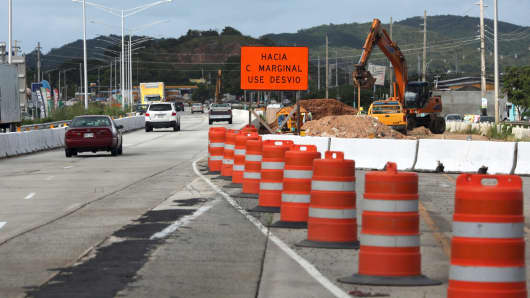
Cars pass a construction site in Fajardo, near San Juan, Puerto Rico, on Dec. 1, 2015.
Granting Puerto Rico what has been referred to as "Super Chapter 9" — lumping all 18 bond issues together under the same terms — could lead to fiscally struggling U.S. states trying to pursue a similar extraordinary restructuring option for their own outstanding debts, said Negroni, who holds bonds issued by Puerto Rico and is the former head of municipal trading at Goldman Sachs.
He believes the political move would be dangerous because it could undermine investor confidence in the willingness for bond issuers to pay holders of its debt.
"It creates a lack of confidence, increases spreads, volatility and makes the cost of financing necessary infrastructure across the nearly $4 trillion marketplace much higher and less certain," Negroni said.
Negroni also said that various creditor groups are "ready and anxious" to start talks with the commonwealth about restructuring the approximately $70 billion in outstanding debt, but that thus far senior officials have "frankly not been very earnest in their availability and their willingness to connect" with the bondholders.
He believes the political move would be dangerous because it could undermine investor confidence in the willingness for bond issuers to pay holders of its debt.
"It creates a lack of confidence, increases spreads, volatility and makes the cost of financing necessary infrastructure across the nearly $4 trillion marketplace much higher and less certain," Negroni said.
Negroni also said that various creditor groups are "ready and anxious" to start talks with the commonwealth about restructuring the approximately $70 billion in outstanding debt, but that thus far senior officials have "frankly not been very earnest in their availability and their willingness to connect" with the bondholders.
Congress' Puerto Rico plan 'insidious': Investor
Mall Owners, Retailers Bullish on Debt-Ridden Puerto Rico
SAN JUAN, P.R.—Puerto Rico’s government is struggling to pay its bills. But mall owners and retailers are betting that consumers on the island will keep on spending.
Fast-fashion retailer Hennes & Mauritz AB’s H&M plans to open its first store in the U.S. territory this year, at the 631,000-square-foot Mall of San Juan. Opened in March, it was the largest new mall on U.S. soil in 2015, according to real-estate firm CoStar Group.
Nordstrom Inc. and Hudson’s Bay Co.’s Saks Fifth Avenue made their island debuts at the Mall of San Juan last year, and other retailers are coming to the island or expanding operations. Retail landlords have invested tens of millions of dollars to upgrade their properties.
The moves amount to a high-stakes wager for mall owners and retailers who face a slow recovery across the U.S. and hope to find a sorely needed source of fresh revenue in Puerto Rico. But they come at a time when the island is contending with crushing public debt. “Puerto Rico’s got serious financial problems,” said Steve Sakwa, a real-estate analyst at Evercore ISI.
Landlords and retailers are counting on a number of factors to weather the storm, including an underground economy that means shoppers are wealthier than official statistics indicate, a lively tourist trade and a relative shortage of retail space compared with the rest of the U.S., according to executives and analysts.
“San Juan is one of the densest markets in North America,” saidRobert Taubman, chief executive of Taubman Centers Inc., a mall owner based in Bloomfield Hills, Mich., that spent about $475 million to build the Mall of San Juan. “We are extremely bullish.”
On Monday, Puerto Rico was expected to make most of roughly $1 billion in scheduled bond payments, but it said last week that it would miss about $37 million in payments due from public agencies, underscoring the severity of the island’s problems. In 2015, the island’s sales tax leapt to 11.5%, up from 7%.
The crisis adds to the challenges facing Puerto Rico’s consumers. The median household income is less than $20,000 a year, roughly half what it is in Mississippi, the poorest U.S. state by that measure, according to Census Bureau data. Nearly half of Puerto Rico’s 3.5 million people live in poverty.
“We don’t feel secure,” said Diana Domenech, a 45-year-old therapist who was shopping recently at Plaza del Sol, a mall in suburban Bayamon. “So I shop less right now.”
In recent years, hundreds of thousands of Puerto Ricans, who are U.S. citizens, have moved to the mainland. Migration is “the largest risk” to the local economy, said Heidie Calero, an economist who heads H. Calero Consulting Group Inc., based in San Juan.
Ms. Calero pointed to declines in sales of new cars and higher home foreclosures as signs of the stress. “You’re seeing evidence that the consumer is not that resilient,” she said.
But mall owners and retailers say they are protected from the problems because the island isn’t saturated with stores like much of the mainland U.S. There are five square feet of mall space per capita in Puerto Rico, compared with 23 square feet around the U.S., according to Taubman Centers.
Puerto Rico’s largest mall, Plaza Las Americas, is crowded with shoppers even on weekday afternoons. Retailers such as J.C. PenneyCo. say their Puerto Rico stores are among their best-performing locations.
“You’ve got lower supply and a consumer who loves to shop,” saidPaul Freddo, a former J.C. Penney executive who is now senior executive vice president for leasing at DDR Corp., which owns Plaza del Sol and 13 other malls and shopping centers in Puerto Rico.
DDR, based in Beachwood, Ohio, has spent about $50 million in recent years to upgrade its island properties, including moving a food court to the second floor at Plaza del Sol to meet demand for additional retail space, according to executives. Existing retailers at the mall include Wal-Mart Stores Inc. and Home Depot Inc.
The arrival of new retailers is a lure for Puerto Rico shoppers who had encountered stores such as Nordstrom and H&M only when traveling to the mainland or buying online. “I was eager to come here and see it,” said Fabiola Colon, 24, who was shopping in Nordstrom recently.
In addition, many consumers have more disposable income than official data might suggest, due to a lower cost of living and a lax tax collection system, experts say.
That was a key factor for Taubman in deciding to build the Mall of San Juan. The company tracked down data showing that more luxury cars were sold per person in the area than almost anywhere else in the U.S.
“That’s when you knew” the market could support a mall with some high-end stores, said William Taubman, the firm’s chief operating officer.
But planning and building the mall took more than a decade, partly because of red tape. In addition to Nordstrom and Saks, stores include LVMH Moët Hennessy Louis Vuitton and Urban OutfittersInc.’s Anthropologie.
The mall opened in March, just as the island’s fiscal problems were coming to a head. “They’re opening this at about as poor a time as you can,” said Mr. Sakwa, the analyst, who added that the property “may be too upscale for the marketplace.”
Robert Taubman, Taubman’s CEO, said the firm is confident the investment will pay off in the long run. But, he added, “There’s no question that we had headwinds, not tailwinds.”
Upscale chains set up shop on island despite massive debt woes
By Liam PlevenMall Owners, Retailers Bullish on Debt-Ridden Puerto Rico
Tuesday, January 05, 2016
Puerto Rico Bond Defaults Early Reminder To Investors: Return Does Not Come Without Risk
Today Puerto Rico will default on payments due to bondholders of several different bond issues. At the same time, Puerto Rico will pay other bonds, particularly its general obligation bonds which are backed with its full faith and credit, meaning that it is essentially obligated to raise taxes or cut expenditures however much it takes to make those payments. The bonds on which Puerto Rico will not make payments were issued by financing authorities and are tied to specific projects or groups of projects.
Many American investors bought Puerto Rican bonds over the past five years as we all searched desperately for yield in the face of the Federal Reserve pushing interest rates down to historic lows. Normally, investors understand that higher yields come with greater risks. However, during the past six years of extraordinary interventions by the Fed into all sorts of financial markets, many investors may have decided that those higher yield investments weren’t really all that risky.
Partly, they were deluding themselves. Clearly, as much as investors may have been pushed into these riskier waters in order to preserve at least some of the income from their investment portfolios, they should still have understood the tradeoff—that they were accepting more risk in order to gain more return. Yet, partly, they thought the Fed had their backs. After all, the Fed had saved a lot of other people and other investments and seemed to be pumping money everywhere. Plus, how could things go bad when yields were so low? Projects that were risky before were surely safer now with the ability to tap debt markets at such low cost. Right?
Puerto Rico’s problems, while not entirely or even mostly related to the long-expected rise in interest rates, may serve as a much-needed wake up call to investors that the times are changing. As rates rise, capital will move back toward safety and the risk premium demanded of higher risk projects is likely to increase.

Puerto Rico Bond Defaults Early Reminder To Investors: Return Does Not Come Without Risk
Many American investors bought Puerto Rican bonds over the past five years as we all searched desperately for yield in the face of the Federal Reserve pushing interest rates down to historic lows. Normally, investors understand that higher yields come with greater risks. However, during the past six years of extraordinary interventions by the Fed into all sorts of financial markets, many investors may have decided that those higher yield investments weren’t really all that risky.
Partly, they were deluding themselves. Clearly, as much as investors may have been pushed into these riskier waters in order to preserve at least some of the income from their investment portfolios, they should still have understood the tradeoff—that they were accepting more risk in order to gain more return. Yet, partly, they thought the Fed had their backs. After all, the Fed had saved a lot of other people and other investments and seemed to be pumping money everywhere. Plus, how could things go bad when yields were so low? Projects that were risky before were surely safer now with the ability to tap debt markets at such low cost. Right?
As rates begin what is likely to be a very slow, very long path back to normal levels, investors would do well to remember that one outcome of rising rates is that capital allocation will move back to more normal patterns. As safer alternatives begin to sport higher rates of return, fewer dollars will be willing to take the risks involved in some of the higher yield vehicles many of us have made part of our portfolio over the post-recession period. That means some of those risky investments that looked “safe enough” for the last few years might suddenly find themselves cash-starved.
Puerto Rico’s problems, while not entirely or even mostly related to the long-expected rise in interest rates, may serve as a much-needed wake up call to investors that the times are changing. As rates rise, capital will move back toward safety and the risk premium demanded of higher risk projects is likely to increase.
Already, the spreads between Treasury yields and both general corporate bond rates and high yield bond rates have increased significantly. The high yield spread is at almost 7 percent, meaning investors now want 7 percent more return to put their money in high yield bonds compared to the return expected from Treasuries. While that is a long way from the recession-peak of 22 percent, it is also pretty far from the post-recession spread low of about 3.5 percent.
Rising interest rates will be good for the economy in a number of ways, including that they will encourage a better allocation of capital across our economy. However, investors must be aware that this reallocation is going to happen (and is already underway). Without the backstop of cheap money that was available because it had few other alternatives, a number of investments that performed well and looked reasonable over the past five or six years are rapidly become riskier. Rising yield spreads mean that the return is rising to try to compensate for that risk, but individual investors will need to make their own assessment of whether the extra return being offered is sufficient.
My guess is that investors will be slow to adjust to new realities (we usually are) and that many of these riskier investments are actually worse than we think. Instead of getting higher returns through greater yields, investors can end up with capital losses thanks to either falling bond prices or even defaults. Puerto Rico may just be the first indication that sometimes the return on a risky investment is much less than you expected.
Pedro Cuellar, marketing director for Puerto Rico Industrial Development Company, spoke with a guest during the Department of Commerce’s SelectUSA Investment Summit in March 2015. (Photo by Kris Connor/Getty Images for Puerto Rico Industrial Development Company)
Puerto Rico Bond Defaults Early Reminder To Investors: Return Does Not Come Without Risk
Subscribe to:
Posts (Atom)