The U.S. Department of Transport warned Puerto Rico that it could jeopardize future funding if it goes ahead with a planned shutdown of its public transit network on Monday, as a local union leader urged bus drivers to show up for work as normal.
In what would be a major escalation of Puerto Rico's debt crisis, the local government is planning to shut down its bus and suburban train service after lawmakers were unable to agree to hike its oil tax by 68 percent, to back a vital bond sale of up to $2.9 billion. Buses and the suburban Tren Urbano serve 75,000 people daily.
The U.S. government pays billions of dollars annually to Puerto Rico for items such as grants for transport projects, healthcare and social security. The warnings apply to transport-related financing.
Two letters from the Federal Highway Administration (FHWA) and the Federal Transit Administration (FTA) warned Miguel Torres, Puerto Rico's transport secretary, that the shutdown could breach commitments to maintain a basic level of operations needed to carry out safety and security duties.
"Failure to fulfill these capacity obligations or your responsibility to properly protect federal assets could jeopardize future federal funding or potentially result in a debt to the federal government," the FTA said in a letter dated Wednesday, Nov. 26.
The letters were posted on local news website Noticel. The FHWA and the FTA could not immediately be reached for comment.
^^^^^^^^^^^^^^^^^^^^^^^^^^^^^^^^^^^^^^^^^^^^^^^^^^^^^^^^^^^^^^^^
For links to the letters:
here documents/1d9283058ff742eebc4abb7196595555.pdf
here
^^^^^^^^^^^^^^^^^^^^^^^^^^^^^^^^^^^^^^^^^^^^^^^^^^^^^^^^^^^^^^^^
Adding to potential confusion on the scheduled day of shutdown, the president of the United Workers Metropolitan Bus (TUAMA) Authority, Antonio Diaz Lopez, urged employees to report to work on Monday, according to local press reports. He said workers could be paid retroactively if authorities did not have funds to pay salaries in mid-December.
Governor Garcia Padilla has said that the Metropolitan Bus Authority and the Tren Urbano will stop Dec. 1 because there is no money to pay salaries on Dec. 15. The Highway and Transportation Authority is also planning to cease operations on Monday, according to the FHWA letter.
The FHWA warned that the federal government would not meet any claims resulting from contracts canceled due to the shutdown and said it was "deeply concerned that if PRHTA (Puerto Rico Highways and Transportation Authority) ceases operations, it may be unable to meet these federal requirements."
Puerto Rico is struggling with over $70 billion in debt and its economy has been in or near recession for the last eight years. It is in the process of restructuring its electric power authority PREPA, which could lead to a writedown to over $9 billion in debt.
(Reporting by Reuters; Writing by Edward Krudy; editing by Megan Davies and Bernard Orr)
U.S. government warns Puerto Rico of funding loss if transit shuts
Saturday, November 29, 2014

Thursday, November 27, 2014
Cruise ships to make rare stop in Puerto Rico city
SAN JUAN, Puerto Rico (AP) — Cruise ships are returning to Puerto Rico's second-largest city for the first time in three years.
The mayor of the southern coastal city of Ponce says seven luxury ships operated by Monaco-based Silversea Cruises are expected through 2016.
Maria Melendez said Wednesday that each arrival is expected to generate some $70,000 in revenue. The first ship carrying 540 tourists is scheduled to arrive on Friday.
Puerto Rico overall has seen a 10 percent increase in cruise ship passenger arrivals this year with nearly 860,000 people visiting the U.S. territory through August.
Cruise ships to make rare stop in Puerto Rico city
FBI investigation does not affect rating of Puerto Rico's PRASA
An investigation by the U.S Federal Bureau of Investigation into activities at the Puerto Rico Aqueduct and Sewer Authority (PRASA) will not impact the agency's credit rating, Standard & Poor's said on Wednesday.
The FBI launched a surprise raid at PRASA on Tuesday. The head of the commonwealth agency said the probe was focused on a single case and not the entire agency.
S&P's comments come as PRASA, which the agency rates BB-minus, is preparing a bond sale of at least $770 million in the first half of 2015, $500 million of which will be new money intended for investments.
"We will continue to monitor the situation for materiality, especially as it relates to PRASA's ability to renew or otherwise extend its committed lines of credit, and possibly convert draws on those lines to long-term debt," S&P said in a statement.
PRASA has about $3.4 billion in senior-lien revenue bonds, according to S&P. It also has nearly $280 million in rated debt, plus another $870 million in unrated debt that is backed by the Commonwealth of Puerto Rico, S&P said. (Reporting by Edward Krudy; Editing by Leslie Adler)
FBI investigation does not affect rating of Puerto Rico's PRASA -S&P
Puerto Rico threatened with transit shutdown in political spat
Puerto Rico's public transit system will shut down on Monday if lawmakers do not increase a tax on oil, the U.S. commonwealth's Government Development Bank said, accusing politicians of taking an "irresponsible" gamble on the island's economy.
The possible shutdown of Puerto Rico's buses and commuter train services, affecting 75,000 commuters, would be a major escalation of the island's debt crisis and would threaten its fragile economy.
It would come as a further blow to residents already facing budget cuts and paying among the highest electricity costs in the United States.
The move is scheduled to come when citizens return from their Thanksgiving break and ramps up the pressure on politicians to resolve their wrangling over the tax hike, which was to back a loan for its highways authority.
"It is irresponsible to continue playing with (Puerto Rico's) economic and fiscal stability," the GDB said in a statement. "The immediate consequences of these actions are already evident: public employees out of work and citizens on foot in the height of the holiday season."
Puerto Rico is struggling with a debt load of more than $70 billion and an economy that has been in or near recession for eight years. The latest data showed economic activity continued to slide last month and is the lowest in 20 years.
Governor Alejandro Garcia Padilla has been unable to convince enough members of his party to back a 68 percent increase to a tax on crude oil, which was expected to be passed last week. He convened a special session of the legislature on Monday, but lawmakers called a recess until Dec. 1.
The governor, whose popularity is sinking in the polls ahead of elections in 2016, appears to be just one vote short despite attempts this week to rally lawmakers. Some of them want to wait to pass the measure with a package of tax reforms expected in early 2015 to lessen the political hit from unpopular tax measures.
Padilla has been losing support after delivering an austerity budget that cut spending by $1.4 billion.
With opposition lawmakers voting against the unpopular tax measure, the bill needs support from 26 of the 28 members of the Popular Democratic Party members in the House. At least three members remain opposed, with a fourth vowing to abstain, according to local news reports.
TRANSIT THREATENED
While the transit links only serve a small proportion of Puerto Rico's 3.6 million population, the closure would be a indictment of the government's ability to run basic services.
The shutdown would immediately affect rail and bus services, but boats could be threatened in the future.
"The Metropolitan Bus Authority will stop Dec. 1 because there is no money to pay salaries on Dec. 15. That's the same situation with the Tren Urbano. The Maritime Transportation Authority has a few more months. We don't have money for payroll," Padilla said at a press conference on Monday. Tren Urbano is a commuter train service.
The island's Highways and Transportation Authority does not have sufficient income or liquidity to meet its payroll obligations for December, the bank said in a statement, adding that meant public transport services will close on Monday.
Puerto Rico has delayed a bond sale of up to $2.9 billion until early 2015 which it had been aiming to complete this year using the proceeds of the oil tax increase. The government planned to increase its tax on crude oil by $6.25 per barrel, to $15.50, to raise $178 million a year to back the bonds.
Without proceeds from the bond sale, the island could also lack the liquidity to meet government emergencies in 2015, the GDB said. It has contingency plans to postpone loans for public works and stop disbursement of municipal and government loans, it said.
Ratings agency Moody's Investors Service said the island faces financial trouble next year if it is unable to complete the transaction.
(The story corrects third paragraph from bottom to state that planned oil tax increase was by $6.25, not from $6.25)
(Reporting by Edward Krudy in New York; Editing by Megan Davies, Chris Reese and Lisa Shumaker)
By Edward Krudy
Puerto Rico threatened with transit shutdown in political spat
Wednesday, November 26, 2014
Mass transit shutdowns around corner as oil tax hike still stuck in Capitol
Puerto Rico lawmakers were called back to the Capitol for a special session Monday as Gov. Alejandro García Padilla pushes for passage of a step hike in the petroleum tax to bail out the debt-ridden and cash-strapped Highways & Transportation Authority and keep mass transit systems in operation. However, both the House of Representatives and Senate recessed until December 1 without taking up the legislation.
Mass transit shutdowns around corner as oil tax hike still stuck in Capitol
The bill would need 26 of the 28 PDP votes in the House, but some members of the majority delegation still oppose the tax hike. García Padilla said Monday he needs just one more vote, but sources said the measure is still several votes short of exiting the lower chamber.
The session was called as administration officials ramp up pressure for passage of the tax increase, saying mass transit services could skid to a halt if the HTA doesn’t get bailed out. The government has resorted to placing advertisements in local Spanish-language media outlets warning of dire consequences of not passing the legislation including broken roads and laid workers.
García Padilla said Monday that HTA and the Integrated Transport Authority would shut down next Monday due a lack of liquidity to cover payrolls.
“The Metropolitan Bus Authority and the Urban Train will shut down December 1 because they don’t have money for payroll,” the governor said in a radio interview.
The Maritime Transit Authority, which operates the ferries to offshore island towns of Vieques and Culebra, has “several more months,” García Padilla said.
The special session comes after the legislation hit a wall when the House of Representatives and the Senate pushed through separate last-minute bills that failed to exit the Capitol before the deadline earlier this month. In light of the impasse over the tax hike in the House, legislation to give the HTA a short-term shot of up to $45 million for payroll and operational costs was filed and approved by the lower chamber on the last day of the regular session. The money would come from cigarette taxes and feed a new fund managed by the Government Development Bank. The measure wasn’t taken up by the Senate before the close of the legislative term and was rejected by La Fortaleza.
La Fortaleza has said the House “didn’t finish the job” of considering a bill to surge the petroleum excise tax from $9.25 to $15.50 per barrel. The levy had been increased from $3 just last year.
García Padilla and other administration officials have said consumers will not feel the tax hike when fueling up their automobiles. Gasoline retailers have said the higher levy could drive up pump prices despite falling oil prices.
La Fortaleza has said the legislation is needed to “move forward on infrastructure projects that are necessary for the island’s economic development.”
Many investors and analysts believe the HTA will follow the Puerto Rico Electric Power Authority in moving to restructure its long-term debt, but government officials insist they are working to resolve the public corporation’s fiscal challenges without resorting to the Recovery Act.
Puerto Rico government officials had detailed plans last month to borrow up to $2.5 billion in a bond deal backed by a proposed new hike in the crude oil and petroleum products tax. The issue is now expected to reach up to $2.9 billion and the target has been pushed up to this month instead of early next year.
As reported previously by CARIBBEAN BUSINESS, the move is being undertaken to erase a $1.9 billion loan from the books of the GDB in light of its dwindling cash reserves.
The $1.9 million loan on the GDB’s books was made to the HTA, mostly for public works, but market conditions and the public corporation’s own fiscal problems have prevented it from returning to the market to undertake a bond issue to pay off the GDB loan.
The bill would transfer the loan to the Infrastructure Financing Authority (PRIFA) along with the means to pay for it via revenue produced by hikes in the crude oil and petroleum products that were undertaken in June 2013. The new bill increases these taxes further to cover operational budget gaps in the HTA, including its mass transit assets that are being spun off into a new public corporation.
The bill adjusts the excise tax on the barrel of crude oil, at a time when oil prices has decreased significantly; the increase will be bring this excise tax to $15.50 per barrel. This tax is expected to generate an additional $178 million per year. The taxes would be distributed as follows: $6.00 per barrel for the PRHTA to cover its operational costs and debt service obligations, $8.25 per barrel for the PRIFA to cover debt service, and $1.25 per barrel to finance the new Integrated Transportation Authority, which comprises the Metropolitan Bus Authority bus services, the ferry services (Maritime Transportation Authority) and the Urban Train system, once their transferred is completed.
GDB officials say the tax hike will provide funding to operate Puerto Rico’s highways network, protect thousands of public and private jobs, and continue to provide maintenance to the road network, the Urban Train operation, and the bus and ferry services.
The measure explicitly excludes the taxation of crude oil and its by products used by the Puerto Rico Electric Power Authority to generate electricity, as well as those that are exported from Puerto Rico; those used by local refineries and petrochemical companies in the oil refining process; and those used as lubricants or fuel for aircrafts and shipping vessels traveling by air or sea between Puerto Rico and other places; among other exclusions.
The transfer to PRIFA is needed because, “it is necessary to identify an entity that has better access to the market to assume the HTA’s debt and, in this way, repay the debt to the GDB,” GDB officials said.
The legislation also provides additional guarantees and legal protections to investors to make the bonds offering more appealing.
Puerto Rico bonds have been hit by a series of downgrades since the enactment last June of the Puerto Rico Public Corporations Debt Compliance & Recovery Act (Recovery Act), which outlines a local bankruptcy-like procedure for most public corporations to restructure their debts. When the bill to transfer the debt to PRIFA from HTA was first filed, it caused alarm among some analysts and investors who saw it as clearing the way for the HTA to restructure its nearly $5 billion in outstanding bond debt without harming the GDB. Both GDB and PRIFA are barred from restructuring its debts under the Recovery Act.
Mass transit shutdowns around corner as oil tax hike still stuck in Capitol
o Rico lawmakers were called back to the Capitol for a special session Monday as Gov. Alejandro García Padilla pushes for passage of a step hike in the petroleum tax to bail out the debt-ridden and cash-strapped Highways & Transportation Authority and keep mass transit systems in operation. However, both the House of Representatives and Senate recessed until December 1 without taking up the legislation.
Mass transit shutdowns around corner as oil tax hike still stuck in Capitol
The bill would need 26 of the 28 PDP votes in the House, but some members of the majority delegation still oppose the tax hike. García Padilla said Monday he needs just one more vote, but sources said the measure is still several votes short of exiting the lower chamber.
The session was called as administration officials ramp up pressure for passage of the tax increase, saying mass transit services could skid to a halt if the HTA doesn’t get bailed out. The government has resorted to placing advertisements in local Spanish-language media outlets warning of dire consequences of not passing the legislation including broken roads and laid workers.
García Padilla said Monday that HTA and the Integrated Transport Authority would shut down next Monday due a lack of liquidity to cover payrolls.
“The Metropolitan Bus Authority and the Urban Train will shut down December 1 because they don’t have money for payroll,” the governor said in a radio interview.
The Maritime Transit Authority, which operates the ferries to offshore island towns of Vieques and Culebra, has “several more months,” García Padilla said.
The special session comes after the legislation hit a wall when the House of Representatives and the Senate pushed through separate last-minute bills that failed to exit the Capitol before the deadline earlier this month. In light of the impasse over the tax hike in the House, legislation to give the HTA a short-term shot of up to $45 million for payroll and operational costs was filed and approved by the lower chamber on the last day of the regular session. The money would come from cigarette taxes and feed a new fund managed by the Government Development Bank. The measure wasn’t taken up by the Senate before the close of the legislative term and was rejected by La Fortaleza.
La Fortaleza has said the House “didn’t finish the job” of considering a bill to surge the petroleum excise tax from $9.25 to $15.50 per barrel. The levy had been increased from $3 just last year.
García Padilla and other administration officials have said consumers will not feel the tax hike when fueling up their automobiles. Gasoline retailers have said the higher levy could drive up pump prices despite falling oil prices.
La Fortaleza has said the legislation is needed to “move forward on infrastructure projects that are necessary for the island’s economic development.”
Many investors and analysts believe the HTA will follow the Puerto Rico Electric Power Authority in moving to restructure its long-term debt, but government officials insist they are working to resolve the public corporation’s fiscal challenges without resorting to the Recovery Act.
Puerto Rico government officials had detailed plans last month to borrow up to $2.5 billion in a bond deal backed by a proposed new hike in the crude oil and petroleum products tax. The issue is now expected to reach up to $2.9 billion and the target has been pushed up to this month instead of early next year.
As reported previously by CARIBBEAN BUSINESS, the move is being undertaken to erase a $1.9 billion loan from the books of the GDB in light of its dwindling cash reserves.
The $1.9 million loan on the GDB’s books was made to the HTA, mostly for public works, but market conditions and the public corporation’s own fiscal problems have prevented it from returning to the market to undertake a bond issue to pay off the GDB loan.
The bill would transfer the loan to the Infrastructure Financing Authority (PRIFA) along with the means to pay for it via revenue produced by hikes in the crude oil and petroleum products that were undertaken in June 2013. The new bill increases these taxes further to cover operational budget gaps in the HTA, including its mass transit assets that are being spun off into a new public corporation.
The bill adjusts the excise tax on the barrel of crude oil, at a time when oil prices has decreased significantly; the increase will be bring this excise tax to $15.50 per barrel. This tax is expected to generate an additional $178 million per year. The taxes would be distributed as follows: $6.00 per barrel for the PRHTA to cover its operational costs and debt service obligations, $8.25 per barrel for the PRIFA to cover debt service, and $1.25 per barrel to finance the new Integrated Transportation Authority, which comprises the Metropolitan Bus Authority bus services, the ferry services (Maritime Transportation Authority) and the Urban Train system, once their transferred is completed.
GDB officials say the tax hike will provide funding to operate Puerto Rico’s highways network, protect thousands of public and private jobs, and continue to provide maintenance to the road network, the Urban Train operation, and the bus and ferry services
The measure explicitly excludes the taxation of crude oil and its by products used by the Puerto Rico Electric Power Authority to generate electricity, as well as those that are exported from Puerto Rico; those used by local refineries and petrochemical companies in the oil refining process; and those used as lubricants or fuel for aircrafts and shipping vessels traveling by air or sea between Puerto Rico and other places; among other exclusions.
The transfer to PRIFA is needed because, “it is necessary to identify an entity that has better access to the market to assume the HTA’s debt and, in this way, repay the debt to the GDB,” GDB officials said.
The legislation also provides additional guarantees and legal protections to investors to make the bonds offering more appealing.
Puerto Rico bonds have been hit by a series of downgrades since the enactment last June of the Puerto Rico Public Corporations Debt Compliance & Recovery Act (Recovery Act), which outlines a local bankruptcy-like procedure for most public corporations to restructure their debts. When the bill to transfer the debt to PRIFA from HTA was first filed, it caused alarm among some analysts and investors who saw it as clearing the way for the HTA to restructure its nearly $5 billion in outstanding bond debt without harming the GDB. Both GDB and PRIFA are barred from restructuring its debts under the Recovery Act.
Puerto Rico to halt buses, trains amid fiscal woes
SAN JUAN, Puerto Rico (AP) — Puerto Rico's government is preparing to paralyze public transportation across the U.S. territory following a legislative impasse over a proposed oil tax increase meant to strengthen a debt-ridden transportation agency amid growing bankruptcy concerns.
Buses and trains that serve an estimated 75,000 people daily will cease operations Monday, Miguel Torres, secretary of the Department of Transportation and Public Works, announced at a news conference Tuesday.
"We are being forced to make several decisions that unfortunately will have an impact on thousands of public workers," he said, adding that his agency previously took steps to reduce expenses. "Even then, it's not enough ... (We're) up against the wall."
Torres said that all public work projects also will be suspended and that the department will not have enough money to pay salaries starting Monday without the tax boost. Officials said agencies within the Department of Transportation and Public Works do not operate on a yearly budget but rather on quarterly spending plans because of their precarious fiscal situation.
U.S. bondholders have become increasingly worried about public corporations possibly declaring bankruptcy as credit rating agencies have downgraded the island's public debt. Gov. Alejandro Garcia Padilla approved a law earlier this year that would allow public corporations to restructure, but none has done so.
Economist Gustavo Velez questioned whether a tax boost would help the money-strapped Highway and Transportation Authority, which is part of the transportation department. "In the long run, or even now, what the agency needs is a complete restructuring," he said.
Garcia last week called a special legislative session and urged lawmakers to approve the oil tax measure, which would increase the excise tax on a barrel of crude oil from $9.25 to $15.50 and help generate $178 million a year. The measure aims to help the government sell up to $2.9 billion in bonds and refinance at least $1 billion in loans made to the highway authority, which owes $2.2 billion to the island's Government Development Bank, about 21 percent of the bank's loan portfolio.
The House of Representatives met Monday for the first day of the session but did not reach an agreement on the tax and then called a recess until Monday. Several legislators affiliated with Garcia's party have said they would not support the tax boost.
Union leaders say they will organize a large march to the seaside capitol Monday to protest the impasse, which comes as Puerto Rico enters its eighth year in recession and struggles with $73 billion in public debt.
By Danica Coto
Puerto Rico to halt buses, trains amid fiscal woes
Tuesday, November 25, 2014
Puerto Rico Said to Pick Barclays to Lead $2.9 Billion Offer
Puerto Rico will use the same Wall Street banks that marketed its junk-rated bond deal in March to sell as much as $2.9 billion of debt back by petroleum-tax revenue, according to three people familiar with the plan.
Barclays Plc (BARC) will lead underwriters on the deal, said the people, who requested anonymity because the Government Development Bank, which works on the island’s borrowings, hasn’t announced the details. Morgan Stanley (MS) and RBC Capital Markets will serve as co-lead managers, two of the people said.
The three companies handled the struggling U.S. territory’s $3.5 billion general-obligation offer in March, the largest speculative-grade borrowing ever in the $3.7 trillion municipal market. The banks working on the petroleum-tax borrowing were reported by Reuters earlier. Debt of Puerto Rico, which is tax-exempt throughout the U.S., has traded at distressed levels for more than a year.
The deal may price as soon as January, according to one of the people. Officials had planned to sell the debt this year to bolster the Development Bank’s cash.
Lawmakers returned today for a special session after failing earlier this month to pass a bill authorizing the borrowing. The plan would allow the Infrastructure Financing Authority to sell the bonds, with proceeds repaying debt the Highways & Transportation Authority owes the GDB.
The GDB declined to comment through a New York-based spokesman, David Millar. Marc Hazelton, a spokesman in New York for Barclays; Elisa Barsotti at RBC in New York; and Lauren Bellmare, a spokeswoman for New York-based Morgan Stanley, all declined to comment.
For Related News and Information: Puerto Rico Rally at Risk With Rising Debt Expenses: Muni Credit Puerto Rico Governor to Call Special Session on Bond Bill Puerto Rico Notes Show Cost of Economy’s Struggle: Muni Credit
To contact the reporter on this story: Michelle Kaske in New York at mkaske@bloomberg.net
To contact the editors responsible for this story: Stephen Merelman at smerelman@bloomberg.net Mark Tannenbaum, Mitchell Martin
Puerto Rico Said to Pick Barclays to Lead $2.9 Billion Offer
Puerto Rico delays $2.9 billion bond sale, says public transit may shut down
(Reuters) - Puerto Rico delayed a bond sale of up to $2.9 billion until early 2015, two finance industry sources said Monday, and the governor threatened to shut down the island's public transportation system after lawmakers revolted against a tax increase needed to back the bonds.
Governor Alejandro Garcia Padilla has been unable to muster the support of his own party, which was expected to sign off last week on the 68 percent increase in the tax on crude oil. He convened a special session of the legislature on Monday, but lawmakers swiftly called a recess until Dec. 1.
Puerto Rico needs the bond deal to boost liquidity and keep it out of capital markets for up to two years. Ratings agency Moody's Investors Service said the island faces financial trouble next year if it is unable to complete the transaction.
"The Metropolitan Bus Authority will stop Dec. 1 because there is no money to pay salaries on Dec. 15. That's the same situation with the Tren Urbano. The Maritime Transportation Authority has a few more months. We don't have money for payroll," Padilla said at a press conference. Tren Urbano is a commuter train service.
An interruption of key services would be a major escalation of the island's ongoing debt crisis. Officials said the Government Development Bank (GDB) could also cancel loans to municipal governments if the tax increase is not passed.
Lawmakers could still pass the bill this week. Under Puerto Rico's constitution the session can last up to 20 days.
Barclays has been selected as lead underwriter for the bonds. Morgan Stanley and Royal Bank of Canada are co-managers, said the sources, who had been briefed on the matter. Another source said all three banks were joint underwriters on the deal. The banks did not comment.
Officials at the GDB had said they wanted to complete the deal this year. A spokesman for the GDB did not comment.
Puerto Rico, which is struggling with more than $70 billion in debt, needs to increase its tax on crude oil by $6.25 to $15.50 per barrel to raise $178 million a year to back the bonds.
With opposition lawmakers voting against the unpopular tax measure, the bill needs support from 26 of the 28 PDP members in the House, but at least three members remain opposed, with a fourth vowing to abstain, according to local news reports.
(Reporting by Reuters in San Juan and Edward Krudy in New York; Editing by G Crosse, Bernadette Baum and Steve Orlofsky)
Puerto Rico delays $2.9 billion bond sale, says public transit may shut down
Monday, November 24, 2014
GEM Puerto Rico 2013 National Report :: GEM Global Entrepreneurship Monitor ::
GEM Puerto Rico 2013 National Report
GEM Puerto Rico 2013 National Report :: GEM Global Entrepreneurship Monitor ::
Year of publication: 2013
category: National Reports
Upload date: 22/11/2014
Filesize: 2.49 MB
Language: Spanish
Author(s): Marinés Aponte and Marta Álvarez
Download fileGEM Puerto Rico 2013 National Report :: GEM Global Entrepreneurship Monitor ::
Puerto Rico sees slight decrease in unemployment rate
SAN JUAN, Puerto Rico – Puerto Rico's unemployment rate has dropped slightly as the U.S. territory struggles to emerge from a nearly decade-long economic slump.
The U.S. Bureau of Labor Statistics says the unemployment rate was 14 percent in October, compared to 14.1 percent in September. In October of last year, the rate was 14.9 percent.
The unemployment rate for the island of nearly 3.7 million people remains far greater than last month's total U.S. rate of 5.8 percent and is higher than any state.
The bureau reports that the percentage of Puerto Ricans participating in the labor market also declined, dropping to 39.9 percent in October compared to 41.2 percent a year ago.
Officials said Friday the island saw job growth in five of eight sectors over last year, including manufacturing and construction.
Puerto Rico sees slight decrease in unemployment rate
Saturday, November 22, 2014
Puerto Rico Resorts to Gas Tax amid Crippling Debt
On October 30, Puerto Rican Governor Alejandro García Padilla proposed a tax increase on imports of petroleum and its derivatives from US$9.25 to $15.50 per barrel. If approved, the tax would go into effect after March 2015.
However, the proposal to increase the import tax by 68 percent is yet to receive sufficient votes in the Senate and Chamber of Representatives of the island
To secure the extra income, which will help lift a range of public institutions out of bankruptcy, the governor held a meeting with the president of the Senate, Eduardo Bhatia, and the president of the Chamber of Representatives, Jaime Perelló.
In the meeting, they agreed to the changes contained within the governor’s proposals, and to the Highways and Transportation Authority (ACT), one of the agencies of the Department of Transport and Public Works (DTOP) which finds itself in difficulties.
It’s essential for Padilla that the change is approved before the end of November. Otherwise, the Urban Train and the DTOP’s Metropolitan Bus Authority (AMA) services will remain paralyzed due to lack of resources.
After the meeting, Bhatia commented that the budget for these departments will need to be evaluated, along with the best way to provide funding for these transportation services. For his part, Perelló said that the proposal as currently configured won’t secure enough votes to pass the Chamber of Representatives.
When the new draft of the bill is ready, García Padilla will convene an extraordinary legislative session to submit the proposal to a vote, complete with the modifications sought by the legislature’s representatives.
The plan is to transfer the debt of the ACT to the Authority of the Financing of Infrastructure (AFI), a government department that would in turn issue between $2,500 and $2,900 in public bonds to pay the BGF’s debt. The idea is to transfer ownership of the debt from the bank to those investors who buy the bonds.
For lawyer and local political analyst Luis Dávila Colón, the increase in the petroleum import tax shouldn’t be seen as an isolated act, but rather as part of a series of actions by the government that will directly hit the wallets of Puerto Ricans.
“It’s a new tax system, a very complex law code which tackles necessary aspects, such as the income of municipal authorities and procedural matters,” said Suárez.
 In order to understand the increase in taxes, Dávila Colón says it’s necessary to analyze Puerto Rico’s financial system. “This tax on gasoline doesn’t come alone. Puerto Rican’s pockets will also suffer from the proposed tax reform. With these changes, the state is looking to burden the consumer with a $1.5 billion debt.”
Among the principal modifications are a new Internal Revenue Code that replaces the Sales and Use Tax (IVU) with Value-Added Tax (IVA). This will be a tax applied to all goods and services that are consumed on the island, but with different rates according to each item.
“The substitution of the IVU for IVA means an increase in expenditure in each phase of production. Currently IVU is at 7 percent, but with the IVA the tax will be between 12 percent and 21 percent of the costs of production,” said Colón.
Another proposal within the tax reform is that companies pay a capital gains tax at the same percentage as individuals do on their income — currently a maximum of 30 percent.
These tax changes are being introduced after 20 years of economic recession, and when the island faces an external debt of more than $73 billion, unemployment higher than 14 percent, and as a potential reform to electricity tariffs could increase the economic pressure even further.
Puerto Rico Resorts to Gas Tax amid Crippling Debt
However, the proposal to increase the import tax by 68 percent is yet to receive sufficient votes in the Senate and Chamber of Representatives of the island
To secure the extra income, which will help lift a range of public institutions out of bankruptcy, the governor held a meeting with the president of the Senate, Eduardo Bhatia, and the president of the Chamber of Representatives, Jaime Perelló.
In the meeting, they agreed to the changes contained within the governor’s proposals, and to the Highways and Transportation Authority (ACT), one of the agencies of the Department of Transport and Public Works (DTOP) which finds itself in difficulties.
It’s essential for Padilla that the change is approved before the end of November. Otherwise, the Urban Train and the DTOP’s Metropolitan Bus Authority (AMA) services will remain paralyzed due to lack of resources.
After the meeting, Bhatia commented that the budget for these departments will need to be evaluated, along with the best way to provide funding for these transportation services. For his part, Perelló said that the proposal as currently configured won’t secure enough votes to pass the Chamber of Representatives.
When the new draft of the bill is ready, García Padilla will convene an extraordinary legislative session to submit the proposal to a vote, complete with the modifications sought by the legislature’s representatives.
Highway System Faces Financial Difficulty
The objective of this increase — nicknamed la crudita — is to create a special fund of almost $178 million available annually to cover the costs of ACT operations. It will furthermore enable the ACT to comply with the hefty credit obligations it has with the Government Development Bank (BGF), which are affecting the bank’s liquidity.The plan is to transfer the debt of the ACT to the Authority of the Financing of Infrastructure (AFI), a government department that would in turn issue between $2,500 and $2,900 in public bonds to pay the BGF’s debt. The idea is to transfer ownership of the debt from the bank to those investors who buy the bonds.
For lawyer and local political analyst Luis Dávila Colón, the increase in the petroleum import tax shouldn’t be seen as an isolated act, but rather as part of a series of actions by the government that will directly hit the wallets of Puerto Ricans.
With these changes, the state is looking to burden the consumer with a $1.5 billion debt.“The government is carrying out these reforms not out of genuine necessity, but rather out of foolishness. Puerto Rico’s problem is not a lack of money, but excessive spending. Each year the national budget rises by 15 percent. Instead of cutting expenditure, the government boosts it.”
Puerto Rico Moves Towards Tax Reform
Puerto Rico Government Secretary Víctor Suárez, who was present at the meeting concerning the proposals, explained that the Executive is to present the general outlines and a date for discussion for tax reform prior to March 2015, in order to be put in practice in April 2016.“It’s a new tax system, a very complex law code which tackles necessary aspects, such as the income of municipal authorities and procedural matters,” said Suárez.

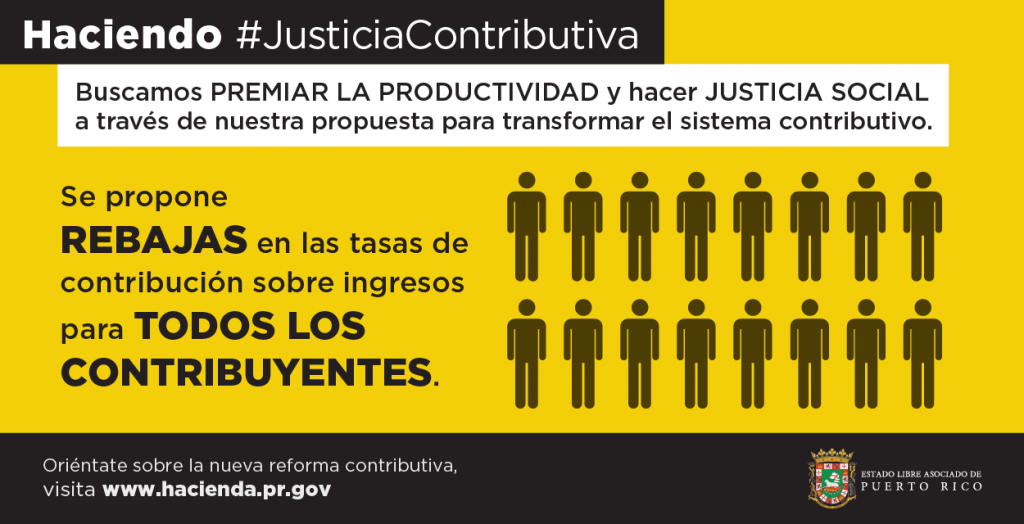
Official publicity concerning forthcoming tax reform in Puerto Rico. (La Fortaleza de PR)
Among the principal modifications are a new Internal Revenue Code that replaces the Sales and Use Tax (IVU) with Value-Added Tax (IVA). This will be a tax applied to all goods and services that are consumed on the island, but with different rates according to each item.
“The substitution of the IVU for IVA means an increase in expenditure in each phase of production. Currently IVU is at 7 percent, but with the IVA the tax will be between 12 percent and 21 percent of the costs of production,” said Colón.
Another proposal within the tax reform is that companies pay a capital gains tax at the same percentage as individuals do on their income — currently a maximum of 30 percent.
These tax changes are being introduced after 20 years of economic recession, and when the island faces an external debt of more than $73 billion, unemployment higher than 14 percent, and as a potential reform to electricity tariffs could increase the economic pressure even further.
Puerto Rico Resorts to Gas Tax amid Crippling Debt
Puerto Rico Rally at Risk With Rising Debt Expenses: Muni Credit
The biggest rally in Puerto Rico debt in five years is at risk as the struggling U.S. territory piles up debt costs and moves toward a historic restructuring of its electric utility.
While lawmakers in the junk-rated commonwealth plan a sale of as much as $2.9 billion of bonds backed by petroleum taxes to boost cash, investors say a spiral of fiscal strains may halt the bond gains. Debt service consumes 15 percent of the budget, triple the median for U.S. states, and the pension system has only 3 percent of the assets needed to pay current and future retirees.
Securities from the Caribbean island, which are tax-exempt nationwide, have earned 9.8 percent this year, the most for the period since 2009, according to S&P Dow Jones Indices. The gain follows a 20 percent drop in 2013, and investors anticipate renewed volatility if the Electric Power Authority renegotiates its $8.6 billion of debt in March. It would be a record restructuring for the municipal market.
“That’s going to affect all Puerto Rico bonds and then the gains that they’ve made this year will get washed away,” said Matt Dalton, chief executive officer of White Plains, New York-based Belle Haven Investments, which manages $2.4 billion of munis.
The economy has shrunk about 19 percent since July 2005, according to the Government Development Bank, which handles the island’s bond sales. Compounding the slide, the population has declined for eight straight years as residents moved to the U.S. mainland, according to Census data.
Puerto Rico and its agencies have a history of using deficit financing to balance budgets, and bond sales to repay bank loans and short-term debt. A $3.5 billion general-obligation sale in March, the biggest junk-rated muni deal ever, and a $1.2 billion short-term borrowing in October generated cash. Yet the deals underscored that the island depends on capital markets to maintain services.
“It’s a game of musical chairs,” said Sergio Marxuach, public-policy director at the Center for a New Economy, a research group in San Juan that focuses on economic development. “What you’re essentially doing is shifting it from the GDB to another agency.”
Puerto Rico securities have gained this year as investors seek lower-rated credits for higher yields with interest rates close to generational lows. The advance surpasses the gains in the debt of all U.S. states but Alabama, Colorado and Iowa, Standard & Poor’s data show.
General obligations sold at 93 cents on the dollar in March and maturing in July 2035 demonstrate the volatility in Puerto Rico. The bonds traded today at about 87.3 cents on the dollar, up from 83.5 cents July 8, the lowest this year, data compiled by Bloomberg show.
Escaping the borrowing cycle will require stronger economic growth, Dalton and Marxuach said. S&P has threatened to lower Puerto Rico’s rating deeper into speculative grade if economic declines widen budget gaps, said David Hitchcock, an analyst in New York. The company ranks Puerto Rico BB, two steps below investment grade, with a negative outlook.
“It really boils down to getting whatever gross-domestic-product growth back on the island so that they can break that cycle,” said Bill Black, who manages Invesco Ltd’s $7.3 billion High Yield Municipal Fund in Downers Grove, Illinois.
That’s not enough to tackle the island’s mounting obligations, Hitchcock said. The retirement system’s 3 percent funding level as of June 30, 2013, was lower than any U.S. state. The territory also faces an estimated $1.8 billion shortfall in fiscal 2018 in its health-insurance program, and a $287 million increase in principal and interest payments on debt in fiscal 2016.
“To comfortably cover some of these liabilities -- some of which will increase in the short-run, some in the long-run -- they’re going to need real economic growth,” Hitchcock said.
The fiscal 2015 general fund directs $1.45 billion toward principal and interest on general obligations, Public Buildings Authority bonds and other government debt, consuming 15 percent of the $9.56 billion budget. In comparison, U.S. states devoted a median of 5.1 percent of 2013 operating revenue to paying tax-supported debt, according to Moody’s Investors Service.
The governor also wants authorities and utilities to operate without subsidies. He signed legislation in June allowing certain agencies to negotiate with bondholders to reduce debt. The Electric Power Authority, called Prepa, is set to release a debt-restructuring plan by March that would ask investors to take a loss.
A revamp of Prepa obligations would cheapen commonwealth securities and spur investors to withdraw cash from muni mutual funds, said Tom Metzold, co-director of munis in Boston at Eaton Vance Management, which oversees about $27 billion of local bonds. About 57 percent of muni mutual funds held Puerto Rico securities as of September, down from 77 percent in October 2013, according to Morningstar Inc.
“This is going to be the next draw-down event only because Puerto Rico is still owned by a lot of individuals,” he said.
To contact the reporter on this story: Michelle Kaske in New York at mkaske@bloomberg.net
To contact the editors responsible for this story: Stephen Merelman at smerelman@bloomberg.net Mark Tannenbaum, Mark Schoifet
Puerto Rico Rally at Risk With Rising Debt Expenses: Muni Credit
While lawmakers in the junk-rated commonwealth plan a sale of as much as $2.9 billion of bonds backed by petroleum taxes to boost cash, investors say a spiral of fiscal strains may halt the bond gains. Debt service consumes 15 percent of the budget, triple the median for U.S. states, and the pension system has only 3 percent of the assets needed to pay current and future retirees.
Securities from the Caribbean island, which are tax-exempt nationwide, have earned 9.8 percent this year, the most for the period since 2009, according to S&P Dow Jones Indices. The gain follows a 20 percent drop in 2013, and investors anticipate renewed volatility if the Electric Power Authority renegotiates its $8.6 billion of debt in March. It would be a record restructuring for the municipal market.
“That’s going to affect all Puerto Rico bonds and then the gains that they’ve made this year will get washed away,” said Matt Dalton, chief executive officer of White Plains, New York-based Belle Haven Investments, which manages $2.4 billion of munis.
Island’s Burden
Commonwealth debt has traded at distressed levels for more than a year as investors speculate that Puerto Rico and its agencies will fail to repay $73 billion of bonds. Only California and New York have larger debt burdens among U.S. states.The economy has shrunk about 19 percent since July 2005, according to the Government Development Bank, which handles the island’s bond sales. Compounding the slide, the population has declined for eight straight years as residents moved to the U.S. mainland, according to Census data.
Puerto Rico and its agencies have a history of using deficit financing to balance budgets, and bond sales to repay bank loans and short-term debt. A $3.5 billion general-obligation sale in March, the biggest junk-rated muni deal ever, and a $1.2 billion short-term borrowing in October generated cash. Yet the deals underscored that the island depends on capital markets to maintain services.
‘Musical Chairs’
In the latest plan, the Infrastructure Financing Authority, which borrows for capital projects, would sell bonds backed by petroleum taxes. Proceeds would repay $2.3 billion of Highways & Transportation Authority obligations, most of which is owed to the GDB. Governor Alejandro Garcia Padilla plans to call lawmakers back for a special session to work on the deal.“It’s a game of musical chairs,” said Sergio Marxuach, public-policy director at the Center for a New Economy, a research group in San Juan that focuses on economic development. “What you’re essentially doing is shifting it from the GDB to another agency.”
Puerto Rico securities have gained this year as investors seek lower-rated credits for higher yields with interest rates close to generational lows. The advance surpasses the gains in the debt of all U.S. states but Alabama, Colorado and Iowa, Standard & Poor’s data show.
General obligations sold at 93 cents on the dollar in March and maturing in July 2035 demonstrate the volatility in Puerto Rico. The bonds traded today at about 87.3 cents on the dollar, up from 83.5 cents July 8, the lowest this year, data compiled by Bloomberg show.
Bond Cycle
While Garcia Padilla, who took office in January 2013, has reduced deficit financing, the island hasn’t abandoned the maneuver: $344 million from bond sales in 2012 and 2014 went toward balancing the fiscal 2015 budget, according to GDB data. The commonwealth also reduced its contribution to the pension system to cut expenses.Escaping the borrowing cycle will require stronger economic growth, Dalton and Marxuach said. S&P has threatened to lower Puerto Rico’s rating deeper into speculative grade if economic declines widen budget gaps, said David Hitchcock, an analyst in New York. The company ranks Puerto Rico BB, two steps below investment grade, with a negative outlook.
“It really boils down to getting whatever gross-domestic-product growth back on the island so that they can break that cycle,” said Bill Black, who manages Invesco Ltd’s $7.3 billion High Yield Municipal Fund in Downers Grove, Illinois.
Growth Lacking
The fiscal 2015 budget assumes economic growth of 0.2 percent, according to S&P.That’s not enough to tackle the island’s mounting obligations, Hitchcock said. The retirement system’s 3 percent funding level as of June 30, 2013, was lower than any U.S. state. The territory also faces an estimated $1.8 billion shortfall in fiscal 2018 in its health-insurance program, and a $287 million increase in principal and interest payments on debt in fiscal 2016.
“To comfortably cover some of these liabilities -- some of which will increase in the short-run, some in the long-run -- they’re going to need real economic growth,” Hitchcock said.
The fiscal 2015 general fund directs $1.45 billion toward principal and interest on general obligations, Public Buildings Authority bonds and other government debt, consuming 15 percent of the $9.56 billion budget. In comparison, U.S. states devoted a median of 5.1 percent of 2013 operating revenue to paying tax-supported debt, according to Moody’s Investors Service.
Job Cuts
To get Puerto Rico’s finances back on track, the governor has cut 12,500 jobs payable from the general fund, a 12 percent drop, while boosting the retirement age and worker pension contributions. His administration estimates private businesses will create more than 90,000 jobs by the beginning of 2016.The governor also wants authorities and utilities to operate without subsidies. He signed legislation in June allowing certain agencies to negotiate with bondholders to reduce debt. The Electric Power Authority, called Prepa, is set to release a debt-restructuring plan by March that would ask investors to take a loss.
A revamp of Prepa obligations would cheapen commonwealth securities and spur investors to withdraw cash from muni mutual funds, said Tom Metzold, co-director of munis in Boston at Eaton Vance Management, which oversees about $27 billion of local bonds. About 57 percent of muni mutual funds held Puerto Rico securities as of September, down from 77 percent in October 2013, according to Morningstar Inc.
“This is going to be the next draw-down event only because Puerto Rico is still owned by a lot of individuals,” he said.
To contact the reporter on this story: Michelle Kaske in New York at mkaske@bloomberg.net
To contact the editors responsible for this story: Stephen Merelman at smerelman@bloomberg.net Mark Tannenbaum, Mark Schoifet
Puerto Rico Rally at Risk With Rising Debt Expenses: Muni Credit
Puerto Rico Legislators to Debate Oil Tax Increase
Puerto Rico's governor on Friday called a special legislative session for next week to debate a measure that seeks to boost an oil tax by 68 percent.
Gov. Alejandro Garcia Padilla said legislators will meet starting Monday as part of a session that can legally be extended for up to 20 days.
The measure aims to help sell up to $2.9 billion in bonds and strengthen the debt-ridden Highway and Transportation Authority. If approved, the U.S. territory's excise tax on a barrel of crude oil would increase from $9.25 to $15.50 and generate $178 million a year.
Supporters have said the increase would not affect the price of electricity on an island where power bills on average are more than twice those on the U.S. mainland.
The measure comes as the island struggles with $73 billion in public debt amid concerns that public agencies might declare bankruptcy.
Moody's has previously warned that the Government Development Bank's liquidity could fall as much as 22 percent if there was no new bond offering to refinance the Highway and Transportation Authority's debt.
Puerto Rico Legislators to Debate Oil Tax Increase
Friday, November 21, 2014
Puerto Rico opens $130 million renovated terminal at island's main international airport
SAN JUAN, Puerto Rico – Officials in Puerto Rico have unveiled a $130 million renovated terminal at the island's main international airport.
Gov. Alejandro Garcia Padilla said Thursday that the terminal features a new passenger inspection center, an automatized baggage handling system and food and shopping establishments.
The renovation is part of a $200 million investment that also features security upgrades.
Officials have made $24 million worth of improvements at another terminal and are spending $75 million for remodeling a third terminal expected to reopen by late 2015.
Aerostar Airport Holdings, a Mexican company, took over operations at the Luis Munoz Marin international airport in a $2.6 billion deal with the U.S. territory's government in 2012.
The airport currently handles about 8.5 million passengers a year and is served by 31 airlines.
Puerto Rico opens $130 million renovated terminal at island's main international airport
Subscribe to:
Posts (Atom)